

Pakistan appealed on Saturday for an “immense humanitarian response” to unprecedented floods that have killed at least 1,290 people.
The request came as planes carried supplies to the country.
Federal Planning Minister Ahsan Iqbal made the appeal as a humanitarian air bridge brought in more relief supplies for more than 30 million people affected by devastating floods caused by monsoon rains. According to initial government estimates, the rain and flooding have caused $10 billion in damage.
“The scale of devastation is massive and requires an immense humanitarian response for 33 million people,” Mr Iqbal said. “For this I appeal to my fellow Pakistanis, Pakistan expatriates and the international community to help Pakistan in this hour of need.”
There were fears on Sunday that the crisis could dramatically worsen after officials warned that the largest freshwater lake in Pakistan, Lake Manchar, could overwhelm a protective embankment, despite an effort by engineers to drain excess water.
Villagers in the Jamshoro and Dadu districts of Sindh province near the lake have been urged to evacuate and more rain is expected in the coming days, meteorologists said.
Officials and experts, including UN Secretary General Antonio Guterres, have blamed the unusually heavy rains and flooding on climate change. Mr Guterres, who called on the world to stop “sleepwalking” through the deadly crisis, will visit Pakistan on September 9 to tour flood-hit areas and meet officials.
Earlier this week, the UN and Pakistan jointly launched an appeal for $160 million in emergency funding to help the millions affected by the floods, which have damaged more than a million homes.
Pakistan’s National Disaster Management Authority on Saturday reported 57 more deaths in flood-affected areas, raising the death toll since monsoon rains began in mid-June to 1,290.
-
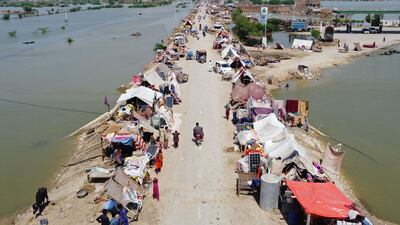
Displaced people have put up makeshift tents along elevated motorways and railway tracks in Pakistan's Balochistan province to escape the flooded plains. AFP -
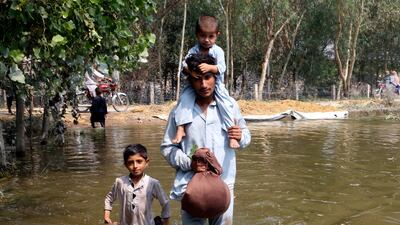
A man and his children wade through floodwaters in Charsadda, Pakistan. AP -
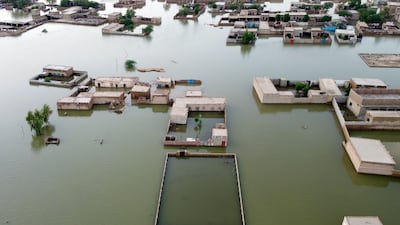
Homes are surrounded by floodwaters in Jaffarabad, a district of Balochistan province. AP -
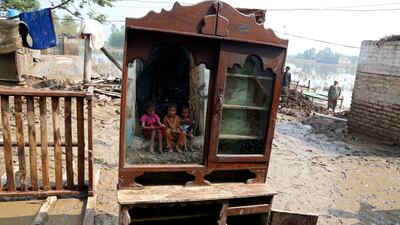
Children are reflected in a mirror near their flood-hit home in Charsadda. AP -
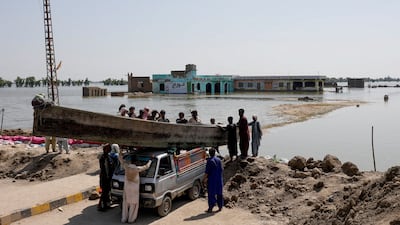
People launch a wooden boat into rising floodwaters in Mehar, Pakistan. Reuters -
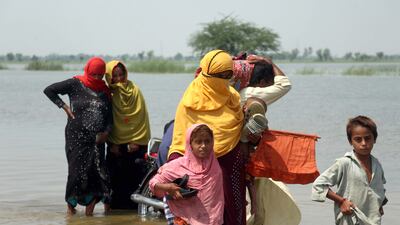
People affected by floods move to higher ground in Dadu district, Sindh province, Pakistan. EPA -

Displaced people take shelter on an elevated motorway to escape rising floodwaters. EPA -
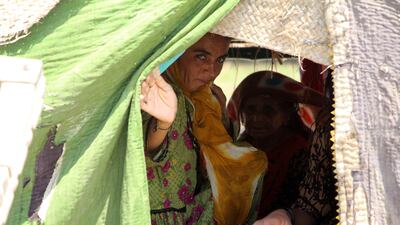
People affected by floods wait for relief in Dadu district, Sindh province. EPA -
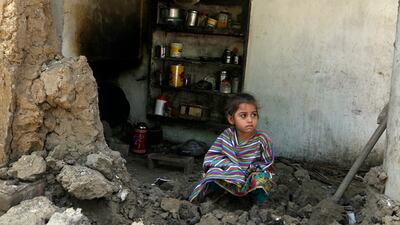
A girl sits amid the rubble of her damaged home in Charsadda district, Khyber Pakhtunkhwa province. AP -
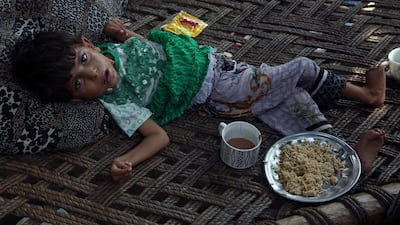
A sick child struggles to eat in Charsadda after his family fled their home due to flooding. AP -
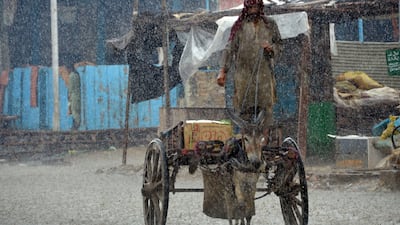
A man rides his donkey-drawn cart during a heavy rainfall in flood-hit Dera Allah Yar town in Balochistan province. AFP -
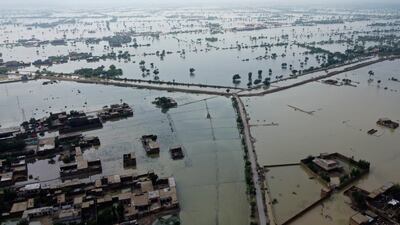
Homes are surrounded by floodwaters in Sohbat Pur, a city in Balochistan. AP -
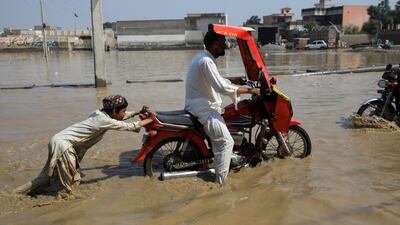
A boy pushes a motorbike after it stalled in Nowshera, Khyber Pakhtunkhwa province. Reuters -
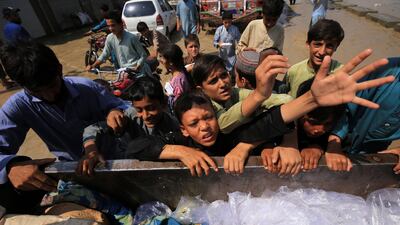
Children affected by floods wait to receive food in Nowshera district. EPA -

A man throws water out of his flooded home in Nowshera. EPA -

People assess the damage to their home in Nowshera. EPA -

A family salvages items from the ruins of their home, which was destroyed by flooding, in the Shikarpur district of Sindh province. AP -
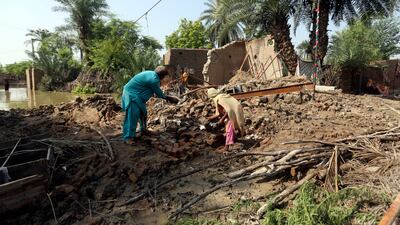
The flooding has affected more than 33 million people in a country of 220 million. AP -
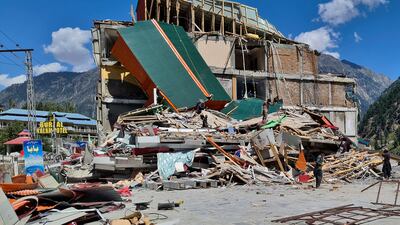
People salvage items from a damaged building in Kalam, Swat Valley. AP -
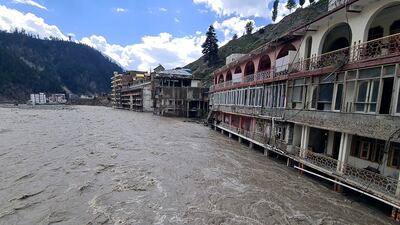
Hotels are surrounded by floodwaters in Kalam. AP -

Displaced people sit on a tractor with their belongings as they make their way to higher ground in Shikarpur. AFP -

A child sits on a dry ground at a makeshift camp in Shikarpur. AFP -
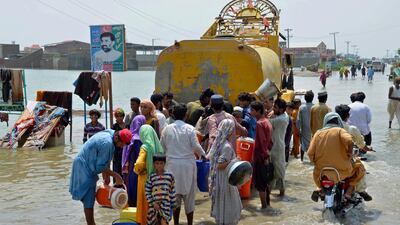
People jostle for drinking water delivered by a municipality lorry along a flooded road in Sohbatpur, Balochistan. AP


Prime Minister Shehbaz Sharif’s earlier appeal for aid got a quick response from the international community, which sent planes loaded with relief goods. A French aircraft carrying relief goods landed in Islamabad on Saturday and was received by Minister for National Health Services Abdul Qadir Patel.
The ninth flight from the UAE and the first from Uzbekistan arrived in Islamabad overnight.
Mr Patel said the relief goods sent by France included medicine and large pumps to reduce water levels. He said France had also sent a team of doctors and experts.
Pakistan has established a national coordination centre to distribute the arriving aid. Mr Iqbal is supervising the army-led centre.
The minister said monsoon season rains have lashed most areas of Balochistan and Sindh provinces as well as parts of Khyber Pakhtunkhwa and Punjab provinces. The Gilgit-Baltistan territory has also been affected. Torrential rains and flash floods caused massive damage to infrastructure, roads, electricity and communications networks.
Mr Iqbal said the government was working to bring normality back to the country as soon as possible but could not do it alone.
Maj Gen Zafar Iqbal, head of the flood response centre, said that during the past four days, 29 planes loaded with relief goods arrived in Pakistan from Turkey, the UAE, China, Qatar, Uzbekistan, Jordan, Turkmenistan and other countries.
Military spokesman Maj Gen Iftikhar Babar said rescuers supported by the military were continuing rescue and relief operations. He said army aviation, air force and navy troops were using boats and helicopters to evacuate people from remote regions and to deliver aid.
The spokesman said the army had set up 147 relief camps that were sheltering and feeding more than 50,000 displaced people, while 250 medical camps had provided help to 83,000 people so far.
Health officials have expressed concern about the spread of waterborne diseases among homeless people living in relief camps and in tents alongside roads.
Lt Gen Akhtar Nawaz, head of the disaster management authority, said areas of the country that were expected to receive 15 to 20 per cent more rain than usual this year actually received in excess of 400 per cent more. Collectively, the country has had 190 per cent more rain than usual this monsoon season.
The US military’s Central Command said it would send an assessment team to Islamabad to see what support it can provide. The US announced $30m worth of aid for the flood victims earlier this week.
Two members of Congress, Sheila Jackson and Tom Suzy, were expected to arrive in Pakistan on Sunday to visit the flood affected areas and meet officials.

