

African nations have opened climate talks in the Mozambican capital of Maputo to identify priorities and come up with a common position before Cop27, the United Nations summit in Egypt in November.
The meeting was jointly organised by the UN, the African Union, the African Development Bank and the Pan African Climate Justice Alliance, a civil society group.
Participants include policymakers and regional institutions, as well as grass roots activists and representatives from the private sector.
The talks come as Africa grapples with devastating cyclones in the south and a debilitating drought across the east and the Horn of Africa.
The continent of 1.2 billion people, making up 17 per cent of the world’s population, contributes less than 4 per cent of global greenhouse gas emissions.
But it faces extreme weather, which scientists have warned will become more frequent due to climate change.
“Africa … is a vulnerability hotspot for climate change,” said Anna Tjaervar, a Swedish diplomat speaking at the forum. She said adapting to climate change should be a priority for the continent.
-
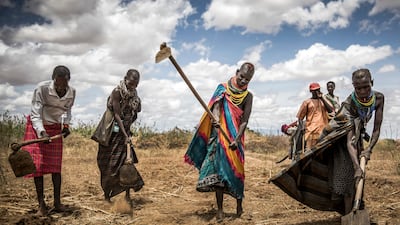
Members of the Turkana community plough a dry field as they prepare to grow sorghum near Lodwar, Kenya, in 2019. Save the Children says that 3.5 million people in Kenya are short of food this year. All photos: AFP -
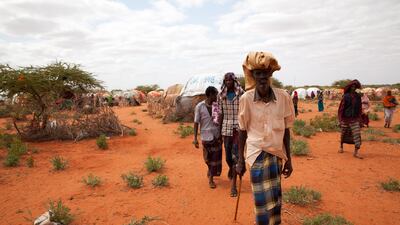
People displaced by Ethiopia's drought walk at a camp for displaced people in Werder. The Somali people of Ethiopia's sout-heast have a name for the drought that has killed livestock, dried up wells and forced hundreds of thousands into camps: sima, which means "equalised". It's an appropriate name, they say, because this drought has left no person untouched, spared no corner of their arid region. And it has forced 7.8 million people across Ethiopia to rely on emergency food handouts to stay alive. -
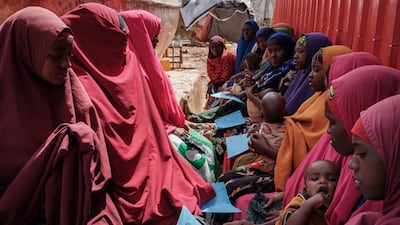
Mothers wait for food relief and health services at Tawkal 2 Dinsoor camp for internally displaced people in Baidoa, Somalia, in February. Insufficient rainfall since late 2020 has come as a fatal blow to populations already suffering from a locust invasion between 2019 and 2021, and the Covid-19 pandemic. -
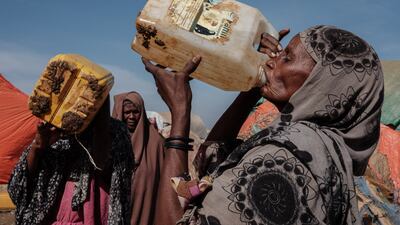
Hawa Mohamed Isack, 60, drinks water at Muuri, one of the 500 camps for internally displaced people, in Baidoa. For several weeks, humanitarian organisations have multiplied alerts on the situation in the Horn of Africa, which raises fears of a tragedy similar to that of 2011, the last famine that killed 260,000 people in Somalia. -
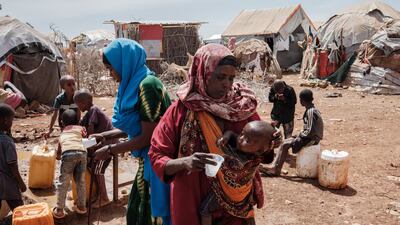
Bulley Hassanow Alliyow,30, gives water to her child at Tawkal 2 Dinsoor camp for internally displaced people in Baidoa. -
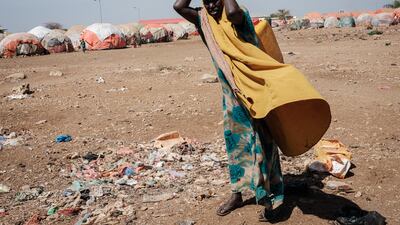
Desperate, hungry and thirsty, more and more people are flocking to Baidoa from rural areas of southern Somalia. -
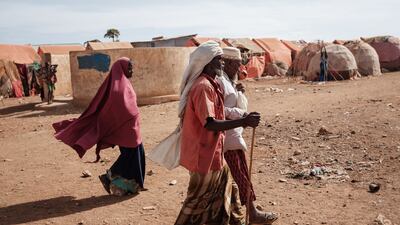
Somalia is one of the countries hardest hit by the drought that is engulfing the Horn of Africa. -
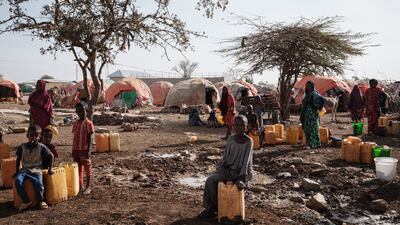
People wait for water with containers at a camp, in Baidoa. -

A field worked by Othman Cheikh Idriss, 60, a Sudanese farmer, in the capital Khartoum's district of Jureif Gharb. -

An aerial veiw of the town of Baidoa, Somalia.


Officials are expected to decide whether to ask developing nations for reparations for environmental damage in Africa, known in climate circles as loss and damage.
The UN estimates that African nations already spend between 2 per cent and 9 per cent of their national income on natural disasters linked to climate change.
The forum will focus on using indigenous knowledge and land practices for conservation and efforts to adapt, rather than relying on external help, said Jean-Paul Adam, the head of climate at the United Nations Economic Commission for Africa.
Indigenous voices will play a critical role in the talks, said James Murombedzi, the head of the African Climate Policy Centre.
He said their experiences would help strengthen Africa’s standing at the international climate talks in November.

