



Rising global temperatures could displace up to 216 million people over the next 30 years and in some countries climate migration has already begun.
An annual report issued by the UN refugee agency on Thursday, titled Global Trends: Forced Displacement in 2021, presented an uncertain future for a world already dealing with about 100 million people displaced by persecution, conflict, violence or “events seriously disturbing public order” to date.
Last year, about 23 million people were displaced in their own countries because of extreme weather such as floods, wildfires and droughts, the Internal Displacement Monitoring Centre said.
Firas Al-Khateeb, spokesman for UNHCR Iraq, told The National that climate change is affecting people worldwide.
"The Middle East is particularly affected by rising temperatures and record low rainfall that is driving desertification and putting millions at risk of losing access to water and food. Coupled with armed conflicts and poverty, it drives people to move from arid rural areas to urban centres," said Mr Al-Khateeb.
While unpredictable weather events, such as storms and fires, have great immediate effect on a population, the people they displace seldom leave their country, or they return within a few months.
Greater long-term effects on populations will come from slow-onset events, such as drought and changes in rainfall patterns that affect agriculture over time.
A drop in crop yields could prompt more permanent or long-term population changes, as people seek a more stable life. This is of particular concern in more developing countries.
Climate change may also eventually lead to conflict as countries compete for land and water resources.
“These risks are especially great in countries with weak governance and infrastructure and/or insufficient resources,” the UNHCR report read.
Recent climate change effects in Middle East
Climate change has already begun taking its toll on people in the Middle East.
Since January, some countries have experienced extreme changes in temperatures, as well as severe sandstorms and drought.
In some cases, these weather events have threatened the livelihood of internally displaced people (IDPs), who have previously escaped conflict only to meet new challenges.
The winter months proved deadly for refugees in Syria and Yemen, where women and children died because of extreme cold and poor living conditions at camps. The snow also killed livestock in Yemen, leaving farmers without a source of income.
At present, Iraq is facing an environmental crisis, with acute water shortages and climate change affecting food security and the daily life of Iraqis, adding to the nation’s endemic woes.
Climate change and drought, combined with reduced flow of water from the Tigris and Euphrates rivers, have exacerbated difficult living conditions and prompted dust storms that lasted days in recent weeks.
About 90 per cent of the water feeding the Tigris and Euphrates originates in Turkey or Iran. The two countries, which are facing their own recent water crises, have built dams and diverted water away from the rivers.
The drought is contributing to the desertification of Iraq as the country continues to lose agricultural and rural land.
"Iraq is ranked as one of the five nations most vulnerable to climate change and desertification," said Mr Al-Khateeb.
"The negative impact on agriculture production means that many who were displaced by the violence triggered by ISIS have difficulties returning to their home communities, as they cannot resume their livelihoods."
He said one in six Iraqi families displaced by ISIS had not yet returned to their home and such a move would depend on their access to basic services as well as an opportunity to make a living.
"Over 25 per cent of those displaced by ISIS used to work in agriculture before being displaced. Among those who have now returned, only two per cent of them still make a living off agriculture. A less productive agricultural sector also makes it harder to integrate Syrian and other refugees living in Iraq, potentially depriving them of a source of livelihood," said Mr Al-Khateeb.
Iraqi farmers, whose livelihoods depend on growing crops, raising animals or fishing, have been struggling with scarcity of water ― and rising salinity in soil and water ― as a result of consecutive heatwaves during the summer, when temperatures have reached about 50°C for days.
The UN report stressed that rain-fed agriculture in the Middle East and North Africa is likely to be particularly affected in future.
Water scarcity is expected to further strain governments already struggling with limited resources and housing a significant number of IDPs.
About 40 per cent of refugees and asylum seekers were hosted in countries with food crises by the end of 2021.
"If this trend continues and agricultural areas, are severely affected, eventually water scarcity will cause people to move in search of water resources and livelihoods as agriculture will not be profitable any more," said Mr Al-Khateeb.
Challenges of quantifying devastation
Climate change and forced displacement are immediate challenges the world faces with long-term repercussions.
Yet challenges remain when it comes to measuring and predicting their effects, because of the lack of commonly accepted statistics on displacement in the context of climate change.
As climate change is rarely the sole factor, rather a contributing or exacerbating factor in migration and conflict, the link between the two cannot be measured directly.
“Simply put, what is not defined cannot be quantified, and what cannot be quantified cannot be predicted,” the UN report read.
-
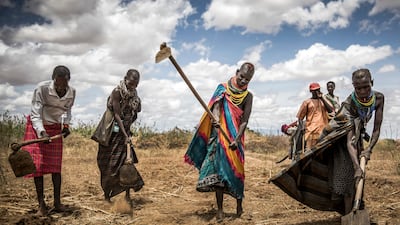
Members of the Turkana community plough a dry field as they prepare to grow sorghum near Lodwar, Kenya, in 2019. Save the Children says that 3.5 million people in Kenya are short of food this year. All photos: AFP -
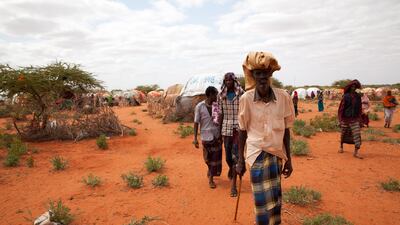
People displaced by Ethiopia's drought walk at a camp for displaced people in Werder. The Somali people of Ethiopia's sout-heast have a name for the drought that has killed livestock, dried up wells and forced hundreds of thousands into camps: sima, which means "equalised". It's an appropriate name, they say, because this drought has left no person untouched, spared no corner of their arid region. And it has forced 7.8 million people across Ethiopia to rely on emergency food handouts to stay alive. -
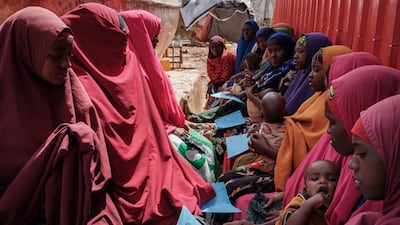
Mothers wait for food relief and health services at Tawkal 2 Dinsoor camp for internally displaced people in Baidoa, Somalia, in February. Insufficient rainfall since late 2020 has come as a fatal blow to populations already suffering from a locust invasion between 2019 and 2021, and the Covid-19 pandemic. -
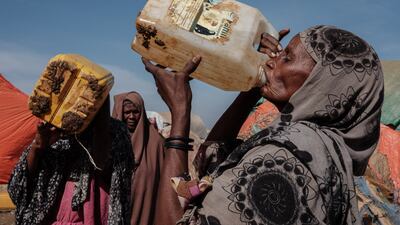
Hawa Mohamed Isack, 60, drinks water at Muuri, one of the 500 camps for internally displaced people, in Baidoa. For several weeks, humanitarian organisations have multiplied alerts on the situation in the Horn of Africa, which raises fears of a tragedy similar to that of 2011, the last famine that killed 260,000 people in Somalia. -
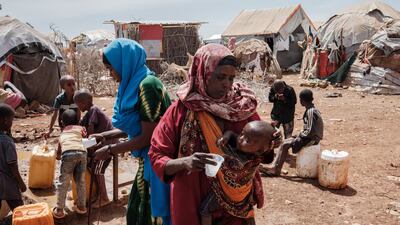
Bulley Hassanow Alliyow,30, gives water to her child at Tawkal 2 Dinsoor camp for internally displaced people in Baidoa. -
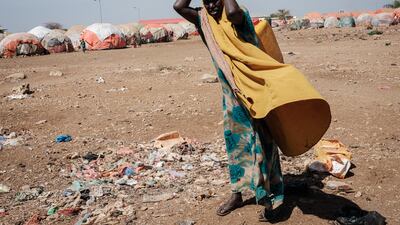
Desperate, hungry and thirsty, more and more people are flocking to Baidoa from rural areas of southern Somalia. -
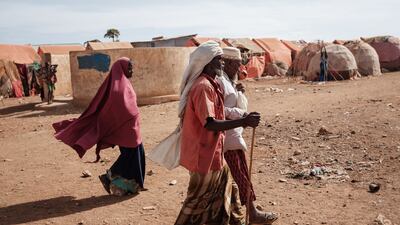
Somalia is one of the countries hardest hit by the drought that is engulfing the Horn of Africa. -
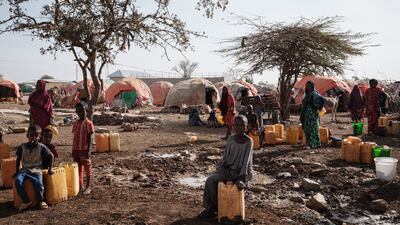
People wait for water with containers at a camp, in Baidoa. -

A field worked by Othman Cheikh Idriss, 60, a Sudanese farmer, in the capital Khartoum's district of Jureif Gharb. -

An aerial veiw of the town of Baidoa, Somalia.



