



Climate change is expected to increase the risk of droughts in many vulnerable regions of the world, particularly those with rapid population growth, vulnerable people and challenges with food security, a report released on Tuesday by the United Nations Convention to Combat Desertification said.
“The world is taking an upward trajectory in the duration of droughts and the severity of impacts, not only affecting human societies but also the ecological systems upon which the survival of all life depends, including that of our own species,” said Ibrahim Thiaw, executive secretary of UNCCD.
The report was released at UNCCD’s 15th Conference of Parties (COP15) in Abidjan, Côte d’Ivoire.

Within the next few decades, 129 countries will experience an increase in drought exposure mainly due to climate change alone – 23 primarily due to population growth and 38 mostly due to the interaction between climate change and population growth.
If global warming reaches 3 degrees Celsius by 2100, as some predict, the report said, drought losses could be five times higher than they are today, with the largest increase in the Mediterranean and the Atlantic regions of Europe.
Unless serious measures are taken, according to the report, an estimated 700 million people will be at risk of being displaced by drought by 2030 and an estimated one in four children will live in areas with extreme water shortages by 2040.
By 2050, droughts may affect over three-quarters of the world’s population, and an estimated 4.8 to 5.7 billion people will live in areas that are water-scarce for at least one month each year, up from 3.6 billion today.

Up to 216 million people could be forced to migrate by 2050, largely due to drought in combination with other factors including water scarcity, declining crop productivity, sea-level rise, and overpopulation.
“We are at a crossroads,” said Mr Thiaw.
-
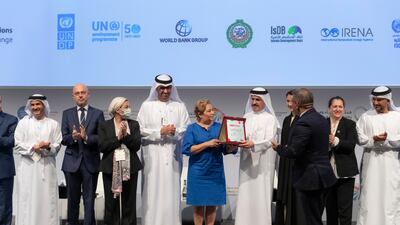
The official opening ceremony of MENA Climate Week 2022 at Atlantis, The Palm in Dubai. All photos: Antonie Robertson / The National -
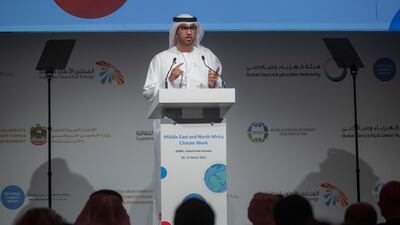
Dr Sultan Al Jaber, Ministry of Industry and Advanced Technology and the UAE's Special Envoy for Climate Change, addresses delegates. -
Dr Al Jaber called on governments to keep investing in 'low-cost, low-carbon energies'. -
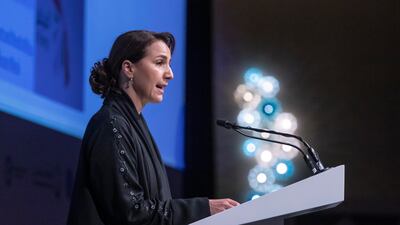
Mariam Al Mheiri, Minister of Climate Change and Environment, speaks at the conference. -

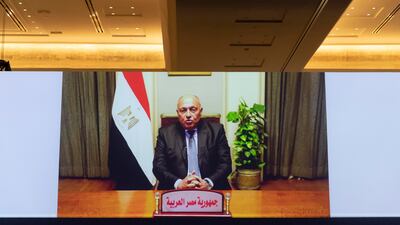
Patricia Espinosa, executive secretary of the United Nations Framework Convention on Climate Change, said the climate crisis was the most lethal threat facing humanity. -
More from the first day. -
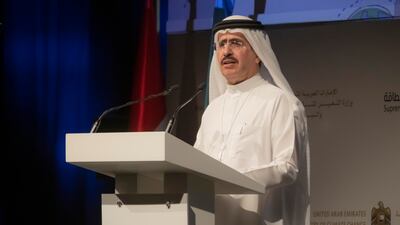
Saeed Mohammed Al Tayer, chairman of the World Green Economy Organisation and managing director and chief executive of Dewa. -
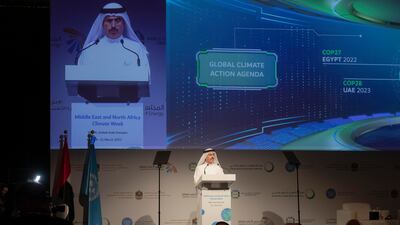
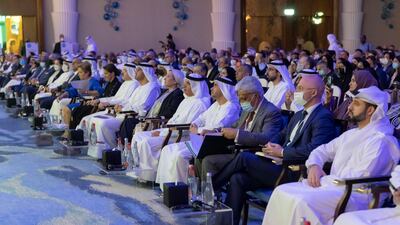
The audience listens to the Dewa chief executive's address. -

There was no benefit to ditching existing energy models if people could not afford to use the alternatives, Dr Al Jaber told those in attendance. -

Dr Al Jaber said any transition to clean energy should be sustainable.


“One of the best, most comprehensive solutions is land restoration, which addresses many of the underlying factors of degraded water cycles and the loss of soil fertility. We must build and rebuild our landscapes better, mimicking nature wherever possible and creating functional ecological systems.”
Historical facts

The report showed that between 1970 and 2019 weather, climate and water hazards accounted for 50 per cent of disasters and 45 per cent of disaster-related deaths, mostly in developing countries.
Droughts represent 15 per cent of natural disasters but took the largest human toll, approximately 650,000 deaths from 1970 to 2019.
And since 2000, the number and duration of droughts has risen 29 per cent, while in 2022, more than 2.3 billion people face water stress; almost 160 million children are exposed to severe and prolonged droughts.
The percentage of plants affected by drought has more than doubled in the past 40 years, with about 12 million hectares of land lost each year due to drought and desertification, while 84 per cent of terrestrial ecosystems are threatened by changing and intensifying wildfires.
During the first two decades of the 21st century, the Amazon experienced three widespread droughts, all of which triggered massive forest fires. Drought events are becoming increasingly common in the Amazon region due to land-use and climate change, which are interlinked.
If Amazonian deforestation continues unabated, 16 per cent of the region’s remaining forests will probably burn by 2050, the report said.
Sustainable techniques
The UNCCD called for sustainable and efficient agricultural management techniques that grow more food on less land and with less water, and called for a drastic change in people’s relationships with food, fodder and fibre, moving towards plant-based diets, and reducing or stopping the consumption of animals.
It urged development and implementation of integrated drought action plans, setting up effective early-warning systems that work across boundaries, investing in soil health and mobilising farmers, local communities, businesses, consumers, investors, entrepreneurs and, above all, young people.
Up to $1.4 trillion in production value can be generated globally by adopting sustainable land and water management practices.
The report also had some good news.
Approximately four million hectares of degraded land within “strict intervention zones” have been rehabilitated under the framework of the African Union–led restoration initiative known as the Great Green Wall – four per cent of the Wall’s ultimate target of restoring 100 million hectares, helping to reduce the immanent threats of desertification and drought.

