


India's prime minister Narendra Modi on Sunday promised to save young people in Kashmir from a decades-long legacy of economic malaise and violence, as he made his first visit to the disputed region.
The visit followed New Delhi’s move to strip the region of semi-autonomy, which shocked international observers.
New Delhi annulled Jammu and Kashmir state’s semi-autonomous status and divided it into two federally administered territories in August 2019, claiming the move was to amend “historic mistakes” and quell an anti-India rebellion.
-
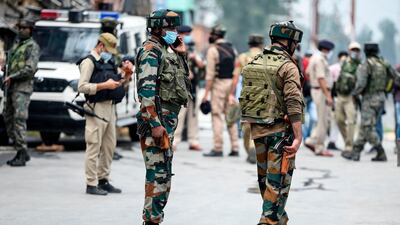
Security personnel stand guard near the site where suspected militants fired at police near Nowgam bypass in Srinagar. At least two policemen were killed and another wounded after militants allegedly opened fire on police party in Nowgam area, local media reported on August 14. AFP -

Security personnel and police on patrol in Srinagar. AFP -
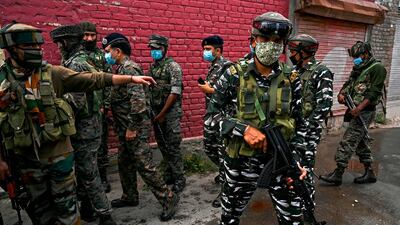
Inspector-General Vijay Kumar said militants sprayed bullets at the police from a narrow lane. AFP -
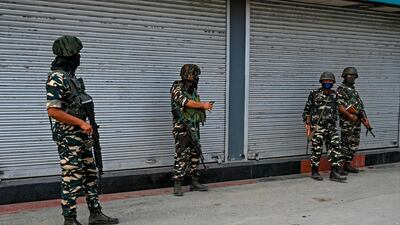
Reinforcements of counterinsurgency police and soldiers were searching the area for the attackers. AFP -
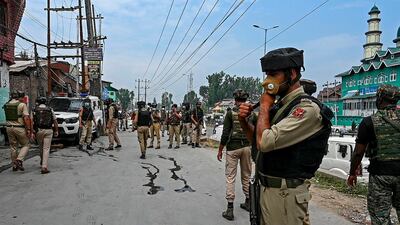
Security personnel gather near the site where suspected militants fired at police near Nowgam bypass in Srinagar. AFP -
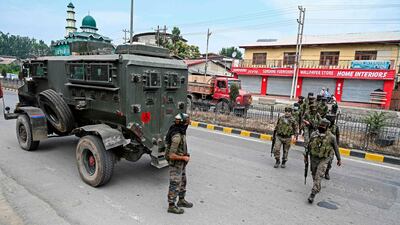
None of the rebel groups that have been fighting against Indian rule since 1989 immediately claimed responsibility for the attack. AFP -
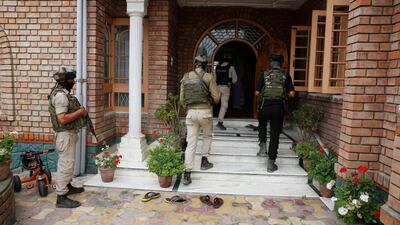
Indian policemen enter homes in Kashmir searching for Anti-India rebels accused of firing on a police convoy in Srinagar, EP -
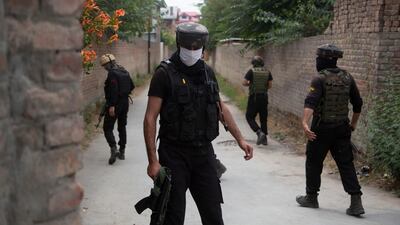
Members of special Operations Group (SOG) of Jammu and Kashmir police examine at the site of the attack. AP Photo


The prime minister addressed his first public event in Jammu’s frontier Samba district, in the village of Palli— India’s first carbon-free “solar village” — to mark the National Panchayati Raj Day – India’s village-level management system.
Large numbers of panchayat representatives and supporters of Mr Modi’s Bharatiya Janata Party gathered at the rally in the Hindu-majority border district with Pakistan.
“I want to tell the youth of Kashmir valley that the hardships your parents and grandparents had to live with, you will never have to live such a life,” Mr Modi said, in reference to the armed militancy in the Kashmir Valley.
The region has been wracked by a decades-long armed rebellion against New Delhi’s rule, particularly in the Muslim-dominated Himalayan Kashmir valley where anti-India sentiment runs high.
Mr Modi said the annulment of the autonomy had brought a windfall of changes in the region and opened investment opportunities, following a failure to create infrastructure in the last seven decades.
He announced many development initiatives worth 200 billion rupees ($US2.7 billion) and inaugurated multiple projects, including two hydropower initiatives, an all-weather tunnel and a plan to rejuvenate water bodies in the region.
Mr Modi said that the region was attracting investment worth billions of rupees in the past two years, including from the UAE
“I also had an opportunity to speak with a delegation from Abu Dhabi and Dubai and they are excited about [investments] in Jammu and Kashmir,” Mr Modi said.
Last month, a large delegation from the UAE visited the region and pledged to invest millions of dollars in road infrastructure, real estate and hospitality sectors.
New Delhi has been pushing to attract foreign and domestic investment to showcase a return to normality in the restive region that remains at the centre of a territorial dispute with its nuclear-armed arch-rival Pakistan.
The Kashmir region is ruled by India and Pakistan in parts, but claimed by both in its entirety since British colonisers left the subcontinent in 1947.
The two countries have fought three wars over the region and a three-decade-long armed insurgency has claimed the lives of tens of thousands of people.
New Delhi argues that Kashmir’s semi-autonomous status fuelled separatist sentiment and deprived the region of investment and development.
The erstwhile state had a separate constitution and the ability to vet federal laws before their imposition in the region, along with laws that barred Indians from permanently settling in Kashmir.
The shock decision was followed by a months-long security clampdown and internet shutdown in the region, triggering a diplomatic war between India and Pakistan.
Islamabad claims New Delhi violated United Nations resolutions which called for a plebiscite – a vote by the people of an entire country or district to decide on some issue in the region. It said the move was part of India’s “settler-colonial” agenda to change the demography of the Muslim-majority region.
Mr Modi’s government has claimed that New Delhi’s direct rule has helped them better tackle militancy, which it says is funded and supported by Islamabad.
But he completely omitted any mention of Pakistan during Sunday’s speech — a rarity for any Indian prime minister visiting the region.
Despite New Delhi’s claims, armed violence in the region remains high, including gunfights and attacks on government forces.
Police on Friday claimed to have killed two heavily armed militants in Jammu, just kilometres away from Sunday’s venue.
A spate of militant attacks on migrants from other Indian states and Hindu minorities have also seen a shap rise in recent months.
Mr Modi’s visit is significant as the region prepares for elections, four years after New Delhi imposed direct rule — a move short of revoking Kashmir’s partial autonomy.
His government has promised elections and claimed it has strengthened grass roots democracy in the region which remains under New Delhi’s direct rule since 2018.
A New Delhi appointed administrator runs the restive region with an iron-hand policy.
The local elections will be held after authorities complete the redrawing of electoral constituencies, a move regional political parties have criticised over claims that it is aimed at handing an advantage to Mr Modi’s BJP.

