

Indian Prime Minister Narendra Modi has congratulated new Pakistan Prime Minister Shehbaz Sharif and spoken of India’s desire for peace and stability in the region.
New Delhi had remained silent on the latest political crisis in Pakistan that led to Imran Khan losing power to the coalition of opposition parties led by Mr Sharif.
“India desires peace and stability in a region free of terror, so that we can focus on our development challenges and ensure the well-being and prosperity of our people,” Mr Modi said on Twitter on Monday.
Bilateral relations between the rival nuclear-power nations have remained tense for decades. They are at their lowest since 2019 after New Delhi unilaterally changed the constitutional status of the disputed region of Kashmir.
Kashmir is ruled by India and Pakistan in parts, but claimed in its entirety by both.
Mr Sharif, 70, and the younger brother of three-time former prime minister Nawaz Sharif, said his government wanted closer relations with India.
“We want good ties with India but durable peace is not possible until the Kashmir dispute is resolved,” Mr Sharif said on Monday soon after taking over as the prime minister.
-

The new Pakistani Prime Minister Shahbaz Sharif, centre, is congratulated by former president Asif Ali Zardari during a National Assembly session in Islamabad on Monday. AP -
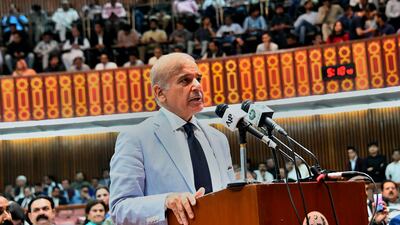
Shahbaz Sharif addresses the National Assembly in Islamabad. AP -
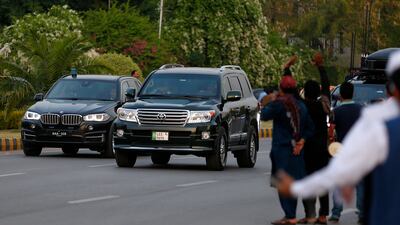
Supporters line the street as Shahbaz Sharif’s motorcade leaves the session, after Pakistan's Parliament elected him as the new prime minister. AP -

Shahbaz Sharif takes over from Imran Khan after a week of political turmoil ended in the latter being removed from office. AP -
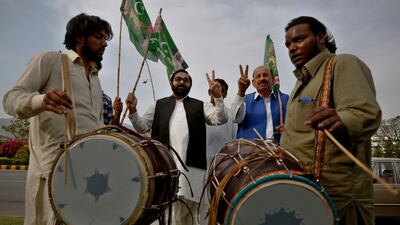
Supporters of Shahbaz Sharif celebrate outside the National Assembly in Islamabad. AP -
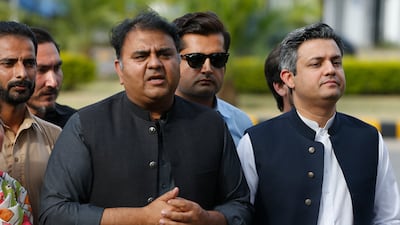
Fawad Chaudhry and Hammad Azhar, leaders of the Pakistan Tehreek-e-Insaf opposition party, speak to the media outside the National Assembly. AP -
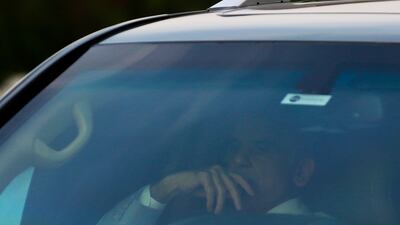
Shahbaz Sharif leaves after attending a National Assembly session as Pakistan’s new prime minister. AP -

People in Pakistan watch a televised speech by newly elected prime minister Shahbaz Sharif. AP -

Shahbaz Sharif addresses the National Assembly. He takes over after a vote of no confidence in Imran Khan. AP -

Jubilant Sharif supporters gather near the office of his party, Pakistan Muslim League (Nawaz), in Lahore on Monday. AFP -

Supporters of the newly elected prime minister flash victory signs in celebration. AP -
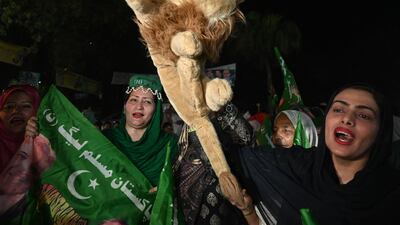
A supporter of Shahbaz Sharif holds a toy lion. His party, PML-N, has a tiger as its mascot. AFP


Mr Sharif called on Mr Modi to come forward to address the Kashmir issue so that Pakistan and India could concentrate on tackling poverty, unemployment, a shortage of medicines and other problems.
New Delhi maintains that it cannot engage with Islamabad unless it ceases to support “terrorist” groups in Kashmir, where a three decades-long armed rebellion against India has left tens of thousands dead.
Islamabad denies allegations it is supporting militant groups.
The two countries have fought three wars over Kashmir since gaining independence from Britain in 1947.
The Asian neighbours were on the brink of another war in February 2019 when India launched “punitive” air strikes on “militant” targets inside Pakistan after a Kashmiri suicide bomber killed 40 paramilitary soldiers in an attack in the disputed Himalayan region.
The attacks triggered a tit-for-tat response from Islamabad, whose fighter jets shot down an Indian Air Force plane and briefly captured its pilot.
New Delhi proceeded with revoking the semi-autonomous status of the disputed region and bringing the contested territory under its direct control, a move Mr Khan’s government said was “illegal”.
Mr Khan cut all trade relations and downgraded diplomatic ties with New Delhi.
But media reports in India said that New Delhi was looking at the regime change in Islamabad with “cautious optimism” and hoped that the new government in Pakistan might offer a “diplomatic opening” for the rival nations to engage.
“The Sharif family has always been an advocate of better ties with India,” The Indian Express newspaper said on Tuesday. “There are some green shoots in the otherwise fractious India-Pakistan ties at present.”

