
Sri Lanka's parliament on Tuesday will meet amid ongoing protests and after President Gotabaya Rajapaksa dissolved his Cabinet and sought to form a unity government.
The country's economic crisis has led to street protests and a number of MPs calling for Mr Rajapaksa to step down over the mismanagement of the country’s finances and his sweeping executive powers.
In a wave of unprecedented spontaneous demonstrations across Sri Lanka, including large gatherings in the commercial capital Colombo, protesters have called for Mr Rajapaksa and members of his powerful ruling family to resign, Reuters reported.
His brother, Mahinda Rajapaksa, is the prime minister.
Social media and TV channels showed footage of people in Colombo and other towns holding up placards and chanting for the president to “go home”.
A countrywide curfew was lifted on Monday morning.
Mr Rajapaksa’s own party, the Sri Lanka Podujuna Peramuna, is counting on keeping his brother as prime minister, although there are reports that some politicians are planning to sit out as independents.
Opposition parties and even members of Mr Rajapaksa's ruling alliance rejected the move for a unity government, setting the stage for a test of strength in parliament.
The Sri Lanka Freedom Party, a ruling coalition partner, said its 14 MPs had decided to withdraw support for Mr Rajapaksa’s government and will sit as an independent group in parliament.
The departure of this party has put Mr Rajapaksa's coalition in a predicament, having lost its two-thirds majority in the 225-seat parliament.
Sri Lankans have been suffering from a shortages of food, fuel and prolonged power cuts lasting up to 13 hours.
Two other brothers, Finance Minister Basil Rajapaksa and Irrigation Minister Chamal Rajapaksa, were among those who resigned, along with the prime minister’s son, Sports Minister Namal Rajapaksa.
Those resignations were regarded as the family’s effort to pacify public anger while retaining executive, defence and legislative powers.
-

Sri Lankans participate in a protest in the capital Colombo, demanding the resignation of President Gotabaya Rajapaksa, shortly before the start of a nationwide curfew. AP -
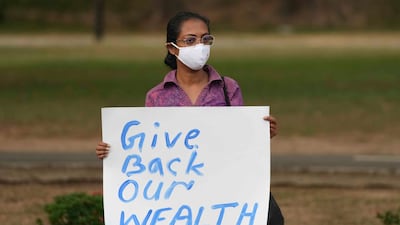
The three-day curfew was imposed by the government from Saturday evening as protests against food and fuel shortages were held in Sri Lanka. AP -

People queue for essentials at a shop before the beginning of the curfew, in Colombo. AP -
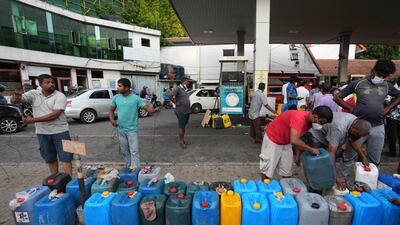
Sri Lankans flock to a fuel station to buy diesel. AP -
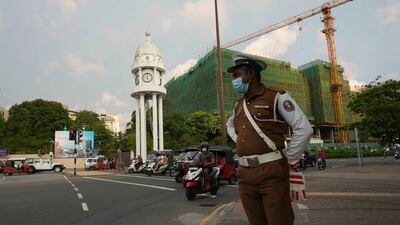
A Sri Lankan police officer stands in a street as curfew begins in Colombo, Sri Lanka. AP -

The military stand guard at a checkpoint in Colombo. AFP -
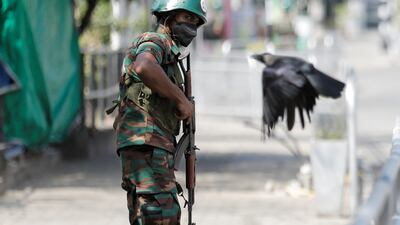
The curfew was imposed after a clash between police and protesters near Sri Lankan President Gotabaya Rajapaksa's residence. Reuters -
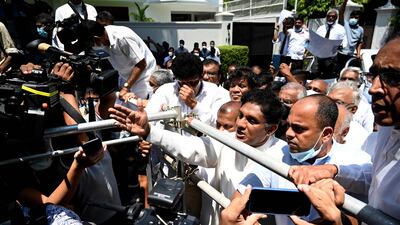
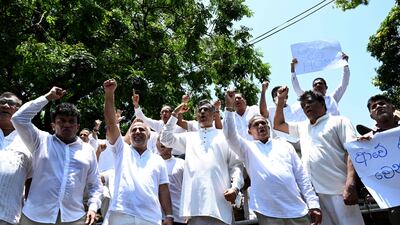
Sri Lanka's main opposition leader Sajith Premadasa (C) and MPs members shout during a protest in Colombo. AFP -
Sri Lankans have urged foreign tourists not to cancel travel plans as the South Asian island battles power cuts linked to soaring fuel prices. AFP -

The country is in the grips of its worst economic downturn in decades, sparked by a lack of foreign currency to pay for essential imports. AFP -
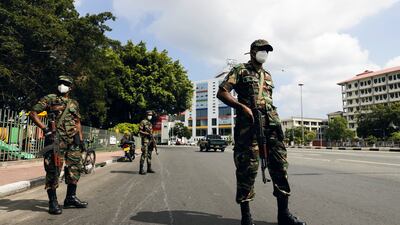
President Gotabaya Rajapaksa has invoked laws that allow the military to arrest and detain protesters without warrants. Reuters -

Tourism in Sri Lanka has been hit hard by the coronavirus pandemic. AFP -

The island welcomed 194,000 foreign tourists in 2021, down from 1.9 million in 2019 and 2.3 million in 2018. AFP -
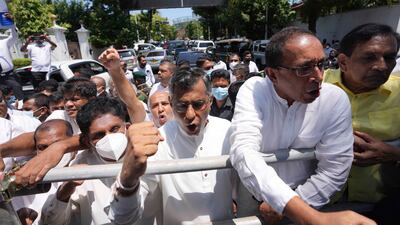
Sajith Premadasa (L) and other opposition politicians lead an anti government rally in Colombo. AP -
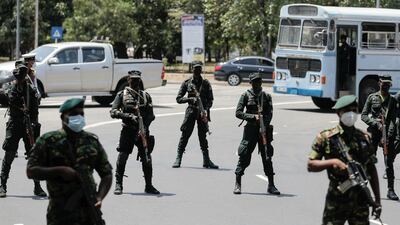
As fuel resources diminish, electricity rationing continues to be enforced and the cost of living rises, the shortages have led to a series power cuts. Reuters


On Monday, Mr Rajapaksa swore in new Finance Minister Ali Sabry, who is among the key decision-makers as the country starts bailout talks with International Monetary Fund.
“You could see the composition of parliament changing today,” said lawyer Luwie Niranjan Ganeshanathan, who specialises in constitutional issues.
Sri Lanka's ruling coalition won 145 out of 225 seats in the last parliamentary election. But some of its 11 coalition partners that collectively hold 30 seats have indicated they will sit independently in parliament.
“If the government loses its majority, you could see the opposition bringing in a vote of no confidence but there is parliamentary procedure that goes around it first and is unlikely to happen immediately,” Mr Ganeshanathan told Reuters.
If a vote of no confidence is adopted, then the president can appoint a new prime minister, he said.
Or, if the government loses its majority, the opposition can also table a resolution to dissolve parliament and call for snap elections, Mr Ganeshanathan said.
Mr Rajapaksa last month said his government was in talks with the International Monetary Fund and had turned to China and India for loans.
He also asked Sri Lankans to limit their use of fuel and electricity, and “extend their support to the country”.
For months, Sri Lankans have endured long queues to buy fuel, cooking gas, food and medicine, most of which come from abroad and are paid for in hard currency.

