Kings for a day: India’s last real royals celebrate in glittering style


Taniya Dutta
  • English
  • Arabic

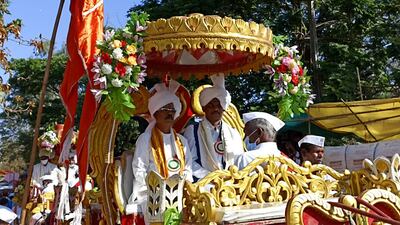
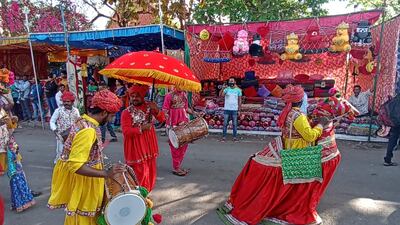
Trikamrao Sahebrao Pawar beamed with pride as he rode in a gleaming chariot drawn by horses with decorated coverings. Around him, revellers danced to the beat of drums in a unique procession to celebrate India's only titular kings.

It is the time of the year when the five descendants of former tribal Bhil rulers — all wearing matching brand-new, crisp white outfits, complete with a turban — come together for an extravaganza.

However, these monarchs' reigns only last a single day each year.

“I feel overwhelmed with all the attention. I enjoy it all, even if it is just for a day,” Mr Pawar, 48, told The National. This year, the entire festival lasts from March 11 to March 15.

The ancestors of Mr Pawar and four other male relatives were tribal kings of Dangs region — a forested belt in the Western Ghats mountains — now a small district in western Gujarat state, with about 300 tribal villages.

They represent the “kingdoms” of Pimpri, Linga, Daher, Gadhvi and Vasurna, located among teak forest.

But while other descendants of Indian royalty still live in opulent palaces and enjoy regal luxuries, despite losing their titles decades ago, these kings have rather more modest lifestyles.

During the rest of the year, they live like their ordinary “subjects”, working in the fields, rearing cattle and running their households.

  • Five descendants of erstwhile tribal kings who once fought against British colonial rulers in India's Gujarat state become kings for a day. Photo: Divyesh Mahati
    Five descendants of erstwhile tribal kings who once fought against British colonial rulers in India's Gujarat state become kings for a day. Photo: Divyesh Mahati
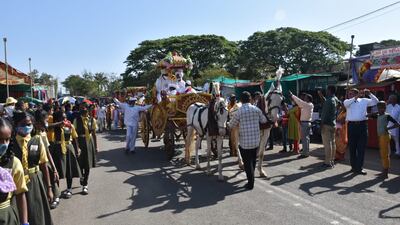
  • The 'kings' travel in a golden horse-drawn chariot, accompanied by a procession. Photo: Divyesh Mahati
    The 'kings' travel in a golden horse-drawn chariot, accompanied by a procession. Photo: Divyesh Mahati
  • People watch as the procession makes its way through the streets of Dang, in Gujarat. Photo: Divyesh Mahati
    People watch as the procession makes its way through the streets of Dang, in Gujarat. Photo: Divyesh Mahati
  • The reign of these 'monarchs' lasts only a single day each year. Photo: Divyesh Mahati
    The reign of these 'monarchs' lasts only a single day each year. Photo: Divyesh Mahati
  • They represent the “kingdoms” of Pimpri, Linga, Daher, Gadhvi and Vasurna. Photo: Divyesh Mahati
    They represent the “kingdoms” of Pimpri, Linga, Daher, Gadhvi and Vasurna. Photo: Divyesh Mahati
  • Every year, a week before Hindu festival of Holi, a five-day cultural extravaganza is organised at Ahwa. Photo: Divyesh Mahati
    Every year, a week before Hindu festival of Holi, a five-day cultural extravaganza is organised at Ahwa. Photo: Divyesh Mahati
  • Drummers perform during the procession. Photo: Divyesh Mahati
    Drummers perform during the procession. Photo: Divyesh Mahati
  • The 'kings' wear matching brand-new, crisp white outfits, complete with a turban. Photo: Divyesh Mahati
    The 'kings' wear matching brand-new, crisp white outfits, complete with a turban. Photo: Divyesh Mahati
  • The men are brought to the district headquarters where they are groomed, given a haircut and gifted new clothes. Photo: Divyesh Mahati
    The men are brought to the district headquarters where they are groomed, given a haircut and gifted new clothes. Photo: Divyesh Mahati
  • These kings live simple lives, with large families living in thatched houses and toiling in fields to make ends meet. Photo: Divyesh Mahati
    These kings live simple lives, with large families living in thatched houses and toiling in fields to make ends meet. Photo: Divyesh Mahati
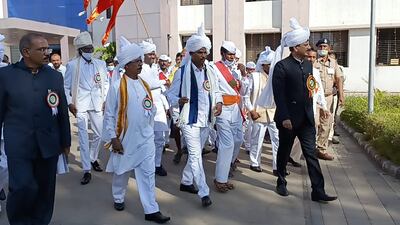
  • Officials during the ceremony to celebrate the 'kings'. Photo: Divyesh Mahati
    Officials during the ceremony to celebrate the 'kings'. Photo: Divyesh Mahati
  • The government is planning to increase the pension amount, after years of demands from the one-time royals. Photo: Divyesh Mahati
    The government is planning to increase the pension amount, after years of demands from the one-time royals. Photo: Divyesh Mahati
  • Delegates at this year's celebration. Photo: Divyesh Mahati
    Delegates at this year's celebration. Photo: Divyesh Mahati

Mr Pawar and others say they are peasants and have no inheritance. They live in extreme poverty with their extended family in thatched houses, toiling hard to make ends meet.

Their children have received no education and work as drivers or do manual work to supplement the family's income, while their queens take charge of the household. Their make a living out of cutting plantations in the forests.

The royals are held in respect by the tribal population, who invite them on special occasions like weddings and continue to hold sway on social issues in the tribal community.

But ahead of the Hindu festival of colours, Holi, the government holds an extravagant five-day Dang Darbar festival to honour the men and their royal lineage.

They are officially treated as kings for a day and sit with the government dignitaries and receive their annual pension while holding their annual “court”, in a tradition that began in British colonial times.

The men are brought to the district headquarters where they are groomed, given a haircut and gifted new clothes. Photo: Divyesh Mahati

“It is a tradition that we maintain to honour the history and dignity of the Dang Darbar,” district official Bhavin Pandya, told The National.

In the mid-19th century, the British tried to conquer the tribal lands on several occasions but were pushed back by the warrior Bhil kings, who defeated the colonisers each time.

Britain made an accord with the kings in 1842 for the lease of the forest to fell teak, in lieu of an annual sum and recognition of their rule over the vast tribal lands.

The colonialists also introduced the tradition of the annual unique ceremony where they lauded the kings and handed over the annual sum.

Dangs never became part of British India, and neither was its occupied by any neighbouring kingdom.

But when the British left India in 1947, New Delhi made Dangs a part of the former state of Bombay, before its inclusion in the state of Gujarat in 1960.

In 1954, the government passed a resolution that took away all the rights and privileges of the kings, granting them a hereditary political pension instead.

It abolished the privy purse of nearly 500 erstwhile rulers in 1971 to reduce the financial burden, but continued to give political pensions to the Dang kings, along with their official recognition of the royal title.

The 'kings' are carried in a golden-coloured chariot drawn by caparisoned horses as dancers frolicked to the beats of drums in a procession. Photo: Divyesh Mahati

In the tradition's current form, the descendants of the Bhil kings are brought to Ahwa, the district headquarters of the Dangs, every year, where they are groomed, given a haircut and presented with new clothes.

On the day of the main event, they are carried on decorated, gold-painted carts, along with their chieftains, in a procession to receive their pension from the state governor.

While the kings, whose ages range from their 30s to 60s, say they appreciate the government endorsement of their title, they are less pleased with the sum they receive as a pension.

The state governor on Sunday handed 3 million rupees ($39,200) to the royals descendants, which is divided between the kings and other court royals.

Each king received an average pension of 8,000 rupees a month.

Chhatrasinh Bhavarsinh Suryavanshi, 38, ruler of the Linga dynasty is critical of the government's treatment of the kings.

“We have nothing left except this name and a few acres of land but we don’t make much money. And then they give us peanuts in pension,” Mr Suryavanshi told The National.

Mr Suryavanshi said his grandfather was one of the richest kings in the tribal land, with silver coins worth millions of rupees in his possession.

But now he and his family live in a wooden hut.

“My grandfather had an elephant, horses and treasure worth 30 kilograms of silver coins. But he buried it in the forest and nobody knows where the coins are,” Mr Suryavanshi said.

“We have no inheritance and no scope to make extra money. We are not educated and know no other skill,” he said.

However, the government is planning to increase the pension amount, after years of demands from the one-time royals.

“With the positive approach of the state government, the amount of political pension would be increased soon,” Gujarat Tribal Development Minister Nareshbhai Patel, said at the event.

The tribal kings are elated with the announcement.

“The government already respects us. If they also raise our pension amount, all our problems will end,” Mr Pawar said.


Top investing tips for UAE residents in 2021

Build an emergency fund: Make sure you have enough cash to cover six months of expenses as a buffer against unexpected problems before you begin investing, advises Steve Cronin, the founder of DeadSimpleSaving.com.

Think long-term: When you invest, you need to have a long-term mindset, so don’t worry about momentary ups and downs in the stock market.

Invest worldwide: Diversify your investments globally, ideally by way of a global stock index fund.

Is your money tied up: Avoid anything where you cannot get your money back in full within a month at any time without any penalty.

Skip past the promises: “If an investment product is offering more than 10 per cent return per year, it is either extremely risky or a scam,” Mr Cronin says.

Choose plans with low fees: Make sure that any funds you buy do not charge more than 1 per cent in fees, Mr Cronin says. “If you invest by yourself, you can easily stay below this figure.” Managed funds and commissionable investments often come with higher fees.

Be sceptical about recommendations: If someone suggests an investment to you, ask if they stand to gain, advises Mr Cronin. “If they are receiving commission, they are unlikely to recommend an investment that’s best for you.”

Get financially independent: Mr Cronin advises UAE residents to pursue financial independence. Start with a Google search and improve your knowledge via expat investing websites or Facebook groups such as SimplyFI. 

Brahmastra%3A%20Part%20One%20-%20Shiva
%3Cp%3E%3Cstrong%3EDirector%3A%20%3C%2Fstrong%3EAyan%20Mukerji%3C%2Fp%3E%0A%3Cp%3E%3Cstrong%3EStars%3A%20%3C%2Fstrong%3ERanbir%20Kapoor%2C%20Alia%20Bhatt%20and%20Amitabh%20Bachchan%3C%2Fp%3E%0A%3Cp%3E%3Cstrong%3ERating%3A%3C%2Fstrong%3E%202%2F5%3C%2Fp%3E%0A
Ferrari 12Cilindri specs

Engine: naturally aspirated 6.5-liter V12

Power: 819hp

Torque: 678Nm at 7,250rpm

Price: From Dh1,700,000

Available: Now

The%20specs
%3Cp%3E%3Cstrong%3EEngine%3A%20%3C%2Fstrong%3E4.0-litre%20twin-turbo%20V8%0D%3Cbr%3E%3Cstrong%3EPower%3A%20%3C%2Fstrong%3E640hp%20at%206%2C000rpm%0D%3Cbr%3E%3Cstrong%3ETorque%3A%20%3C%2Fstrong%3E850Nm%20from%202%2C300-4%2C500rpm%0D%3Cbr%3E%3Cstrong%3ETransmission%3A%20%3C%2Fstrong%3E8-speed%20auto%0D%3Cbr%3E%3Cstrong%3EFuel%20consumption%3A%20%3C%2Fstrong%3E11.9L%2F100km%0D%3Cbr%3E%3Cstrong%3EPrice%3A%20%3C%2Fstrong%3EDh749%2C800%0D%3Cbr%3E%3Cstrong%3EOn%20sale%3A%20%3C%2Fstrong%3Enow%3C%2Fp%3E%0A
COMPANY%20PROFILE%20
%3Cp%3E%3Cstrong%3ECompany%20name%3A%20%3C%2Fstrong%3ETerra%3Cbr%3E%3Cstrong%3EStarted%3A%3C%2Fstrong%3E%202021%3Cbr%3E%3Cstrong%3EBased%3A%3C%2Fstrong%3E%20Dubai%3Cbr%3E%3Cstrong%3EFounder%3A%3C%2Fstrong%3E%20Hussam%20Zammar%3Cbr%3E%3Cstrong%3ESector%3A%3C%2Fstrong%3E%20Mobility%3Cbr%3E%3Cstrong%3EInvestment%20stage%3A%3C%2Fstrong%3E%20Pre-seed%20funding%20of%20%241%20million%3Cbr%3E%3C%2Fp%3E%0A

Huroob Ezterari

Director: Ahmed Moussa

Starring: Ahmed El Sakka, Amir Karara, Ghada Adel and Moustafa Mohammed

Three stars

Gertrude Bell's life in focus

A feature film

At one point, two feature films were in the works, but only German director Werner Herzog’s project starring Nicole Kidman would be made. While there were high hopes he would do a worthy job of directing the biopic, when Queen of the Desert arrived in 2015 it was a disappointment. Critics panned the film, in which Herzog largely glossed over Bell’s political work in favour of her ill-fated romances.

A documentary

A project that did do justice to Bell arrived the next year: Sabine Krayenbuhl and Zeva Oelbaum’s Letters from Baghdad: The Extraordinary Life and Times of Gertrude Bell. Drawing on more than 1,000 pieces of archival footage, 1,700 documents and 1,600 letters, the filmmakers painstakingly pieced together a compelling narrative that managed to convey both the depth of Bell’s experience and her tortured love life.

Books, letters and archives

Two biographies have been written about Bell, and both are worth reading: Georgina Howell’s 2006 book Queen of the Desert and Janet Wallach’s 1996 effort Desert Queen. Bell published several books documenting her travels and there are also several volumes of her letters, although they are hard to find in print. Original documents are housed at the Gertrude Bell Archive at the University of Newcastle, which has an online catalogue.
 

Ant-Man%20and%20the%20Wasp%3A%20Quantumania
%3Cp%3E%3Cstrong%3EDirector%3A%20%3C%2Fstrong%3EPeyton%20Reed%3Cbr%3E%3Cbr%3E%3Cstrong%3EStars%3A%3C%2Fstrong%3E%20Paul%20Rudd%2C%20Evangeline%20Lilly%2C%20Jonathan%20Majors%3Cbr%3E%3Cbr%3E%3Cstrong%3ERating%3A%20%3C%2Fstrong%3E2%2F5%3C%2Fp%3E%0A
The burning issue

The internal combustion engine is facing a watershed moment – major manufacturer Volvo is to stop producing petroleum-powered vehicles by 2021 and countries in Europe, including the UK, have vowed to ban their sale before 2040. The National takes a look at the story of one of the most successful technologies of the last 100 years and how it has impacted life in the UAE.

Part three: an affection for classic cars lives on

Read part two: how climate change drove the race for an alternative 

Read part one: how cars came to the UAE

What the law says

Micro-retirement is not a recognised concept or employment status under Federal Decree Law No. 33 of 2021 on the Regulation of Labour Relations (as amended) (UAE Labour Law). As such, it reflects a voluntary work-life balance practice, rather than a recognised legal employment category, according to Dilini Loku, senior associate for law firm Gateley Middle East.

“Some companies may offer formal sabbatical policies or career break programmes; however, beyond such arrangements, there is no automatic right or statutory entitlement to extended breaks,” she explains.

“Any leave taken beyond statutory entitlements, such as annual leave, is typically regarded as unpaid leave in accordance with Article 33 of the UAE Labour Law. While employees may legally take unpaid leave, such requests are subject to the employer’s discretion and require approval.”

If an employee resigns to pursue micro-retirement, the employment contract is terminated, and the employer is under no legal obligation to rehire the employee in the future unless specific contractual agreements are in place (such as return-to-work arrangements), which are generally uncommon, Ms Loku adds.

DRIVERS' CHAMPIONSHIP STANDINGS

1. Sebastian Vettel (Ferrari) 171 points
2. Lewis Hamilton (Mercedes-GP) 151
3. Valtteri Bottas (Mercedes-GP) 136
4. Daniel Ricciardo (Red Bull Racing) 107
5. Kimi Raikkonen (Ferrari) 83
6. Sergio Perez (Force India) 50
7. Max Verstappen (Red Bull Racing) 45
8. Esteban Ocon (Force India) 39
9. Carlos Sainz (Torro Rosso) 29
10. Felipe Massa (Williams) 22

Updated: March 15, 2022, 8:40 AM