


Live updates: follow the latest news on Russia-Ukraine
India’s diplomatic position on the Russia-Ukraine war may upset the West, but the South Asian nation will stick to its independent stance to safeguard its geopolitical interests, political analysts have said.
“India has been trying to do this balancing act," Sanjay Kumar Pandey, a professor at Jawaharlal Nehru University’s Centre for Russian and Central Studies, told The National. "First and foremost, because Russia has been a reliable partner and a dependable ally.”
New Delhi has abstained on all the five West-sponsored resolutions against Russia on Ukraine in the UN that condemned Moscow’s military offensive on the East European neighbour since February 24.
India, despite having strong ties with the US and the EU to counter China in the Asia-Pacific region, has refused to denounce actions by Russia.
Instead, it made customary statements and called for countries to respect “commitment to the principles of the UN Charter, to international law and respect for sovereignty and territorial integrity of all states”.
“Keeping in view the totality of the evolving situation, India decided to abstain,” T S Tirumurti, India's permanent representative to the UN, said last week ahead of the UN General Assembly vote.
-
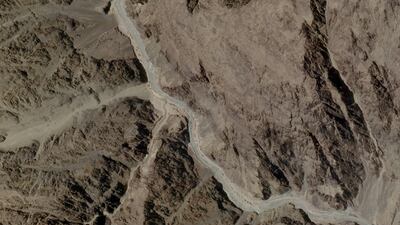
A satellite image taken over Galwan Valley in Ladakh, India, parts of which are contested with China, June 16, 2020, in this handout obtained from Planet Labs Inc. REUTERS -

An Indian army convoy makes way towards Leh, bordering China, in Gagangir. Twenty Indian soldiers were killed during "hand-to-hand' fighting with Chinese troops in a disputed Himalayan region, India's military said, the first deadly clash between the nuclear powers in decades. AFP -
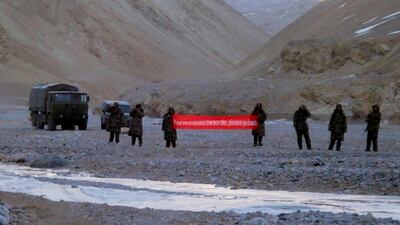
In this May 5, 2013 photo, Chinese troops hold a banner which reads: "You've crossed the border, please go back" in Ladakh, India. China on Tuesday, June 16, 2020 accused Indian forces along their Himalayan border of carrying out "provocative attacks" on its troops, leading to "serious physical conflicts" between the sides. AP Photo -
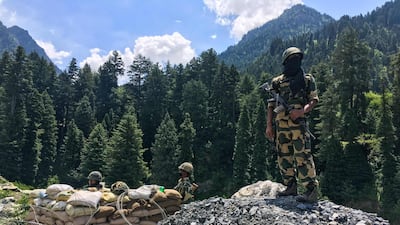
Indian Border Security Force (BSF) soldiers guard a highway leading towards Leh, bordering China, in Gagangir. The long-running border dispute between Asian nuclear powers India and China turned deadly for the first time in nearly half a century after at least 20 Indian soldiers were killed in a "violent face-off", the army said. AFP -
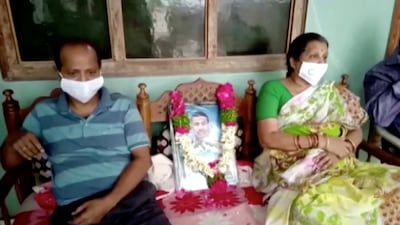
The father and mother of Colonel Santosh Babu, who was killed in border clashes with Chinese troops, sit next to his portrait, in Suryapet,Telangana state, India. REUTERS -
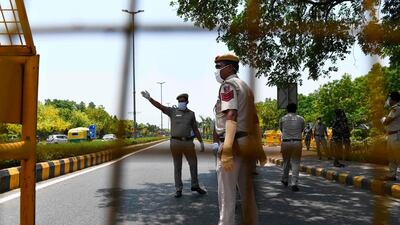
Police set up barricades outside the Chinese embassy in New Delhi. The long-running border dispute between Asian nuclear powers India and China turned deadly for the first time in nearly half a century after at least 20 Indian soldiers were killed in a "violent face-off", the army said on June 16. AFP -
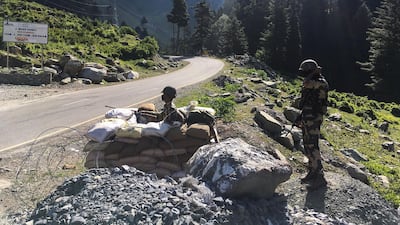
Indian Border Security Force (BSF) soldiers guard a highway leading towards Leh, bordering China, in Gagangir. The long-running border dispute between Asian nuclear powers India and China turned deadly for the first time in nearly half a century after at least 20 Indian soldiers were killed in a "violent face-off", the army said on June 16. AFP -
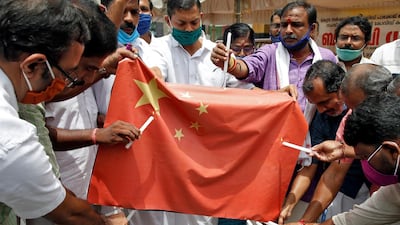
Supporters of India's ruling Bharatiya Jayanta Party (BJP) attempt to burn a sheet resembling the Chinese national flag during a protest against China, in Kochi, India. REUTERS -
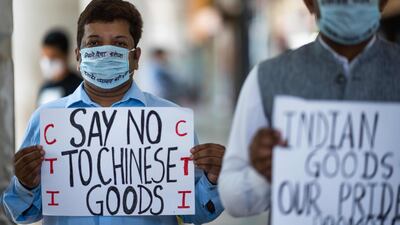
Anti-China protesters display placards urging citizens to boycott Chinese goods at a market in New Delhi. Twenty Indian soldiers were killed during "hand-to-hand' fighting with Chinese troops in a disputed Himalayan region, India's military said, the first deadly clash between the nuclear powers in decades. AFP -
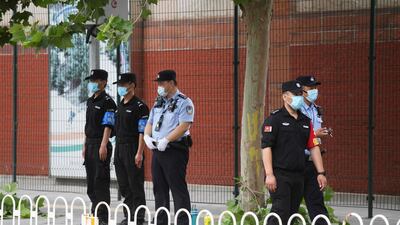
Chinese police and security personnel stand outside the Indian embassy in Beijing. Beijing's state media on June 17 played down a deadly border confrontation between Chinese and Indian troops and did not reveal casualties on its side even as social media users urged retaliation. The Indian army said Tuesday that 20 of its soldiers were killed in a "violent face-off" along the Himalayan frontier on June 16, which resulted in "casualties on both sides". AFP


Russia and India share historical ties and have been time-tested friends.
New Delhi’s focus has mainly remained on evacuating its nationals – at least 20,000 Indians, mostly medical students – from Ukraine as it tries to sidestep the global pressure.
Over the past two weeks, Prime Minister Narendra Modi spoke with both Ukrainian President Volodymyr Zelenskyy and Russian President Vladimir Putin and called for “cessation of violence”, while urging them to use diplomacy and dialogue to resolve the conflict.
But as the US and Europe move beyond the diplomatic bluster, a global alliance is forming to turn Russia into a pariah state, with a slew of crippling sanctions being imposed on Moscow.
India’s continued neutral stand on the conflict has put it and its western allies in a fix.
Its stand on Russian actions has already ruffled feathers in the West, particularly in the US power corridors, as several Congressmen have demanded New Delhi clear its stand on its relationship with Russia.
There were murmurs of India finding itself on the list of countries sanctioned by the US Administration under Countering America’s Adversaries through Sanctions Act, or CAATSA, for buying military equipment from Moscow.
The move could be a jolt to the growing bonhomie between Washington and New Delhi.
Still, experts say New Delhi will continue to follow its independent diplomacy, despite pitfalls to protect its geopolitical interests.
-

Indian soldiers inspect the remains of an Indian Air Force aircraft after it crashed in Budgam district, 30km from Srinagar. AFP -

Indian soldiers stand next to the wreckage of the Indian Air Force's helicopter after it crashed in Budgam district in Kashmir. Reuters -
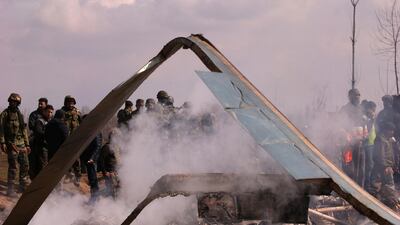
Indian soldiers stand next to the wreckage of the Indian Air Force's helicopter after it crashed in Budgam district in Kashmir. Reuters -
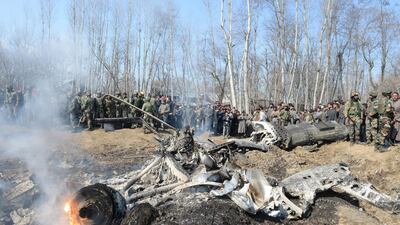
Indian soldiers and Kashmiri onlookers stand near the remains of an Indian Air Force aircraft after it crashed in Budgam district, 30 km from Srinagar. AFP -

Indian soldiers and Kashmiri onlookers stand near the remains of an Indian Air Force aircraft after it crashed in Budgam district, 30 km from Srinagar. AFP -

Indian soldiers and Kashmiri onlookers stand near the remains of an Indian Air Force aircraft after it crashed in Budgam district, some 30 kms from Srinagar. AFP -
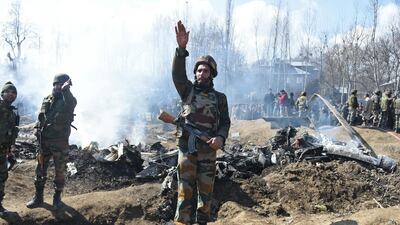
Indian soldiers gesture near the remains of an Indian Air Force aircraft after it crashed in Budgam district, 30km from Srinagar. AFP -
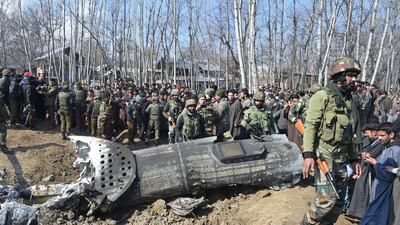
Indian soldiers and Kashmiri onlookers stand near the remains of an Indian Air Force aircraft after it crashed in Budgam district, 30 km from Srinagar. AFP -
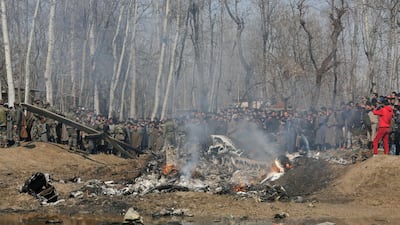
Kashmiri villagers gather near the wreckage of an Indian aircraft after it crashed in the Budgam area on the outskirts of Srinagar. AP Photo


Russia remains a critical source of weapons and military technology for India from where it sources around 85 per cent of the country’s military equipment.
Military hardware ranging from missiles, guns to nuclear submarines, India has major defence deals with Russia.
The two countries recently inked deals on supplying 750,000 AK-203 assault rifles and a $5.43 billion worth deal for S-400 ‘Trimuf’ missile systems.
“We majorly depend on Russia for our military supplies and inputs for sophisticated weapon systems, including technology,” Mr Pandey said.
New Delhi was a close ally of the Soviet Union during the Cold War era and over the years has further strengthened its ties with Moscow to blunt China’s influence in the region.
“So far, India's careful and pragmatic diplomacy has been low key, not condemnatory, but supportive of dialogue,” Jitendra Nath Misra, a former Indian diplomat, told The National.
The concern is that should New Delhi tilt towards the West, it would run the risk of alienating Russia and lead Moscow to move towards Beijing, a strategic nightmare for India.
“India is taking such a stand on Russia because we really can't afford to antagonize Russia, owing to the real and continuing and escalatory threat from China,” Mr Misra said.
China has massively increased its economic and military footprints in the Asian region, particularly with Pakistan. India’s archrival shared a frosty relation with Moscow over its close ties with Washington during the Cold War.
Tensions have remained high between New Delhi and Beijing, particularly since 2020 when a deadly clash erupted between the rival militaries along the disputed Himalayan border region.
Russia tried to play peace-maker and de-escalate tensions between the regional powers and helped facilitate a meeting between the Indian and Chinese foreign ministers in Moscow in 2020.
But hostilities remain.
-
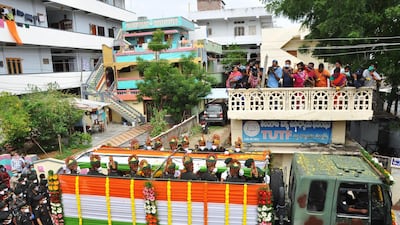
Indian Army personnel carry the body of Col Santosh Babu through Suryapet, a town near the southern Indian city of Hyderabad, on Thursday. Col Babu was among the 20 Indian troops killed in Monday's clash with Chinese soldiers in the Himalayan district of Ladakh. AFP -
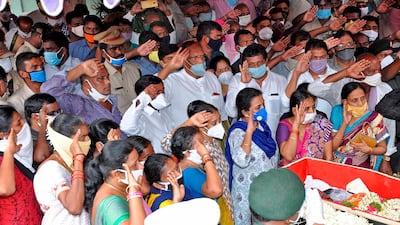
Indian Army personnel, family members and relatives salute next to the body of Col Santosh Babu before his funeral at Suryapet. AFP -

B Upender performs the final rites of his son Col Santosh Babu in Suryapet. AP Photo -
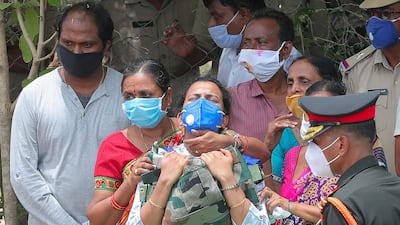
Santoshi mourns after receiving her husband Col Santosh Babu's uniform and the National flag during the last rites ceremony in Suryapet. AP Photo -
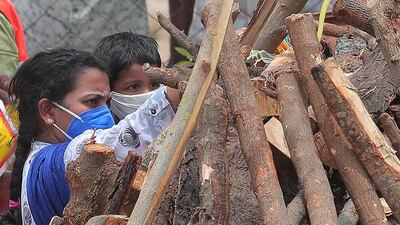
Santoshi performs rituals during the last rites in Suryapet. AP Photo -
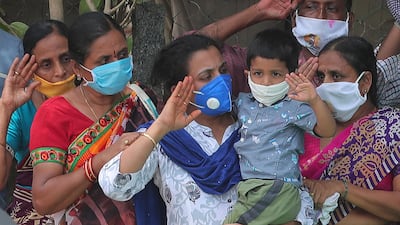
Santoshi and her son salute during the last rites of her husband in Suryapet. AP Photo -
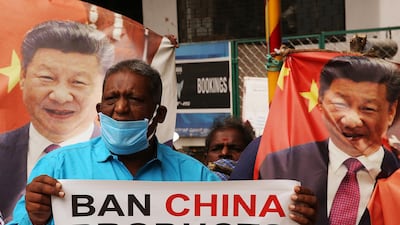
Activists hold photos of Chinese President Xi Jinping and shout slogans against China during a protest in the southern Indian city of Bangalore. EPA -
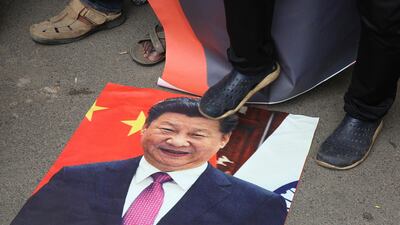
Activists hold photos of Chinese President Xi Jinping and shouts slogans against China in Bangalore. EPA -
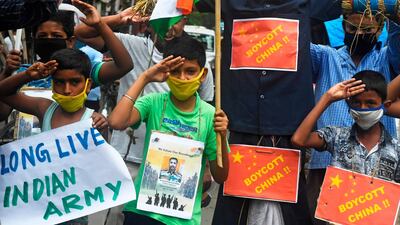
Children take part in an anti-China demonstration in the eastern Indian city of Kolkata. AFP -
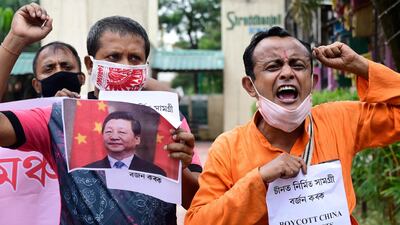
Men shout slogans and call for boycott of Chinese products during a demonstration in the north-eastern Indian city of Guwahati. AP Photo -

Activists throughout India hold candles as a tribute to Indian soldiers killed in clash with Chinese troops in the Himalayan district of Ladakh. EPA -
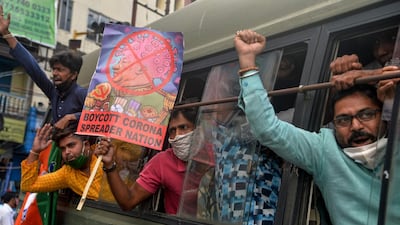
Activists belonging to the Bharatiya Janata Party shout slogans while holding posters as they sit in a police van during an anti-China protest in the eastern Indian city of Siliguri. AFP


Last December, China renamed 15 places in remote Arunachal Pradesh in India’s north-east along the Line of Actual Control that it also claims as its territory.
“India needs to protect its important relationship with Russia, primarily because China is continuing to put pressure on India,” Mr Misra said.
India's move to abstain from voting against Moscow is also seen as a payback time for New Delhi.
Russia over the decades has vetoed several resolutions seeking UN interventions in Kashmir—the Himalayan disputed territory claimed by both India and Pakistan.
China also rules a portion of the erstwhile Himalayan Kingdom known as Aksai Chin, which is now part of the Chinese Xinjiang and Tibet region.
New Delhi is engaged in a tense border dispute with both Islamabad and Beijing, with a decades-long armed insurgency raging in the part of Kashmir ruled by India.
New Delhi was duty-bound to side with Russia at global forums, including the UNSC, Mr Pandey said.
“Russia has bailed out India on so many occasions at the UN Security Council, mainly on Kashmir,” he said. "India cannot forget that."

