• Firefighters arrive at a military building in Kiev that was damaged in an explosion. EPA
    Firefighters arrive at a military building in Kiev that was damaged in an explosion. EPA
  • A man looks at the debris of an unidentified object in the aftermath of an explosion in Kiev. EPA
    A man looks at the debris of an unidentified object in the aftermath of an explosion in Kiev. EPA
  • Black smoke rises from a military airport in Chuguyev near Kharkiv. AFP
    Black smoke rises from a military airport in Chuguyev near Kharkiv. AFP
  • People take shelter in a Kiev subway station, after Russian President Vladimir Putin authorised a military operation in eastern Ukraine. Reuters
    People take shelter in a Kiev subway station, after Russian President Vladimir Putin authorised a military operation in eastern Ukraine. Reuters
  • A Kiev underground train station provides some shelter. Reuters
    A Kiev underground train station provides some shelter. Reuters
  • Clear airspace over Ukraine, shortly after the attack began, as shown on the Flightradar24 website. AP
    Clear airspace over Ukraine, shortly after the attack began, as shown on the Flightradar24 website. AP
  • Kiev residents leave the city following pre-offensive missile strikes by the Russian armed forces and Belarus. Getty
    Kiev residents leave the city following pre-offensive missile strikes by the Russian armed forces and Belarus. Getty
  • Russian President Vladimir Putin justified the attack in a televised address, saying it was to protect civilians in eastern Ukraine. AP
    Russian President Vladimir Putin justified the attack in a televised address, saying it was to protect civilians in eastern Ukraine. AP
  • Ukrainian President Volodymyr Zelenskyy addresses the nation in Kiev. He has declared martial law, saying Russia has targeted Ukraine's military infrastructure. AP
    Ukrainian President Volodymyr Zelenskyy addresses the nation in Kiev. He has declared martial law, saying Russia has targeted Ukraine's military infrastructure. AP
  • Firefighters extinguish a blaze at a house in Muratovo, in Ukraine's Luhansk enclave. AFP
    Firefighters extinguish a blaze at a house in Muratovo, in Ukraine's Luhansk enclave. AFP
  • The house is said to have been hit during shelling by Russian-backed separatists. AFP
    The house is said to have been hit during shelling by Russian-backed separatists. AFP
  • The coffin of Capt Anton Sidorov is carried by members of the honour guard during a ceremony held at the Ministry of Defence in Kiev, Ukraine. Getty
    The coffin of Capt Anton Sidorov is carried by members of the honour guard during a ceremony held at the Ministry of Defence in Kiev, Ukraine. Getty
  • A picture memorial for those killed in the confrontation between Ukraine's military and pro-Russia separatist forces, in the Luhansk region in eastern Ukraine. AP
    A picture memorial for those killed in the confrontation between Ukraine's military and pro-Russia separatist forces, in the Luhansk region in eastern Ukraine. AP
  • UN Secretary General Antonio Guterres and Russia's Ambassador to the UN, Vassily Nebenzia, attend a Security Council meeting in New York to discuss the crisis in Ukraine. Reuters
    UN Secretary General Antonio Guterres and Russia's Ambassador to the UN, Vassily Nebenzia, attend a Security Council meeting in New York to discuss the crisis in Ukraine. Reuters
  • Ukraine's UN ambassador Sergey Kyslytsya speaks during an emergency meeting of the Security Council. AP
    Ukraine's UN ambassador Sergey Kyslytsya speaks during an emergency meeting of the Security Council. AP
  • US Army soldiers from the 82nd Airborne Division head towards an air base near Arlamow, Poland. Reuters
    US Army soldiers from the 82nd Airborne Division head towards an air base near Arlamow, Poland. Reuters
  • An employee works at the gun counter of a tactical equipment shop in Kiev, Ukraine. Getty
    An employee works at the gun counter of a tactical equipment shop in Kiev, Ukraine. Getty
  • A Ukrainian soldier speaks on a walkie-talkie at his position at the line of separation between Ukraine-held territory and rebel-held territory near Svitlodarsk, eastern Ukraine. AP
    A Ukrainian soldier speaks on a walkie-talkie at his position at the line of separation between Ukraine-held territory and rebel-held territory near Svitlodarsk, eastern Ukraine. AP
  • A man removes his belongings from his house after it was struck by artillery shells in Novoluhanske, eastern Ukraine. AP
    A man removes his belongings from his house after it was struck by artillery shells in Novoluhanske, eastern Ukraine. AP
  • A damaged house in Vibrovka village. EPA
    A damaged house in Vibrovka village. EPA
  • A man shows a poster in support of Ukraine as he protests against the escalation of the tension between Russia and Ukraine, in Berlin. AP
    A man shows a poster in support of Ukraine as he protests against the escalation of the tension between Russia and Ukraine, in Berlin. AP
  • Soldiers carry the coffin of Capt Anton Sydorov, 35, after he was killed in eastern Ukraine. AP
    Soldiers carry the coffin of Capt Anton Sydorov, 35, after he was killed in eastern Ukraine. AP
  • Workers look into a destroyed house after shelling near the city of Novoluhanske in Donetsk. Reuters
    Workers look into a destroyed house after shelling near the city of Novoluhanske in Donetsk. Reuters
  • Destroyed buildings in Krasnogorivka, Ukraine. AFP
    Destroyed buildings in Krasnogorivka, Ukraine. AFP
  • Smoke rises from a power plant after shelling outside the town of Schastia, a day after Moscow recognised two Ukrainian separatist republics and ordered the Russian Army to send in troops as ‘peacekeepers’. AFP
    Smoke rises from a power plant after shelling outside the town of Schastia, a day after Moscow recognised two Ukrainian separatist republics and ordered the Russian Army to send in troops as ‘peacekeepers’. AFP
  • A Ukrainian Army soldier trudges through the wintry streets of Schastia on patrol. AFP
    A Ukrainian Army soldier trudges through the wintry streets of Schastia on patrol. AFP
  • Three women run for cover during shelling in Schastia, eastern Ukraine. AFP
    Three women run for cover during shelling in Schastia, eastern Ukraine. AFP
  • Russian tanks and armoured vehicles on the road in Rostov. EPA
    Russian tanks and armoured vehicles on the road in Rostov. EPA
  • A woman shares food with dogs in Stanytsia Luhanska, a crossing point between Ukrainian government-controlled areas and pro-Russian separatists' territory. AP
    A woman shares food with dogs in Stanytsia Luhanska, a crossing point between Ukrainian government-controlled areas and pro-Russian separatists' territory. AP
  • People wave Russian flags in Donetsk, the territory controlled by pro-Russian militants, in eastern Ukraine. AP
    People wave Russian flags in Donetsk, the territory controlled by pro-Russian militants, in eastern Ukraine. AP
  • A tank drives along a street in the city of Donetsk. Reuters
    A tank drives along a street in the city of Donetsk. Reuters
  • Ukrainian President Volodymyr Zelenskyy addresses the nation on TV and says 'we are not afraid' after Russian President Vladimir Putin ordered troops into Donetsk and Luhansk, two Moscow-backed rebel regions of Ukraine. AFP
    Ukrainian President Volodymyr Zelenskyy addresses the nation on TV and says 'we are not afraid' after Russian President Vladimir Putin ordered troops into Donetsk and Luhansk, two Moscow-backed rebel regions of Ukraine. AFP
  • A military truck in Donetsk after Mr Putin ordered the deployment of Russian troops to the city. Reuters
    A military truck in Donetsk after Mr Putin ordered the deployment of Russian troops to the city. Reuters
  • Russian state television showed Mr Putin signing a decree recognising the independence of the two Ukrainian breakaway regions. Reuters
    Russian state television showed Mr Putin signing a decree recognising the independence of the two Ukrainian breakaway regions. Reuters
  • US President Joe Biden signs an executive order at the White House to prohibit trade and investment between US individuals and the two breakaway regions of eastern Ukraine. Reuters
    US President Joe Biden signs an executive order at the White House to prohibit trade and investment between US individuals and the two breakaway regions of eastern Ukraine. Reuters
  • Mr Putin signs documents, including the decree recognising two Russian-backed breakaway regions in eastern Ukraine. Reuters
    Mr Putin signs documents, including the decree recognising two Russian-backed breakaway regions in eastern Ukraine. Reuters
  • Ukraine ambassador to the United Nations, Sergiy Kyslytsya, addresses an emergency meeting of the UN Security Council on the situation between Ukraine and Russia in New York. EPA
    Ukraine ambassador to the United Nations, Sergiy Kyslytsya, addresses an emergency meeting of the UN Security Council on the situation between Ukraine and Russia in New York. EPA

Why has Russia invaded Ukraine and what does Moscow want?


  • English
  • Arabic

Live updates: follow the latest news on Russia-Ukraine

On February 24, Russia invaded Ukraine. The civilian death toll now stands at more than 100 people, with more than 500,000 Ukrainians fleeing to neighbouring countries, the UN said.

Less than a week into the incursion, a Russian military convoy stretching 64 kilometres along a road north of the Ukranian capital threatened Kiev as troops slowly advanced towards the city in hundreds of armoured vehicles and tanks.

Defying escalating trade sanctions from the US, Canada, EU and other countries, including Japan and Australia, Russian President Vladimir Putin said Ukrainian forces must surrender their weapons or bear the consequences.

"All responsibility for possible bloodshed will be completely and totally on the conscience of the regime ruling on Ukrainian territory," he said in a televised address. Ukraine's President Volodymyr Zelensky has declared martial law but asked citizens to remain calm.

This is the worst outcome predicted by analysts and potentially the start of the largest conflict since the US-led invasion of Iraq in 2003. But how did we get here, despite warnings from many analysts that war could be on the cards?

Why is Russia attacking Ukraine?

The conflict is rooted in hundreds of years of bitter history that has included famine and widespread political violence.

Essentially, Mr Putin views Ukraine as being a part of Russia and wishes to restore Moscow's control.

Ukraine was formerly part of the Russian Empire, which existed between 1721 and the Russian revolution of 1917. After the Russian royal family was executed by revolutionaries, Ukraine declared itself an independent state before being absorbed into the Communist Soviet Union in 1922, as Vladimir Lenin and Josef Stalin took control of Russia.

By the start of the 1930s, as the Communists attempted to remake Russian society through a rapid push for industrialisation, agricultural production suffered.

Famine took hold across the Soviet Union and while historians debate how responsible Stalin was for the crisis, at least seven million Ukrainians perished from starvation, a period referred to as the Holodomor, meaning death by starvation.

This episode, and increasingly draconian Soviet rule, fostered growing Ukrainian resistance against Moscow. During the German invasion in 1941, some Ukrainians allied with the Nazis, hoping that Hitler — or a Nazi-allied government – might be better than continued Communist rule.

Despite the fact many Ukrainians resisted the Nazis, Russian nationalists believe the country has never shaken off its WW2 far right ties and on Thursday Mr Putin said Russia would "strive to demilitarise and de-Nazify Ukraine," echoing remarks he made in 2014 when he said the Ukrainians were the "heirs of Bandera." Stepan Bandera was a Ukrainian nationalist who briefly allied with the Nazis.

What does Moscow want?

Since the Soviet Union collapsed in 1991, Russian nationalists like Mr Putin – a former member of the Russian intelligence service, the KGB – have wanted to regain control of former Soviet republics that gained independence in 1991.

Those countries, including Baltic States Latvia, Lithuania and Estonia, as well as Georgia and Ukraine, have forged growing ties with Nato.

Those ties were forged in the aftermath of Russia's war to bring former Soviet republic Chechnya back into the Russian sphere, which ended with the destruction of its capital city, Grozny, and the installation of a Moscow-allied government.

But an agreement to bring Ukraine and Georgia – which fought a short war with Russia in 2008 – into Nato did not begin until that year.

Nato's eastward expansion was seen as a threat by Moscow to its security interests, and efforts by the EU to form closer ties with former Soviet republics have been seen as highly contentious.

During the build up to Thursday's military assault, Mr Putin had issued various security demands to the US before he draws his military forces back. His list includes a ban on Ukraine joining Nato and an agreement that Nato will remove troops and weapons supplied to former Soviet republics.

With no diplomatic solution in sight, Russia has amassed an estimated 190,000 troops along its border with Ukraine over the past several months.

Last week, Russia also moved forces into separatist regions of eastern Ukraine, Donetsk and Luhansk, which have been contested by Kiev and Russian-backed secessionists since 2014. On Tuesday, Mr Putin recognised the two regions as being independent from Ukraine, so-called "people's republics" – a move that immediately triggered US, EU and British trade sanctions.

Previously, Russia had repeatedly denied it planned to invade its neighbour and said troop movements are routine. It claimed to have pulled some forces back and accused western critics of “hysteria”.

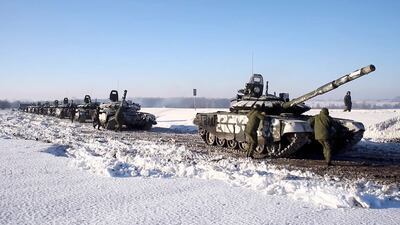
  • Russian tanks return from a shooting range in the Voronezh region. Russia said some of its forces near the Ukraine border would be returning to their bases after completing exercises. EPA
    Russian tanks return from a shooting range in the Voronezh region. Russia said some of its forces near the Ukraine border would be returning to their bases after completing exercises. EPA
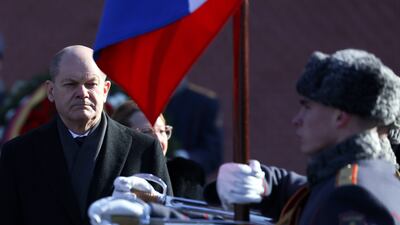
  • Russian President Vladimir Putin meets German Chancellor Olaf Scholz in Moscow to discuss the Ukraine crisis. Reuters
    Russian President Vladimir Putin meets German Chancellor Olaf Scholz in Moscow to discuss the Ukraine crisis. Reuters
  • Russian tanks make their way through snow back to their bases. EPA
    Russian tanks make their way through snow back to their bases. EPA
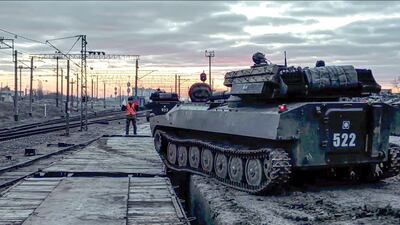
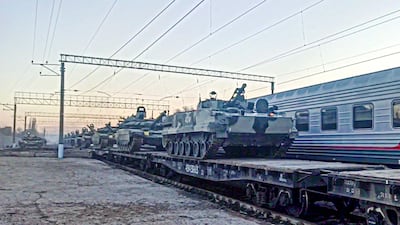
  • Russian armoured vehicles are loaded on to railway platforms after the end of military drills in southern Russia. AP
    Russian armoured vehicles are loaded on to railway platforms after the end of military drills in southern Russia. AP
  • Chancellor Scholz attends a wreath-laying ceremony at the Tomb of the Unknown Soldier in Moscow. EPA
    Chancellor Scholz attends a wreath-laying ceremony at the Tomb of the Unknown Soldier in Moscow. EPA
  • “The units of the southern and western military districts, having completed their tasks, have already begun loading on to rail and road transport,” Russia's Defence Ministry spokesman Igor Konashenkov said. AP
    “The units of the southern and western military districts, having completed their tasks, have already begun loading on to rail and road transport,” Russia's Defence Ministry spokesman Igor Konashenkov said. AP
  • Britain's Foreign Secretary Liz Truss arrives at 10 Downing Street to attend a meeting of the UK's Cobra emergency committee. AFP
    Britain's Foreign Secretary Liz Truss arrives at 10 Downing Street to attend a meeting of the UK's Cobra emergency committee. AFP
  • Russian military vehicles are loaded on to railway freight carriages in Crimea. EPA
    Russian military vehicles are loaded on to railway freight carriages in Crimea. EPA
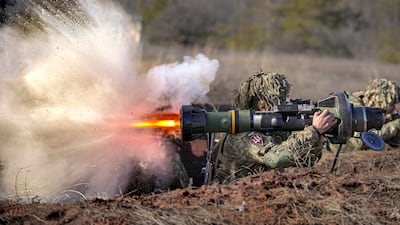
  • A Ukrainian soldier fires an anti-tank weapon during an exercise in eastern Ukraine. AP
    A Ukrainian soldier fires an anti-tank weapon during an exercise in eastern Ukraine. AP

How did the recent tension begin?

Tension between Russia and Ukraine reached a peak in 2014 when protesters ousted Ukraine’s pro-Russian president Viktor Yanukovich, in what is now known by its proponents as the Revolution of Dignity.

Russia forcibly annexed Crimea at the same time, leaving Ukraine in a vulnerable position for self-defence, with a temporary government and unprepared military.

Mr Putin immediately moved to strike in the Donbas region of eastern Ukraine. The armed conflict between Ukrainian government forces and Russia-backed separatists has killed more than 14,000 people – but the US has said this toll would pale in significance compared to a full-scale war for the entire country of 44 million people.

How do Ukrainians view Russia and the conflict?

Since gaining independence 30 years ago after the fall of the Soviet Union, Ukraine has been mired in corruption and internal divisions. Ukraine is a divided country, with its western region generally supporting western Europe, while parts of its eastern side are pro-Russia.

Ukraine and the West accused Russia of backing the rebels with troops and weapons. Moscow said that any Russians who fought in the east were volunteers. Unlike its response to Crimea, Russia continues to officially deny its involvement in the Donbas conflict.

After Ukrainian troops were severely defeated in the battle of Ilovaisk in August 2014, envoys from Kiev, the rebels and the Organisation for Security and Co-operation in Europe (OSCE) signed a truce in the Belarusian capital of Minsk in September 2014.

The document envisaged an OSCE-observed ceasefire, a pullback of all foreign fighters, an exchange of prisoners and hostages, an amnesty for the rebels and a promise that separatist regions could have a degree of self-rule.

Russian President Vladimir Putin has issued various security demands to the US before he draws his military forces back. AFP

The deal quickly collapsed and large-scale fighting resumed, leading to another major defeat for Ukrainian forces at Debaltseve in January-February of 2015.

France and Germany brokered another peace agreement, which was signed in Minsk in February 2015 by representatives of Ukraine, Russia and the rebels. However, the deal is still far from being fulfilled and Russia has expressed its frustration.

Two rounds of talks in Paris and Berlin between presidential envoys from Russia, Ukraine, France and Germany have yielded no progress. Amid the deadlock in talks, the lower house of Russian parliament this week urged Mr Putin to recognise the independence of Donetsk and Luhansk.

Mr Putin indicated he was not inclined to make the move that would effectively shatter the Minsk deal.

Agencies contributed to this report

Recipe: Spirulina Coconut Brothie

Ingredients
1 tbsp Spirulina powder
1 banana
1 cup unsweetened coconut milk (full fat preferable)
1 tbsp fresh turmeric or turmeric powder
½ cup fresh spinach leaves
½ cup vegan broth
2 crushed ice cubes (optional)

Method
Blend all the ingredients together on high in a high-speed blender until smooth and creamy. 

Everybody%20Loves%20Touda
%3Cp%3E%3Cstrong%3EDirector%3A%3C%2Fstrong%3E%20Nabil%20Ayouch%C2%A0%3C%2Fp%3E%0A%3Cp%3E%3Cstrong%3EStarring%3A%3C%2Fstrong%3E%20Nisrin%20Erradi%2C%20Joud%20Chamihy%2C%20Jalila%20Talemsi%3C%2Fp%3E%0A%3Cp%3E%3Cstrong%3ERating%3A%20%3C%2Fstrong%3E4%2F5%3C%2Fp%3E%0A
The Orwell Prize for Political Writing

Twelve books were longlisted for The Orwell Prize for Political Writing. The non-fiction works cover various themes from education, gender bias, and the environment to surveillance and political power. Some of the books that made it to the non-fiction longlist include: 

  • Appeasing Hitler: Chamberlain, Churchill and the Road to War by Tim Bouverie
  • Some Kids I Taught and What They Taught Me by Kate Clanchy
  • Invisible Women: Exposing Data Bias in a World Designed for Men by Caroline Criado Perez
  • Follow Me, Akhi: The Online World of British Muslims by Hussein Kesvani
  • Guest House for Young Widows: Among the Women of ISIS by Azadeh Moaveni
Ziina users can donate to relief efforts in Beirut

Ziina users will be able to use the app to help relief efforts in Beirut, which has been left reeling after an August blast caused an estimated $15 billion in damage and left thousands homeless. Ziina has partnered with the United Nations High Commissioner for Refugees to raise money for the Lebanese capital, co-founder Faisal Toukan says. “As of October 1, the UNHCR has the first certified badge on Ziina and is automatically part of user's top friends' list during this campaign. Users can now donate any amount to the Beirut relief with two clicks. The money raised will go towards rebuilding houses for the families that were impacted by the explosion.”

Our legal columnist

Name: Yousef Al Bahar

Advocate at Al Bahar & Associate Advocates and Legal Consultants, established in 1994

Education: Mr Al Bahar was born in 1979 and graduated in 2008 from the Judicial Institute. He took after his father, who was one of the first Emirati lawyers

Updated: March 01, 2022, 11:53 AM