


An asteroid that was discovered riding along in Earth's orbit is about 1.2 kilometres wide and might trail along for at least 4,000 more years while posing no danger, scientists said on Tuesday.
Using observations from telescopes in Chile, Arizona and the Canary Islands, researchers provided the most comprehensive description yet of the asteroid, named 2020 XL5, first detected two years ago.
They said it was one of only two Trojan asteroids travelling as a companion with Earth.
Trojan asteroids can be wanderers in the solar system, as appears to be the case with this one, or material left over from their home planet's formation.
They become ensnared by the planetary gravitational grip and orbit the Sun along the same path as the planet.
This one looks to be a "C-type" asteroid, one of the most common kinds in the solar system, said planetary scientist Toni Santana-Ros of the University of Alicante and the University of Barcelona's Institute of Cosmos Sciences in Spain.
Mr Santana-Ros was lead author of the study published in the journal Nature Communications.
C-type asteroids are dark in colour and contain a lot of carbon along with rocks and minerals.
"2020 XL5 poses no threat to Earth," said telescope scientist and study co-author Cesar Briceno, of the US National Science Foundation's NoirLab.
"We expect it will remain in its current stable orbit for at least the next 4,000 years."
Its location varies between about 90 million and 270 million kilometres from Earth.
The asteroid occupies one of five "Lagrange points", or positions in space where objects tend to stay put.
These five locales allow for stable orbits due to the competing gravitational forces of Earth and the Sun. This one is at what is called the L4 point.
The only other Trojan asteroid seen around Earth was discovered 12 years ago, also at the L4 point.
It is called 2010 TK7 and is smaller, with a diameter of about 400 metres.
It is also thought to have been captured by Earth's pull while meandering through the solar system.
-
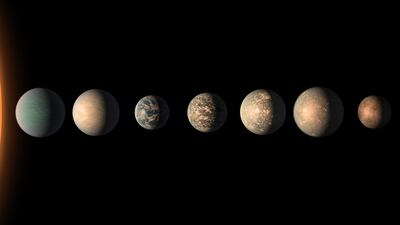
The landmark discovery of Trappist-1 set off a wave of excitement across the space community. It was the first time multiple Earth-sized planets were found in a habitable zone and were orbiting the same star – Trappist-1. Courtesy: Nasa -
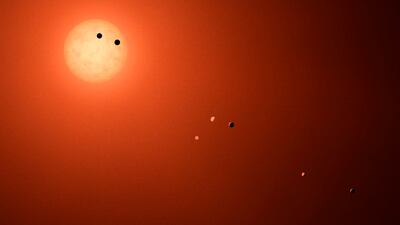
All seven planets orbiting Trappist-1 are believed to be rocky and have potential for water on the surface. Courtesy: Nasa -
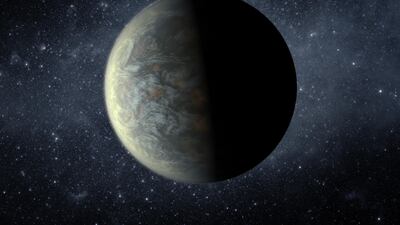
Located in a habitable zone, Kepler-22b was labelled by Nasa as ‘super Earth’. Researchers believe the planet, which is larger than Earth, could be another ocean world. However, because of the planet’s extreme tilt, the north and south poles would experience sunlight and darkness for half a year each. Courtesy: Nasa -
Discovered in 2020, Toi 700 d is only 20 per cent larger than Earth and orbits an M Dwarf star – a cool and stable type of star that do not release killer stellar flares, or radiation. Located 100 million light years away from Earth, one year on the planet is 37.4 days. Courtesy: Nasa -
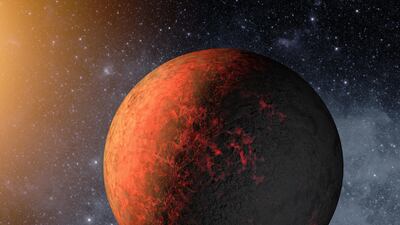
Discovered in 2011, KEPLER-20e is an Earth-size planet that orbits a sun-like star outside of the solar system. It is too close to its star to be in the habitable zone, so it cannot hold liquid water. However, the discovery was still groundbreaking because it was the first time small exoplanets were found to be orbiting around a star that was similar to the Sun. Courtesy: Nasa -

Kepler-20f was discovered along with Kepler-20e. A year on the planet is19.6 days. Courtesy: Nasa


2020 XL5, first detected in December 2020 using a telescope in Hawaii, may have been captured by Earth's gravitational pull somewhere between 500 to 1,000 years ago, Mr Santana-Ros said.
Many Trojan asteroids populate our solar system, with the largest planet Jupiter known to have almost 10,000 of them, Mr Santana-Ros said.
Nasa launched a spacecraft called Lucy last October to explore them.
Trojan asteroids also have been found around Neptune (28), Mars (four), Uranus (two) and Venus (one).
"Jupiter is a giant in all senses, also in terms of mass," Mr Santana-Ros said. "It cleaned its neighbouring region of other objects, and gathered thousands of objects on its L4 and L5 points.
"However, the Earth has a more delicate environment, with close gravitational competitors like Venus, Mars or even the Moon.
"Therefore, gravitational perturbations on 2020 XL5 will eventually allow this object to escape from the L4 stability point."
Mr Santana-Ros said there could be more Trojan asteroids around Earth awaiting detection.
The two Lagrange points where they might exist are difficult to observe from Earth.
"Any asteroid orbiting around these points will only be visible during a short time window close to twilight, at very low elevations above the horizon," Mr Santana-Ros said.
"But if we point our largest telescopes low above horizon and close to twilight I am certain we will find more surprises."

