Fifa president Gianni Infantino. PA

Fifa chief's claim that more World Cups would avert migrant deaths 'taken out of context'


Soraya Ebrahimi
  • English
  • Arabic

Fifa President Gianni Infantino linked his plan for biennial World Cups on Wednesday to giving more hope to Africans who risk their lives crossing the sea to Europe.

Mr Infantino told European politicians that football was being dominated by the few who “have everything” and it needed to be more global and inclusive.

“We need to find ways to include the entire world, to give hope to Africans so that they don’t need to cross the Mediterranean in order to find, maybe, a better life but more probably death in the sea,” he told the Parliamentary Assembly of the Council of Europe in Strasbourg, France.

He spoke on the day Spanish authorities said at least 18 people died and more than 300 were rescued from boats trying to reach the Canary Islands from North Africa.

“We need to give dignity, not by giving charity but by allowing the rest of the world as well to participate,” Mr Infantino said at a session he attended with Arsene Wenger, Fifa’s director of global development.

Fifa and Mr Wenger have been strongly resisted across European football since launching a formal proposal in September to organise men’s and women’s World Cups every two years instead of four.

Mr Infantino has said organising more World Cups would lead to more countries qualifying and fuel interest there.

It would also raise billions of dollars for Fifa and increase funding for its 211 member federations to develop football.

Mr Infantino was a longtime staff member at Uefa before being elected to Fifa in 2016 but a constant theme of his presidency has been countering Europe’s dominance of the World Cup and its clubs hiring the best players from other continents.

Italy, Spain, Germany and France won the past four tournaments.

  • Saudi Arabia football fans celebrate after their national team beat China at the King Abdullah Sports City stadium in Jeddah. Despite a late goal by Wu Xi, the home side prevailed in a 3-2 thriller. AP Photo
    Saudi Arabia football fans celebrate after their national team beat China at the King Abdullah Sports City stadium in Jeddah. Despite a late goal by Wu Xi, the home side prevailed in a 3-2 thriller. AP Photo
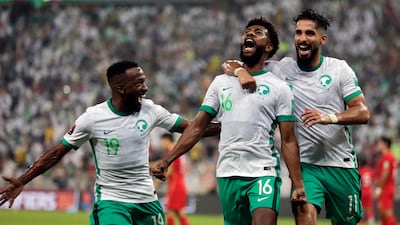
  • Saudi Arabia’s Sami Alnaji is greeted by teammates Saleh Khaled (R) and Fahd Mosaed (L) after scoring in the Asian zone group B qualifying match for the 2020 Fifa World Cup in Qatar. AP Photo
    Saudi Arabia’s Sami Alnaji is greeted by teammates Saleh Khaled (R) and Fahd Mosaed (L) after scoring in the Asian zone group B qualifying match for the 2020 Fifa World Cup in Qatar. AP Photo
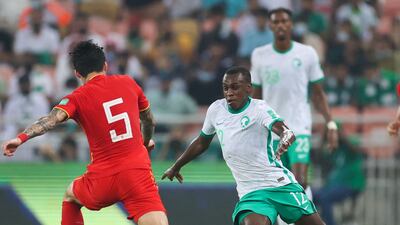
  • Saud Abdulhamid (R) is challenged by China defender Zhang Linpeng as he brings the ball out from the back to start an attack. AFP
    Saud Abdulhamid (R) is challenged by China defender Zhang Linpeng as he brings the ball out from the back to start an attack. AFP
  • Chinese forward Wu Lei (C) finds the going tough in Jeddah. AFP
    Chinese forward Wu Lei (C) finds the going tough in Jeddah. AFP
  • Ali Mabkhout scores a crucial equaliser for the UAE against Iraq in the World Cup qualifier at Zabeel Stadium, Dubai. Chris Whiteoak / The National
    Ali Mabkhout scores a crucial equaliser for the UAE against Iraq in the World Cup qualifier at Zabeel Stadium, Dubai. Chris Whiteoak / The National
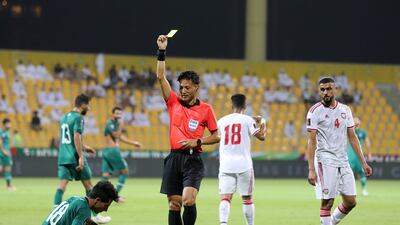
  • An Iraq player is booked for simulation in the 2-2 draw. Chris Whiteoak / The National
    An Iraq player is booked for simulation in the 2-2 draw. Chris Whiteoak / The National
  • I can't watch ... it's all too much for this Iraq fan at the Zabeel Stadium. Chris Whiteoak / The National
    I can't watch ... it's all too much for this Iraq fan at the Zabeel Stadium. Chris Whiteoak / The National
  • Fabio De Lima of the UAE takes on Mohammed Ali Abboud. Chris Whiteoak / The National
    Fabio De Lima of the UAE takes on Mohammed Ali Abboud. Chris Whiteoak / The National
  • Iran's Mehdi Taremi shoots in the World Cup qualifier against South Korea at Azadi Stadium, Tehran. AP Photo
    Iran's Mehdi Taremi shoots in the World Cup qualifier against South Korea at Azadi Stadium, Tehran. AP Photo
  • Iran midfielder Alireza Jahanbakhsh (L) is marked by South Korea's Moon Seon-min. AFP
    Iran midfielder Alireza Jahanbakhsh (L) is marked by South Korea's Moon Seon-min. AFP
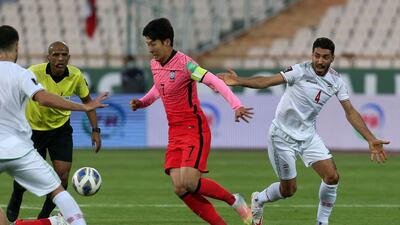
  • South Korea's inspirational forward Son Heung-min shows close control in Tehran. Son went on to score the opening goal in the 1-1 draw. AFP
    South Korea's inspirational forward Son Heung-min shows close control in Tehran. Son went on to score the opening goal in the 1-1 draw. AFP

One of Mr Infantino’s first big projects at Fifa was adding 16 nations to the World Cup for a 48-team competition from 2026, when Africa will have nine entries instead of five. Europe will have 16.

“In Europe, there is no need for additional possibilities and events,” he said at the 47-nation Council of Europe, which promotes human rights, democracy and the rule of law.

Football must not effectively tell the world to hand over its money and best players “but watch us on TV", Mr Infantino said.

“We have to make it truly global, we have to make it truly inclusive, such as the values that have built Europe and we are bringing as well all over the world.”

Hours later, Fifa issued a statement from its president in which he said “certain remarks” made in Strasbourg “appear to have been misinterpreted and taken out of context".

Mr Infantino said his speech’s “more general message was that everyone in a decision-making position has a responsibility to help improve the situation of people around the world".

It added to uncertainty about Fifa’s push for biennial World Cups, which stalled before an online meeting of its members in December where a vote had once been expected but was not called.

Mr Infantino also acknowledged in his speech that “maybe the World Cup every two years is not the answer".

Leaders of Uefa and South American football body Conmebol have threatened to boycott biennial World Cups.

They said more World Cups could disrupt the balance between national and club football and damage continental competitions such as the Champions League, European Championship and Copa America.

Star players such as Kylian Mbappe, a 2018 World Cup winner with France, have said doubling the number of World Cups would dilute its prestige and overload them in an already congested fixture schedule.

The International Olympic Committee has also publicly criticised Fifa’s plan, which could put the World Cup in direct competition with the Summer Games by 2032.

The IOC rallied other sports to challenge Mr Infantino in December over football’s plan to acquire more space and commercial income in the global schedule.


Tamkeen's offering
  • Option 1: 70% in year 1, 50% in year 2, 30% in year 3
  • Option 2: 50% across three years
  • Option 3: 30% across five years 
The specs

Engine: 2-litre 4-cylinder and 3.6-litre 6-cylinder

Power: 220 and 280 horsepower

Torque: 350 and 360Nm

Transmission: eight-speed automatic

Price: from Dh136,521 VAT and Dh166,464 VAT 

On sale: now

Global state-owned investor ranking by size

1.

United States

2.

China

3.

UAE

4.

Japan

5

Norway

6.

Canada

7.

Singapore

8.

Australia

9.

Saudi Arabia

10.

South Korea

Mercer, the investment consulting arm of US services company Marsh & McLennan, expects its wealth division to at least double its assets under management (AUM) in the Middle East as wealth in the region continues to grow despite economic headwinds, a company official said.

Mercer Wealth, which globally has $160 billion in AUM, plans to boost its AUM in the region to $2-$3bn in the next 2-3 years from the present $1bn, said Yasir AbuShaban, a Dubai-based principal with Mercer Wealth.

Within the next two to three years, we are looking at reaching $2 to $3 billion as a conservative estimate and we do see an opportunity to do so,” said Mr AbuShaban.

Mercer does not directly make investments, but allocates clients’ money they have discretion to, to professional asset managers. They also provide advice to clients.

“We have buying power. We can negotiate on their (client’s) behalf with asset managers to provide them lower fees than they otherwise would have to get on their own,” he added.

Mercer Wealth’s clients include sovereign wealth funds, family offices, and insurance companies among others.

From its office in Dubai, Mercer also looks after Africa, India and Turkey, where they also see opportunity for growth.

Wealth creation in Middle East and Africa (MEA) grew 8.5 per cent to $8.1 trillion last year from $7.5tn in 2015, higher than last year’s global average of 6 per cent and the second-highest growth in a region after Asia-Pacific which grew 9.9 per cent, according to consultancy Boston Consulting Group (BCG). In the region, where wealth grew just 1.9 per cent in 2015 compared with 2014, a pickup in oil prices has helped in wealth generation.

BCG is forecasting MEA wealth will rise to $12tn by 2021, growing at an annual average of 8 per cent.

Drivers of wealth generation in the region will be split evenly between new wealth creation and growth of performance of existing assets, according to BCG.

Another general trend in the region is clients’ looking for a comprehensive approach to investing, according to Mr AbuShaban.

“Institutional investors or some of the families are seeing a slowdown in the available capital they have to invest and in that sense they are looking at optimizing the way they manage their portfolios and making sure they are not investing haphazardly and different parts of their investment are working together,” said Mr AbuShaban.

Some clients also have a higher appetite for risk, given the low interest-rate environment that does not provide enough yield for some institutional investors. These clients are keen to invest in illiquid assets, such as private equity and infrastructure.

“What we have seen is a desire for higher returns in what has been a low-return environment specifically in various fixed income or bonds,” he said.

“In this environment, we have seen a de facto increase in the risk that clients are taking in things like illiquid investments, private equity investments, infrastructure and private debt, those kind of investments were higher illiquidity results in incrementally higher returns.”

The Abu Dhabi Investment Authority, one of the largest sovereign wealth funds, said in its 2016 report that has gradually increased its exposure in direct private equity and private credit transactions, mainly in Asian markets and especially in China and India. The authority’s private equity department focused on structured equities owing to “their defensive characteristics.”

The biog

Name: Sari Al Zubaidi

Occupation: co-founder of Cafe di Rosati

Age: 42

Marital status: single

Favourite drink: drip coffee V60

Favourite destination: Bali, Indonesia 

Favourite book: 100 Years of Solitude 

Updated: January 27, 2022, 12:12 AM