

Spring 1953, a popular mambo song with characteristic jazzy Cuban rhythms blared out across Manila.
Railing against widespread corruption, the song Magsaysay Mambo called on Filipinos to vote for the young defence secretary, Ramon Magsaysay.
The candidate was known for campaigning in impoverished areas avoided by his rivals, his love of dancing and having led a campaign against Communist insurgents known as the Hukbalahap — the Huk rebellion.
But Magsaysay Mambo may not be the kind of clever, grass roots campaign gimmick that helped propel Magsaysay to a landslide win.
Instead, The National can tell the story of how CIA officer Edward Lansdale — described by former CIA director William Colby as “one of the greatest spies in history” — may well have written the catchy pop song.
-
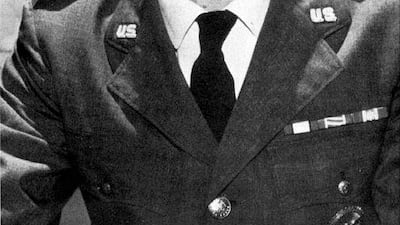
Edward Geary Lansdale, who died in 1987, was a US Air Force officer who served in the Office of Strategic Services and the Central Intelligence Agency. Getty -
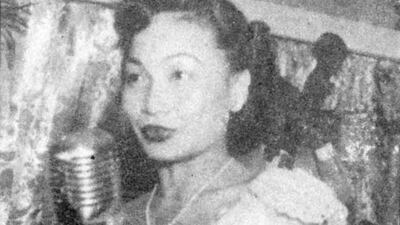
Rosita de La Vega sings at a Manila nightclub, circa 1953. Photo: Weekend Magazine -

The lyrics to the song 'Mambo Magsaysay'. Photo: Hoover Institution Library & Archives -
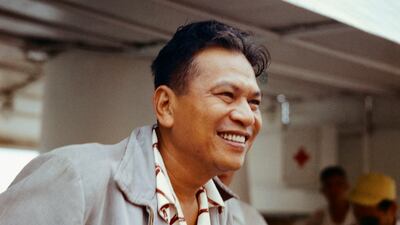
Ramon Magsaysay, president of the Phillipines from 1953 to 1957. Getty Images -

Huk guerrilla leader and founder of the Communist struggle in the Philippines, Luis Taruc, in 1950 disproves government claims of his demise by posing with a newspaper dated July 1. He is surrounded by members of his guerrilla band. AFP -
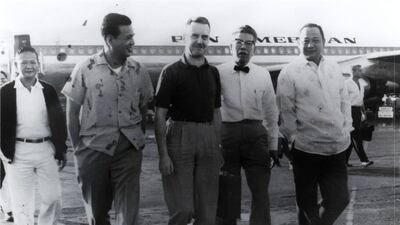
Photographed at Manila International Airport in December 1960 are, from left: Dario Arellano, Manny Manahan, Edward Lansdale, Johnny Orendain and Oscar Arellano. Photo: Muir S. Fairchild Research Information Centre, Maxwell Air Force Base -
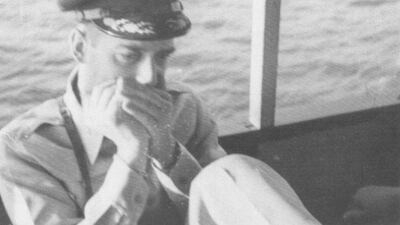
Mr Lansdale plays the harmonica while on deployment. Photo: American Folklife Centre, Library of Congress, Washington, DC. -
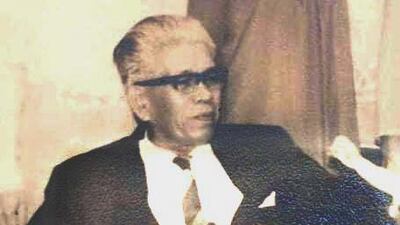
Johnny Orendain, a lawyer turned key ally of the CIA in Manila as the US sought to defeat the Communists. Victor Besa


In an attempt to help America win the Cold War, he may inadvertently have started a now long-running political tradition.
Political pop songs are a staple in Philippine elections. Two candidates for the election in May this year, Manny Pacquiao and Vice President Leni Robredo, have each released original pop campaign songs.
Pacquiao, for example, announced his entry into the political arena as his boxing career ended with the ballad One Pacquiao for the Nation, (which was played at the end of his campaign announcement).
They follow a tradition of scores of original compositions, from Arsenio H Lacson’s Lacson Mambo in 1959 to dictator Ferdinand Marcos’s March of the New Society — the last political jingle until the return of democracy in 1987.
That year, jingles returned, with senator Leticia Ramos Shahani commissioning her own song for the new democratic era.
But Mambo Magsaysay was a milestone.
The candidate’s soundtrack was played at rallies in the barrios on community PA systems, Time magazine recalled.
And the reporter recalled clearly how — like the CIA — Magsaysay saw the Soviet Union as a threat, recalling the candidate telling him: “If I lose, the Philippines becomes a banana republic beholden to the communists.”
The song was timely — that year, Tito Puente, a Puerto Rican mambo singer, played in Manila during a postwar Latin jazz craze that swept the nation.
Magsaysay Mambo was also perhaps one of the smarter US moves in the much, much broader “Cultural Cold War”, a soft-power fight for influence between the US and the Soviet Union that included funding concerts, albums, art shows, events, books, films and newspapers.
Lansdale himself in fact outlined helping write the song and how he planned to distribute it ahead of the vote in his now declassified cables, today stored at the Hoover Institution archives in Stanford, California.
Lansdale's apparent involvement in writing the song briefly appears in Max Boot's excellent biography of the spy, The Road Not Taken.
Cables show that the master records were pressed in the US and then smuggled by the CIA into the Philippines to be mass-produced and distributed, rather than attempting to smuggle in thousands of copies.
The National has seen documents that show how the CIA hedged its bets on the soon-to-be hit single, distributing not one but two songs for Magsaysay.
Officially, the mambo hit was written by Raul Manglapus, campaign manager for Magsaysay and future foreign minister, who moonlighted as a jazz pianist.
“I called it the Magsaysay Mambo and it was very popular,” he told The New York Times in 1974.
Manglapus later claimed to have had “jam sessions with Prince Norodom Sihanouk of Cambodia and King Aduldet Phumiphol of Thailand” — both “excellent saxophonists".
Interviewed in 1986, Rosita de la Vega, a nightclub singer who performed the hit, said it was arranged by Angel Pena, a well-known pianist on the Manila jazz scene.
Pena, who died in 2014, seems to have had some political contacts, performing jazz for the king of Thailand at the Thai embassy in Manila in 1963.

The National contacted a relative of Pena, but she could not remember him discussing details of his early career.
And a lengthy 1986 interview with De La Vega in the Filipino Weekend Magazine makes no mention of Lansdale.
Publicly, there is no mention of Lansdale having a hand in writing the song. Nor could anyone The National spoke to alive today confirm the CIA spy's claim to have written the lyrics.
So, what actually happened?
Music as a weapon
“There are two master records, one for the Magsaysay March, the other for the Magsaysay Mambo,” the now-declassified CIA cable from Lansdale to his handlers says.
“These are to be sent to a recording company in the United States in order that a ‘STAMPER’ be made out of them.”
A stamper is a negative impression of the master disc for mass production.
The cable goes on to say that the record's master disc can be reproduced by “any recording company” in the Philippines.
The documents represent a subtle hedging of bets on public taste — the second song, the forgotten Magsaysay March, appears pompous in comparison with the hit, with stilted lyrics about wanting the “bell of liberty”.
Mambo Magsaysay proved simply to be the better song and survived the ages, being revived as a protest anthem during the 1986 pro-democracy uprisings — ironically against the US-backed dictator Marcos.

The cable also shines more light on the Cultural Cold War typically associated with covert CIA action in postwar Europe between the early 1950s and the late 1960s, mainly accomplished through the Congress for Cultural Freedom (CCF).
CFF was a network of artists, writers and musicians in 35 countries, the vast majority of whom had no idea they were working for a CIA influence operation to counter the cultural appeal of socialism.
Many unwittingly contributed to CIA-funded concerts, art exhibitions — including abstract expressionist exhibitions at the Museum of Modern Art in New York — and literary magazines — including Paris Review in the US and France, Encounter in the UK and Quest in India.
Some of the art and literature world’s biggest names were unwitting contributors, including Gabriel Garcia Marquez, who wrote a piece for the CCF-funded Mundo Nuevo magazine. Jazz legend Louis Armstrong benefited from covert US government-backed music tours, with painters Jackson Pollock and Mark Rothko among others who exhibited at CIA-funded shows.
“The agency also funded high American culture, including international performances by the Boston Symphony, via fake foundations and front organisations. They wanted to give the lie to communist propaganda that the US lacked high artistic traditions,” says Hugh Wilford, author of The Mighty Wurlitzer: How the CIA Played America.
So, could a CIA agent like Lansdale really have been involved without it coming out?
“They probably would have used some commercial firm to distribute Magsaysay Mambo, which they would have dealt with via intermediaries — rather like they produced a movie in this period, the cartoon version of Orwell’s Animal Farm, using an independent production company,” Prof Wilford says.
CCF was less active in the Philippines than in Europe, sponsoring a quarterly magazine, Comment, which was edited by celebrated author Francisco Sionil Jose. A related front organisation, Committee for a Free Asia, established a long-range radio transmitter in Manila for Radio Free Asia to broadcast propaganda into China, countering a similar Russian broadcast effort in Asia.
“This was not just a clash of two nuclear weapon states, it was also a clash of cultures, of two systems that were trying to map out the future for everybody, and offer images and ideas of a better future for everybody, be that a capitalist democratic future or some kind of communist collectivist future,” says Giles Scott Smith, a lecturer in diplomatic history at Leiden University in the Netherlands.
“So, if you think of the Cold War in those terms, as a battle of ideas, then the whole cultural realm, from popular culture — movies, right through to things like cartoons — and then high culture, including theatre, art, literature, all of that was brought into this, this extensive, global-wide battle of ideas,” he says.
That puts the spotlight on Lansdale, an almost mythical figure in the CIA’s history. But he doesn’t appear, at least publicly, to have worked with CCF and instead appears to have acted on his own instincts.
Who was Edward Lansdale?
A former PR copywriter, Lansdale’s military career began with the CIA's forerunner, the Office of Strategic Services.
He later smuggled arms to anti-communist groups in North Vietnam concealed in coffins, spread folklore myths in the hills of the Philippines — prodding government troops to put “vampire bite” wounds on a dead communist Huk fighter — and helped to fund publications to discredit America’s enemies.
His reputation led him to play a key role in Operation Mongoose, a plot to overthrow Cuba's Fidel Castro, although he later said he felt the operation was a fool’s errand.
To Joan Orendain, however, Lansdale was just Uncle Ed.
Ms Orendain, now 82, is the daughter of Lansdale’s colleague Johnny Orendain, a lawyer turned key ally of the CIA in Manila as the US sought to defeat the communists.
Orendain, who worked with Lansdale from the start of his intelligence posting in Manila in 1945, went on to work with Lansdale in South Vietnam, pioneering what would become known as “hearts and minds” — winning over the people through political warfare and social influence operations by establishing things such as health clinics, a project known as Operation Brotherhood.
A lawyer and amateur historian, Ms Orendain believes Lansdale could have written the words to Magsaysay Mambo.
“I don’t really know who composed the lyrics, but Manglapus could very well have done so,” she says. “It’s quite possible that both Manglapus and Uncle Ed composed the lyrics jointly.”
“The giveaway may be the rhyme 'our democracy will die, kung wala si [without] Magsaysay', which sounds like something Uncle Ed would write,” she says, referencing his gift for words.
She recalls Lansdale’s musical streak.
“Uncle Ed always carried a harmonica with him — a professional one, which he whipped out of his pocket as the spirit moved him. He loved singing, and taught us our favourite songs Buffalo Gals Won’t You Come Out Tonight, Red River Valley, Where Have You Been Billy Boy. He absolutely loved to sing.”
“On provincial sorties, he would bring out his harmonica and make people sing local folk songs in Tagalog while he played on his harmonica,” she says.
Lansdale was known for his common touch, and was considered by some as an Asian equivalent to TE Lawrence.
He soon positioned himself to influence media perceptions on the campaign trail, having helped Magsaysay defeat the Huk rebels while organising a PR campaign for the young candidate.
Both men’s success was helped by the fact that the incumbent, Elpidio Quirino, was beset by health problems and was widely seen as having won the previous election by distributing fake ballots.
That was a point the Magsaysay Mambo authors didn’t miss, as the song contains the lyrics, “the birds, they voted in Lanao”, a province of Mindanao where voter fraud was thought to be rife in the 1949 election.
Washington was less than impressed by the fact that Quirino allowed a rebellion by the Huks — marginalised, impoverished farmers who had turned to communism to gain the upper hand in a seven-year war.
US diplomatic cables from the time describe Huk motivations as pushing back against exploitation by powerful landlords. Stories of civilians being tortured by the army were commonplace.
Washington decided that Quirino was a lost cause as Magsaysay distinguished himself by advocating an approach focused on social and political reforms to address the Huks' grievances.
But information operations were key.
“Ed worked with a printing press and its offices in the heart of town which Johnny occupied during the Magsaysay campaign, to publish the daily Free Philippines, a tabloid-sized daily eight-page, put together specifically for the campaign,” Ms Orendain says.
“They’d write articles slamming the government, exposing corruption. You know, the president bought a bed for 5,000 pesos, that kind of thing,” she says, describing Quirino as notoriously corrupt.
“Every opportunity was taken. Ed never missed a beat to further their message,” she says.
Jazz ambassadors
Orendain and Lansdale’s efforts were a spectacular success, gaining Lansdale the nickname “Edward Landslide”, but it would not last: Magsaysay died in a plane crash in 1957.
By that time, Lansdale and Orendain’s efforts in South Vietnam were well under way.
And the CIA's efforts in Manila floundered with the charismatic Magsaysay gone.
Agent Joseph Burkholder Smith recalled in his autobiography, Portrait of a Cold Warrior, how the agency funded a number of candidates in the 1959 election with the brief “find a new Magsaysay”.
One of those candidates was the official Magsaysay Mambo writer, Raul Manglapus.
But the new CIA effort did not stop future US ally Ferdinand Marcos — whom Washington did not yet favour — from securing victory in 1965.
“Manglapus fled the Marcos regime and really suffered, he became politically irrelevant,” Ms Orendain recalls.
But before Manglapus was forced into exile, he told The New York Times he’d had “the pleasure of playing with Duke Ellington a few months before the [Marcos] takeover” in 1972.
In an ironic twist, history had come full circle, for Ellington was playing as part of a US State Department-funded trip to Manila, an element of a US cultural influence operation called “the jazz ambassadors” — the same programme that Louis Armstrong toured with.
That public diplomacy programme was in full swing after the CFF was exposed as a front in 1966, shocking the world.
Manglapus was playing with a US government-funded jazz legend weeks before the Philippines slid into a 14-year dictatorship — which was also backed by the US.
“You know, we've been through a dictatorship that killed thousands of Filipinos and imprisoned thousands more, including my brother, by the way, and Lansdale's godson,” Ms Orendain says.
With elections looming in May this year and a son of Marcos on the ballot, she says she is not sure if foreign powers would still be funding Filipino campaign pop songs.
“I can't think of any candidate who had as catchy a tune as Magsaysay did. Since then, there have been a few, but none of them are memorable.”

