Ethiopia, a founding member of the Confederation of African Football, play in the Cup of Nations for the first time in 31 years. Reuters

Can Afcon 2021 help Ethiopia heal the wounds of civil war?


  • English
  • Arabic

When Ethiopia qualified for the African Cup of Nations (Afcon) in March 2021, its capital, Addis Ababa, exploded with joy.

Droves of flag-waving youths took to the streets in celebration, bringing what would have otherwise been bustling traffic in some areas to a standstill.

Drivers didn’t seem to care as the blaring of their horns filled the air.

“I remember boarding a taxi minibus and getting a ride home free of charge,” recalls Wondimu Temesgen, an Ethiopian football fan.

“A lot of public transportation drivers drove people free of charge that day!”

Our team is composed of players with different backgrounds and truly represents Ethiopia and its nations and nationalities
Ebawak Tesfaye,
sports journalist

The success of the national team, nicknamed the Walias after the mountain goat endemic to northern Ethiopia, was a bright spark in an otherwise dark year.

Once listed as a beacon of stability in the Horn of Africa region and among the fastest-growing economies in Africa, a tragic reversal of fortunes plunged the country into a devastating civil war last year. Tens of thousands have died; famine and displacement have harmed millions more.

In the lead up to the final round of qualifying fixtures, members of Ethiopia’s national team have expressed a desire to not only win their country its first Afcon berth since 2013, but to foster unity in the process.

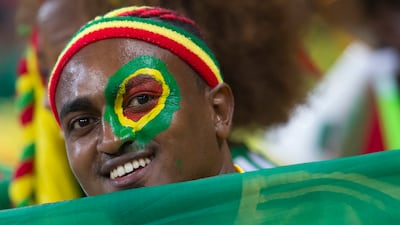
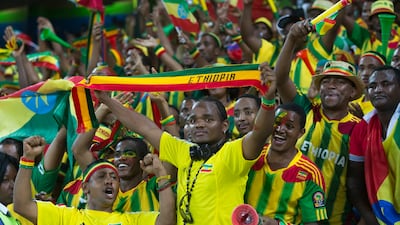
  • An Ethiopia fan enjoys the atmosphere during the 2013 African Cup of Nations match between Burkina Faso and Ethiopia from Mbombela Stadium on January 25, 2013, in Mbombela, formerly called Nelspruit, in South Africa. All photos by Getty
    An Ethiopia fan enjoys the atmosphere during the 2013 African Cup of Nations match between Burkina Faso and Ethiopia from Mbombela Stadium on January 25, 2013, in Mbombela, formerly called Nelspruit, in South Africa. All photos by Getty
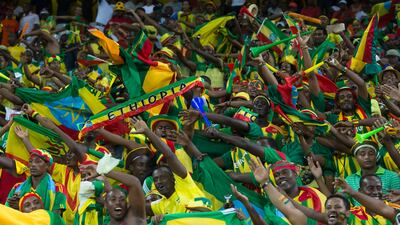
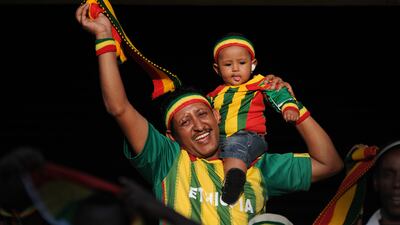
  • Ethiopia fans enjoy the atmosphere during the game.
    Ethiopia fans enjoy the atmosphere during the game.
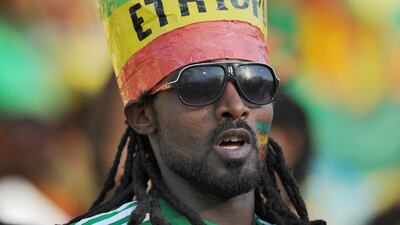
  • An Ethiopia fan.
    An Ethiopia fan.
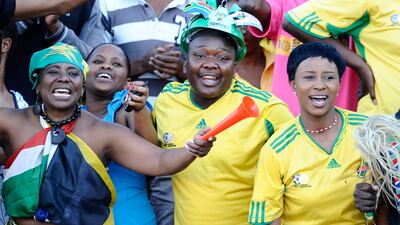
  • Fans during the 2014 Fifa World Cup Qualifier match between South Africa and Ethiopia at Royal Bafokeng Stadium on June 3, 2012, in Rustenburg, South Africa.
    Fans during the 2014 Fifa World Cup Qualifier match between South Africa and Ethiopia at Royal Bafokeng Stadium on June 3, 2012, in Rustenburg, South Africa.
  • Ethiopia fans enjoy the atmosphere during the 2013 African Cup of Nations match between Burkina Faso and Ethiopia at Mbombela Stadium, South Africa.
    Ethiopia fans enjoy the atmosphere during the 2013 African Cup of Nations match between Burkina Faso and Ethiopia at Mbombela Stadium, South Africa.
  • Ethiopia fans wearing the team’s colours celebrate during the 2013 African Cup of Nations Group C match between Ethiopia and Nigeria at Royal Bafokeng Stadium, Rustenburg, South Africa.
    Ethiopia fans wearing the team’s colours celebrate during the 2013 African Cup of Nations Group C match between Ethiopia and Nigeria at Royal Bafokeng Stadium, Rustenburg, South Africa.
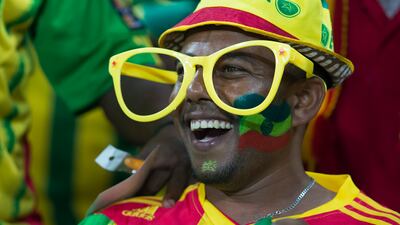
  • An Ethiopia fan in a distinctive hat watches his team’s 2013 African Cup of Nations Group C match against Nigeria, in Rustenburg, South Africa.
    An Ethiopia fan in a distinctive hat watches his team’s 2013 African Cup of Nations Group C match against Nigeria, in Rustenburg, South Africa.

As the Walias prepare to face Cape Verde in the first round of the competition on Sunday, those calls for unity may not have reached Ethiopia’s northern Tigray region. Tigray is home to about 5 per cent of Ethiopia’s 115 million-strong population, as well as the Tigray People’s Liberation Front, which governs the region and has been at war with federal government forces since November 2020.

War in Tigray leaks out of restive region

Years of worsening tension between Addis Ababa and the TPLF eventually gave way to violence when Tigray forces launched late-night ambushes against federal army bases on November 3. Ethiopian Prime Minister Abiy Ahmed responded by declaring all-out war, deploying the full might of the Ethiopian army, backed by soldiers from allied neighbouring Eritrea.

As territory changed hands repeatedly during a year of conflict, Ethiopian and Eritrean soldiers were accused of ethnic cleansing, weaponised rape and civilian massacres. Tigrayans taking new territory were also accused of killing indiscriminately and looting.

Eventually, rebuffed by a strong Ethiopian recruitment drive and an arsenal of newly purchased drones, Tigrayan forces withdrew to their frontier, resulting in the current bloody stalemate.

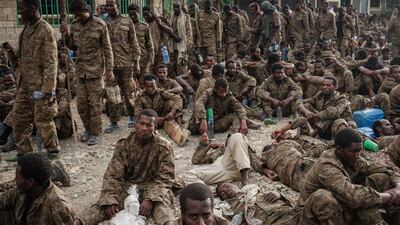
  • Captive Ethiopian soldiers arrive at the Mekele Rehabilitation Centre in Tigray, Ethiopia, after a four-day journey from Abdi Eshir. All photos: AFP
    Captive Ethiopian soldiers arrive at the Mekele Rehabilitation Centre in Tigray, Ethiopia, after a four-day journey from Abdi Eshir. All photos: AFP
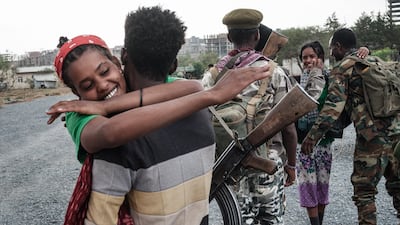
  • Women welcome Tigray People's Liberation Front fighters as they return to Mekele after seizing control of the city in June 2021.
    Women welcome Tigray People's Liberation Front fighters as they return to Mekele after seizing control of the city in June 2021.
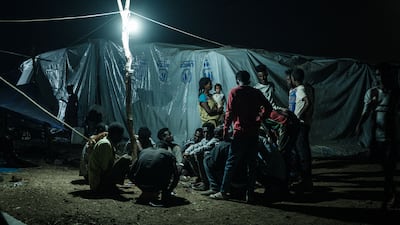
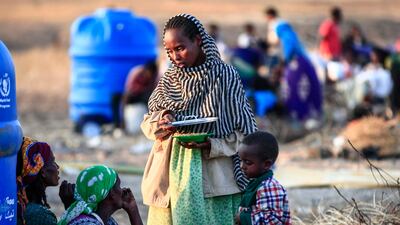
  • Ethiopians who fled the Tigray conflict wait to charge their phones at Um Raquba refugee camp in Gedaref, Sudan.
    Ethiopians who fled the Tigray conflict wait to charge their phones at Um Raquba refugee camp in Gedaref, Sudan.
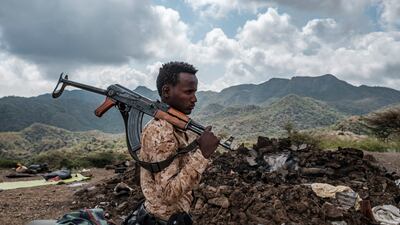
  • A member of the Afar Special Forces stands in front of the debris of a house on the outskirts of the village of Bisober in Tigray.
    A member of the Afar Special Forces stands in front of the debris of a house on the outskirts of the village of Bisober in Tigray.
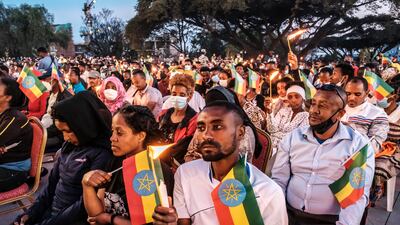
  • People hold candles and Ethiopian flags at a memorial service for the victims of the Tigray conflict in Addis Ababa.
    People hold candles and Ethiopian flags at a memorial service for the victims of the Tigray conflict in Addis Ababa.
  • An Ethiopian refugee who fled fighting in Tigray waits behind a fence in a camp in Sudan.
    An Ethiopian refugee who fled fighting in Tigray waits behind a fence in a camp in Sudan.
  • Refugees living in a camp in Sudan after fleeing violence in Tigray.
    Refugees living in a camp in Sudan after fleeing violence in Tigray.
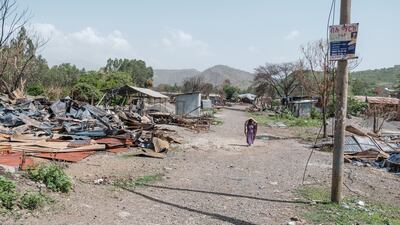
  • A woman walks among the remains of a destroyed factory in Ataye, Ethiopia, where more than 100 civilians died in a recent flare-up of violence.
    A woman walks among the remains of a destroyed factory in Ataye, Ethiopia, where more than 100 civilians died in a recent flare-up of violence.
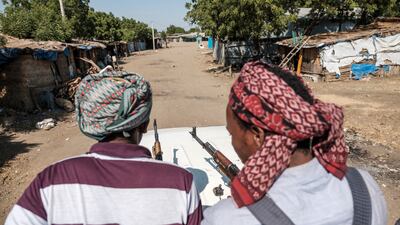
  • Two members of the Amhara militia ride in the back of a pick-up truck. Amharas and Tigrayans were uneasy neighbours before the current fighting, with tension over land sparking violent clashes.
    Two members of the Amhara militia ride in the back of a pick-up truck. Amharas and Tigrayans were uneasy neighbours before the current fighting, with tension over land sparking violent clashes.
  • Militias from the Amhara region have been involved in the fighting in Tigray.
    Militias from the Amhara region have been involved in the fighting in Tigray.
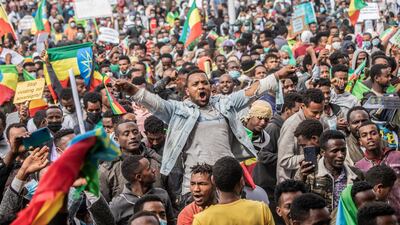
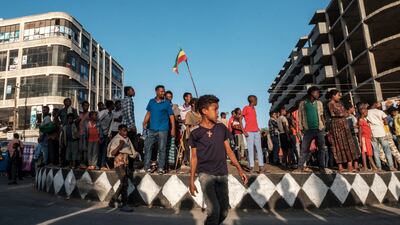
  • Tens of thousands of Ethiopians gather at a rally organised by the mayor of Addis Ababa to show support for the military's efforts in Tigray.
    Tens of thousands of Ethiopians gather at a rally organised by the mayor of Addis Ababa to show support for the military's efforts in Tigray.
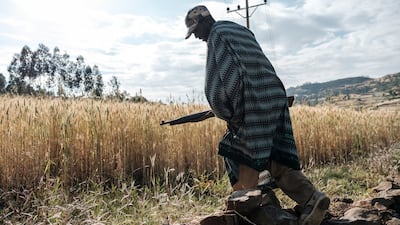
  • Zeleke Alabachew, farmer and militia fighter, tends to his land near the village of Tekeldengy, Ethiopia, Africa's second most populous nation.
    Zeleke Alabachew, farmer and militia fighter, tends to his land near the village of Tekeldengy, Ethiopia, Africa's second most populous nation.
  • People celebrate the liberation of opposition leaders in the city of Alamata, Ethiopia.
    People celebrate the liberation of opposition leaders in the city of Alamata, Ethiopia.
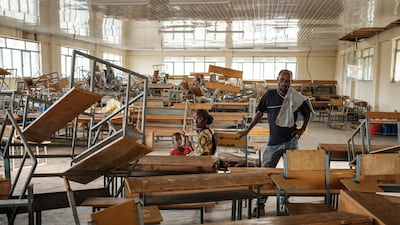
  • A family fleeing violence sit in a former classroom at May Weyni secondary school, now hosting 10,500 displaced people, in Mekele, capital of Tigray.
    A family fleeing violence sit in a former classroom at May Weyni secondary school, now hosting 10,500 displaced people, in Mekele, capital of Tigray.
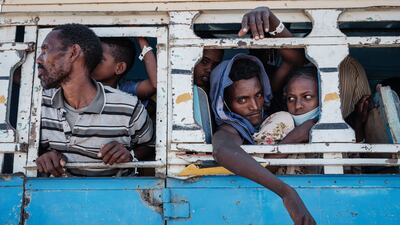
  • Ethiopian refugees travel to Sudan to escape violence in Tigray.
    Ethiopian refugees travel to Sudan to escape violence in Tigray.
  • Ethiopian refugees gather to celebrate the 46th anniversary of the Tigray People's Liberation Front at Um Raquba refugee camp in Gedaref, Sudan. The TPLF dominated Ethiopian politics before being ousted from their regional stronghold last year.
    Ethiopian refugees gather to celebrate the 46th anniversary of the Tigray People's Liberation Front at Um Raquba refugee camp in Gedaref, Sudan. The TPLF dominated Ethiopian politics before being ousted from their regional stronghold last year.
  • An Ethiopian refugee sets up a tent in a camp in the town of Gedaref, Sudan, after being transported from the border reception centre.
    An Ethiopian refugee sets up a tent in a camp in the town of Gedaref, Sudan, after being transported from the border reception centre.
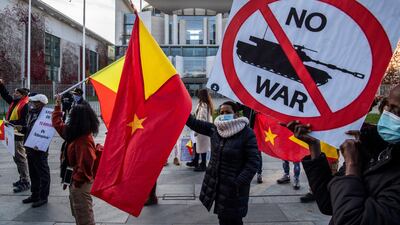
  • Pro-Tigrayan demonstrators display placards during a protest in front of the chancellery in Berlin.
    Pro-Tigrayan demonstrators display placards during a protest in front of the chancellery in Berlin.
  • The aftermath of heavy shelling in Wukro, a city north of Mekele, in Ethiopia.
    The aftermath of heavy shelling in Wukro, a city north of Mekele, in Ethiopia.

In Tigray, a federal government-enacted blockade has left millions without food and hospitals running out of medicine. The war has effectively torn the social fabric that had bound Tigrayans to the rest of Ethiopia. For Tigrayans who are increasingly contemplating separation from Ethiopia, the footballers’ exploits mean little.

“I don’t think there is a single Tigrayan who cares about sport right now, let alone the national team,” said 32-year-old Abraha, an ethnic Tigrayan who lives in Amsterdam.

Abraha, who asked to be identified only by his first name, says he was formerly a fan of the Walias, and recalls with bitter fondness now, memories of the last time Ethiopia qualified for Africa’s most prestigious sporting competition. On that day in October 2012, Ethiopia defeated Sudan 2-0 at Addis Ababa stadium, a result that led the Walias to a major international tournament for the first time since 1982.

Abraha was in Axum, Tigray, at the time.

“I watched the game on television with friends and neighbours. When the game ended, we ran into the streets where so many were already out with their faces painted in green, yellow and red colours,” he said.

“I know several who were celebrating that day who died in the massacre.”

He was referring to the killing of hundreds of men and boys in Axum by Eritrean soldiers in late 2020.

“They don’t see us as Ethiopians anyway. I won’t watch the games.”

Ethiopia’s successful qualification for the 2013 Afcon was a mini footballing renaissance of sorts and the team nearly qualified for the 2014 World Cup.

In the years that followed, new stadiums were built in an effort to maintain the momentum.

Ethiopia coach Wubetu Abate is hoping for success at Afcon 2021. Reuters

One of them was the Woldia stadium. About 500 kilometres north of Addis Ababa, it was built at a cost of $22 million and was largely paid for by Ethiopian-Saudi billionaire and Woldia native Mohammed Al Amoudi to cater to the city’s growing football potential.

Woldia was recently freed from rebel control after Tigrayan troops withdrew, ending their six-month stint in control of the town. Residents spoke to The National of shortages of food, water and electricity as the rebels looted homes and businesses, murdering those who stood in their way.

Images of the looted Woldia stadium’s café and recreation centre have made the rounds on social media. The surrounding area was heavily shelled by TPLF forces when they entered the town in August.

Mobile internet and phone services were only recently restored to the town. When asked about Ethiopia’s prospects of putting on a good showing at the Afcon, one resident broke into ironic laughter.

“There’s no power here. How would we be able to watch the games?” the young man said. “Soldiers were delivering water door to door just last week. We need our basic needs met.”

First to arrive at Afcon 2021

The Walias were the first team to set up camp in Cameroon, buoyed by a desire to provide some respite for their fans and facing no pressure to perform.

Headed to the tournament as minnows, the second-lowest-ranked side will mark their eight-year wait to return to major international football by a baptism of fire, including a January 13 match with host nation Cameroon.

At least one member of the country’s sports press corps hopes the team will inspire others with more than their feted short passing game.

“Our team is composed of players with different backgrounds and truly represents Ethiopia and its nations and nationalities,” sportswriter Ebawak Tesfaye told The National.

“During this period of turmoil and chaos, they are a symbol of unity. I am personally excited to see this team back where it belongs.”

Ethiopia will seek to emulate Iraq’s Asia Cup winning team of 2007, Libya’s African Nations Championship winning side of 2014 and, more recently, the Yemeni team that clinched the U-15 West Asian title last month, as war-torn countries that tasted footballing glory.


Who's who in Yemen conflict

Houthis: Iran-backed rebels who occupy Sanaa and run unrecognised government

Yemeni government: Exiled government in Aden led by eight-member Presidential Leadership Council

Southern Transitional Council: Faction in Yemeni government that seeks autonomy for the south

Habrish 'rebels': Tribal-backed forces feuding with STC over control of oil in government territory

The years Ramadan fell in May

1987

1954

1921

1888

Classification of skills

A worker is categorised as skilled by the MOHRE based on nine levels given in the International Standard Classification of Occupations (ISCO) issued by the International Labour Organisation. 

A skilled worker would be someone at a professional level (levels 1 – 5) which includes managers, professionals, technicians and associate professionals, clerical support workers, and service and sales workers.

The worker must also have an attested educational certificate higher than secondary or an equivalent certification, and earn a monthly salary of at least Dh4,000. 

Our legal consultant

Name: Dr Hassan Mohsen Elhais

Position: legal consultant with Al Rowaad Advocates and Legal Consultants.

The President's Cake

Director: Hasan Hadi

Starring: Baneen Ahmad Nayyef, Waheed Thabet Khreibat, Sajad Mohamad Qasem 

Rating: 4/5

10 tips for entry-level job seekers
  • Have an up-to-date, professional LinkedIn profile. If you don’t have a LinkedIn account, set one up today. Avoid poor-quality profile pictures with distracting backgrounds. Include a professional summary and begin to grow your network.
  • Keep track of the job trends in your sector through the news. Apply for job alerts at your dream organisations and the types of jobs you want – LinkedIn uses AI to share similar relevant jobs based on your selections.
  • Double check that you’ve highlighted relevant skills on your resume and LinkedIn profile.
  • For most entry-level jobs, your resume will first be filtered by an applicant tracking system for keywords. Look closely at the description of the job you are applying for and mirror the language as much as possible (while being honest and accurate about your skills and experience).
  • Keep your CV professional and in a simple format – make sure you tailor your cover letter and application to the company and role.
  • Go online and look for details on job specifications for your target position. Make a list of skills required and set yourself some learning goals to tick off all the necessary skills one by one.
  • Don’t be afraid to reach outside your immediate friends and family to other acquaintances and let them know you are looking for new opportunities.
  • Make sure you’ve set your LinkedIn profile to signal that you are “open to opportunities”. Also be sure to use LinkedIn to search for people who are still actively hiring by searching for those that have the headline “I’m hiring” or “We’re hiring” in their profile.
  • Prepare for online interviews using mock interview tools. Even before landing interviews, it can be useful to start practising.
  • Be professional and patient. Always be professional with whoever you are interacting with throughout your search process, this will be remembered. You need to be patient, dedicated and not give up on your search. Candidates need to make sure they are following up appropriately for roles they have applied.

Arda Atalay, head of Mena private sector at LinkedIn Talent Solutions, Rudy Bier, managing partner of Kinetic Business Solutions and Ben Kinerman Daltrey, co-founder of KinFitz

Types of bank fraud

1) Phishing

Fraudsters send an unsolicited email that appears to be from a financial institution or online retailer. The hoax email requests that you provide sensitive information, often by clicking on to a link leading to a fake website.

2) Smishing

The SMS equivalent of phishing. Fraudsters falsify the telephone number through “text spoofing,” so that it appears to be a genuine text from the bank.

3) Vishing

The telephone equivalent of phishing and smishing. Fraudsters may pose as bank staff, police or government officials. They may persuade the consumer to transfer money or divulge personal information.

4) SIM swap

Fraudsters duplicate the SIM of your mobile number without your knowledge or authorisation, allowing them to conduct financial transactions with your bank.

5) Identity theft

Someone illegally obtains your confidential information, through various ways, such as theft of your wallet, bank and utility bill statements, computer intrusion and social networks.

6) Prize scams

Fraudsters claiming to be authorised representatives from well-known organisations (such as Etisalat, du, Dubai Shopping Festival, Expo2020, Lulu Hypermarket etc) contact victims to tell them they have won a cash prize and request them to share confidential banking details to transfer the prize money.

Turkish Ladies

Various artists, Sony Music Turkey 

INDIA SQUAD

Virat Kohli (capt), Rohit Sharma, Shikhar Dhawan, KL Rahul, Vijay Shankar, MS Dhoni (wk), Kedar Jadhav, Dinesh Karthik, Yuzvendra Chahal, Kuldeep Yadav, Bhuvneshwar Kumar, Jasprit Bumrah, Hardik Pandya, Ravindra Jadeja, Mohammed Shami

Other acts on the Jazz Garden bill

Sharrie Williams
The American singer is hugely respected in blues circles due to her passionate vocals and songwriting. Born and raised in Michigan, Williams began recording and touring as a teenage gospel singer. Her career took off with the blues band The Wiseguys. Such was the acclaim of their live shows that they toured throughout Europe and in Africa. As a solo artist, Williams has also collaborated with the likes of the late Dizzy Gillespie, Van Morrison and Mavis Staples.
Lin Rountree
An accomplished smooth jazz artist who blends his chilled approach with R‘n’B. Trained at the Duke Ellington School of the Arts in Washington, DC, Rountree formed his own band in 2004. He has also recorded with the likes of Kem, Dwele and Conya Doss. He comes to Dubai on the back of his new single Pass The Groove, from his forthcoming 2018 album Stronger Still, which may follow his five previous solo albums in cracking the top 10 of the US jazz charts.
Anita Williams
Dubai-based singer Anita Williams will open the night with a set of covers and swing, jazz and blues standards that made her an in-demand singer across the emirate. The Irish singer has been performing in Dubai since 2008 at venues such as MusicHall and Voda Bar. Her Jazz Garden appearance is career highlight as she will use the event to perform the original song Big Blue Eyes, the single from her debut solo album, due for release soon.

Fitness problems in men's tennis

Andy Murray - hip

Novak Djokovic - elbow

Roger Federer - back

Stan Wawrinka - knee

Kei Nishikori - wrist

Marin Cilic - adductor

UK’s AI plan
  • AI ambassadors such as MIT economist Simon Johnson, Monzo cofounder Tom Blomfield and Google DeepMind’s Raia Hadsell
  • £10bn AI growth zone in South Wales to create 5,000 jobs
  • £100m of government support for startups building AI hardware products
  • £250m to train new AI models

The Case For Trump

By Victor Davis Hanson
 

Who is Mohammed Al Halbousi?

The new speaker of Iraq’s parliament Mohammed Al Halbousi is the youngest person ever to serve in the role.

The 37-year-old was born in Al Garmah in Anbar and studied civil engineering in Baghdad before going into business. His development company Al Hadeed undertook reconstruction contracts rebuilding parts of Fallujah’s infrastructure.

He entered parliament in 2014 and served as a member of the human rights and finance committees until 2017. In August last year he was appointed governor of Anbar, a role in which he has struggled to secure funding to provide services in the war-damaged province and to secure the withdrawal of Shia militias. He relinquished the post when he was sworn in as a member of parliament on September 3.

He is a member of the Al Hal Sunni-based political party and the Sunni-led Coalition of Iraqi Forces, which is Iraq’s largest Sunni alliance with 37 seats from the May 12 election.

He maintains good relations with former Prime Minister Nouri Al Maliki’s State of Law Coaliton, Hadi Al Amiri’s Badr Organisation and Iranian officials.

W.
Wael Kfoury
(Rotana)

Match info

UAE v Bolivia, Friday, 6.25pm, Maktoum bin Rashid Stadium, Dubai

THE%20HOLDOVERS
%3Cp%3E%3Cstrong%3EDirector%3A%20%3C%2Fstrong%3EAlexander%20Payne%3C%2Fp%3E%0A%3Cp%3E%3Cstrong%3EStarring%3A%3C%2Fstrong%3E%20Paul%20Giamatti%2C%20Da'Vine%20Joy%20Randolph%2C%20Dominic%20Sessa%3C%2Fp%3E%0A%3Cp%3E%3Cstrong%3ERating%3A%3C%2Fstrong%3E%204.5%2F5%3C%2Fp%3E%0A
FROM%20THE%20ASHES
%3Cp%3EDirector%3A%20Khalid%20Fahad%3C%2Fp%3E%0A%3Cp%3EStarring%3A%20Shaima%20Al%20Tayeb%2C%20Wafa%20Muhamad%2C%20Hamss%20Bandar%3C%2Fp%3E%0A%3Cp%3ERating%3A%203%2F5%3C%2Fp%3E%0A
Nepotism is the name of the game

Salman Khan’s father, Salim Khan, is one of Bollywood’s most legendary screenwriters. Through his partnership with co-writer Javed Akhtar, Salim is credited with having paved the path for the Indian film industry’s blockbuster format in the 1970s. Something his son now rules the roost of. More importantly, the Salim-Javed duo also created the persona of the “angry young man” for Bollywood megastar Amitabh Bachchan in the 1970s, reflecting the angst of the average Indian. In choosing to be the ordinary man’s “hero” as opposed to a thespian in new Bollywood, Salman Khan remains tightly linked to his father’s oeuvre. Thanks dad. 

The specs

Engine: 2x201bhp AC Permanent-magnetic electric

Transmission: n/a

Power: 402bhp

Torque: 659Nm

Price estimate: Dh200,000

On sale: Q3 2022 

Updated: January 10, 2022, 4:39 PM