Live updates: follow the latest news on Covid-19 variant Omicron
The AstraZeneca coronavirus vaccine could be protecting vulnerable people in the UK from deaths as the highly contagious Omicron mutation spreads rapidly, the former chief of the country's vaccine task force said.
Dr Clive Dix said early data showed the durable cellular immunity response produced by the shot could “last for life".
The vaccine, developed with the University of Oxford, was approved last December and vaccines were initially distributed among the older and the most vulnerable in society.
But fears over links to blood clots led some European countries to pause their use of the inoculation.
“We've seen early data that the Oxford jab produces a very durable cellular response and if you've got a durable cellular immunity response then they can last for a long time. It can last for life in some cases,” Dr Dix said.
In December, countries across Europe have been battling a new Covid-19 wave driven by the Omicron variant.
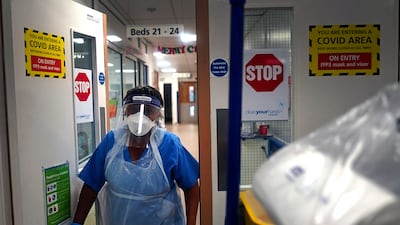
The UK has had a surge in daily cases to record levels but so far there has not been a similar increase in deaths.
Going into the holiday period, France and Germany and the Netherlands were imposing new Covid restrictions. Germany fears Omicron will become the dominant strain by mid-January.
“If you look across Europe, with the rise in cases, there's also a corresponding lagged rise in deaths but not in the UK, and we have to understand that,” Dr Dix said.
“I personally believe that's because most of our vulnerable people were given the AstraZeneca vaccine.”
AstraZeneca has been praised and criticised in the pandemic.
Its coronavirus vaccine was one of the first on the market and at a low cost compared to others.
The introduction of the Oxford-AstraZeneca shot in the UK led government advisers to recommend that under-40s should be offered alternatives after evidence that it may be linked to very rare blood clots.
In Europe, there was more widespread reaction to the clotting.

What is the FNC?
The Federal National Council is one of five federal authorities established by the UAE constitution. It held its first session on December 2, 1972, a year to the day after Federation.
It has 40 members, eight of whom are women. The members represent the UAE population through each of the emirates. Abu Dhabi and Dubai have eight members each, Sharjah and Ras al Khaimah six, and Ajman, Fujairah and Umm Al Quwain have four.
They bring Emirati issues to the council for debate and put those concerns to ministers summoned for questioning.
The FNC’s main functions include passing, amending or rejecting federal draft laws, discussing international treaties and agreements, and offering recommendations on general subjects raised during sessions.
Federal draft laws must first pass through the FNC for recommendations when members can amend the laws to suit the needs of citizens. The draft laws are then forwarded to the Cabinet for consideration and approval.
Since 2006, half of the members have been elected by UAE citizens to serve four-year terms and the other half are appointed by the Ruler’s Courts of the seven emirates.
In the 2015 elections, 78 of the 252 candidates were women. Women also represented 48 per cent of all voters and 67 per cent of the voters were under the age of 40.
In-demand jobs and monthly salaries
- Technology expert in robotics and automation: Dh20,000 to Dh40,000
- Energy engineer: Dh25,000 to Dh30,000
- Production engineer: Dh30,000 to Dh40,000
- Data-driven supply chain management professional: Dh30,000 to Dh50,000
- HR leader: Dh40,000 to Dh60,000
- Engineering leader: Dh30,000 to Dh55,000
- Project manager: Dh55,000 to Dh65,000
- Senior reservoir engineer: Dh40,000 to Dh55,000
- Senior drilling engineer: Dh38,000 to Dh46,000
- Senior process engineer: Dh28,000 to Dh38,000
- Senior maintenance engineer: Dh22,000 to Dh34,000
- Field engineer: Dh6,500 to Dh7,500
- Field supervisor: Dh9,000 to Dh12,000
- Field operator: Dh5,000 to Dh7,000
Timeline
2012-2015
The company offers payments/bribes to win key contracts in the Middle East
May 2017
The UK SFO officially opens investigation into Petrofac’s use of agents, corruption, and potential bribery to secure contracts
September 2021
Petrofac pleads guilty to seven counts of failing to prevent bribery under the UK Bribery Act
October 2021
Court fines Petrofac £77 million for bribery. Former executive receives a two-year suspended sentence
December 2024
Petrofac enters into comprehensive restructuring to strengthen the financial position of the group
May 2025
The High Court of England and Wales approves the company’s restructuring plan
July 2025
The Court of Appeal issues a judgment challenging parts of the restructuring plan
August 2025
Petrofac issues a business update to execute the restructuring and confirms it will appeal the Court of Appeal decision
October 2025
Petrofac loses a major TenneT offshore wind contract worth €13 billion. Holding company files for administration in the UK. Petrofac delisted from the London Stock Exchange
November 2025
180 Petrofac employees laid off in the UAE
Related
TEACHERS' PAY - WHAT YOU NEED TO KNOW
Pay varies significantly depending on the school, its rating and the curriculum. Here's a rough guide as of January 2021:
- top end schools tend to pay Dh16,000-17,000 a month - plus a monthly housing allowance of up to Dh6,000. These tend to be British curriculum schools rated 'outstanding' or 'very good', followed by American schools
- average salary across curriculums and skill levels is about Dh10,000, recruiters say
- it is becoming more common for schools to provide accommodation, sometimes in an apartment block with other teachers, rather than hand teachers a cash housing allowance
- some strong performing schools have cut back on salaries since the pandemic began, sometimes offering Dh16,000 including the housing allowance, which reflects the slump in rental costs, and sheer demand for jobs
- maths and science teachers are most in demand and some schools will pay up to Dh3,000 more than other teachers in recognition of their technical skills
- at the other end of the market, teachers in some Indian schools, where fees are lower and competition among applicants is intense, can be paid as low as Dh3,000 per month
- in Indian schools, it has also become common for teachers to share residential accommodation, living in a block with colleagues
More from Rashmee Roshan Lall
Avatar: Fire and Ash
Director: James Cameron
Starring: Sam Worthington, Sigourney Weaver, Zoe Saldana
Rating: 4.5/5
More Expo 2020 Dubai pavilions:
Lexus LX700h specs
Engine: 3.4-litre twin-turbo V6 plus supplementary electric motor
Power: 464hp at 5,200rpm
Torque: 790Nm from 2,000-3,600rpm
Transmission: 10-speed auto
Fuel consumption: 11.7L/100km
On sale: Now
Price: From Dh590,000
%20Ramez%20Gab%20Min%20El%20Akher
%3Cp%3E%3Cstrong%3ECreator%3A%3C%2Fstrong%3E%20Ramez%20Galal%3C%2Fp%3E%0A%3Cp%3E%3Cstrong%3EStarring%3A%3C%2Fstrong%3E%20Ramez%20Galal%3C%2Fp%3E%0A%3Cp%3E%3Cstrong%3EStreaming%20on%3A%20%3C%2Fstrong%3EMBC%20Shahid%3C%2Fp%3E%0A%3Cp%3E%3Cstrong%3ERating%3A%20%3C%2Fstrong%3E2.5%2F5%3C%2Fp%3E%0A
Global state-owned investor ranking by size
|
1.
|
United States
|
|
2.
|
China
|
|
3.
|
UAE
|
|
4.
|
Japan
|
|
5
|
Norway
|
|
6.
|
Canada
|
|
7.
|
Singapore
|
|
8.
|
Australia
|
|
9.
|
Saudi Arabia
|
|
10.
|
South Korea
|
MATCH SCHEDULE
Uefa Champions League semi-final, first leg
Tuesday, April 24 (10.45pm)
Liverpool v Roma
Wednesday, April 25
Bayern Munich v Real Madrid (10.45pm)
Europa League semi-final, first leg
Thursday, April 26
Arsenal v Atletico Madrid (11.05pm)
Marseille v Salzburg (11.05pm)
More coverage from the Future Forum
THE SPECS
Engine: six-litre W12 twin-turbo
Transmission: eight-speed dual clutch auto
Power: 626bhp
Torque: 900Nm
Price: Dh940,160 (plus VAT)
On sale: Q1 2020
The five stages of early child’s play
From Dubai-based clinical psychologist Daniella Salazar:
1. Solitary Play: This is where Infants and toddlers start to play on their own without seeming to notice the people around them. This is the beginning of play.
2. Onlooker play: This occurs where the toddler enjoys watching other people play. There doesn’t necessarily need to be any effort to begin play. They are learning how to imitate behaviours from others. This type of play may also appear in children who are more shy and introverted.
3. Parallel Play: This generally starts when children begin playing side-by-side without any interaction. Even though they aren’t physically interacting they are paying attention to each other. This is the beginning of the desire to be with other children.
4. Associative Play: At around age four or five, children become more interested in each other than in toys and begin to interact more. In this stage children start asking questions and talking about the different activities they are engaging in. They realise they have similar goals in play such as building a tower or playing with cars.
5. Social Play: In this stage children are starting to socialise more. They begin to share ideas and follow certain rules in a game. They slowly learn the definition of teamwork. They get to engage in basic social skills and interests begin to lead social interactions.
57%20Seconds
%3Cp%3E%3Cstrong%3EDirector%3A%3C%2Fstrong%3E%20Rusty%20Cundieff%0D%3Cbr%3E%3Cstrong%3EStars%3A%20%3C%2Fstrong%3EJosh%20Hutcherson%2C%20Morgan%20Freeman%2C%20Greg%20Germann%2C%20Lovie%20Simone%0D%3Cbr%3E%3Cstrong%3ERating%3A%20%3C%2Fstrong%3E2%2F5%0D%3Cbr%3E%0D%3Cbr%3E%3C%2Fp%3E%0A