


A temperature of 38°C in the Russian town of Verkhoyansk on June 20, 2020, has been recognised as an Arctic record by the World Meteorological Organisation.
The temperature, more befitting the Mediterranean than the Arctic, was measured at a meteorological observing station during an exceptional and prolonged Siberian heatwave.
Average temperatures over Arctic Siberia reached as much as 10°C above normal for much of summer last year, causing devastating fires and massive sea ice loss, and playing a major role in 2020 being one of the three warmest years on record.
“This new Arctic record is one of a series of observations reported to the WMO Archive of Weather and Climate Extremes that sound the alarm bells about our changing climate," said Prof Petteri Taalas, the organisation's Secretary General.
"In 2020, there was also a new temperature record [18.3°C] for the Antarctic continent.
“WMO investigators are currently seeking to verify temperature readings of 54.4°C recorded in both 2020 and 2021 in the world’s hottest place, Death Valley in California, and to validate a new reported European temperature record of 48.8°C in the Italian island of Sicily this summer."
The Arctic is among the fastest-warming regions in the world and is heating at more than twice the global average.
The extreme temperature and climate change prompted a WMO panel of experts to add a new climate category, “highest recorded temperature at or north of 66.5°, the Arctic Circle” to its international archive.
The archive includes the world’s highest and lowest temperatures, rainfall, heaviest hailstone, longest dry period, maximum gust of wind, longest lightning flash and weather-related deaths.
The WMO created a new category that now represents both Polar regions.
Since 2007, it has listed temperature extremes for the Antarctic region, corresponding to the land and ice shelf areas included in the Antarctic Treaty.
Verkhoyansk is about 115 kilometres north of the Arctic Circle and the meteorological station has been observing temperatures since 1885.
It is in the northern part of Republic of Sakha, a region of eastern Siberia that has an extreme harsh dry continental climate, with a very cold winter and hot summer.
“Fundamentally, this investigation highlights the increasing temperatures occurring for a climatically important region of the world," said Prof Randall Cerveny, rapporteur of climate and weather extremes for the WMO.
"Through continued monitoring and assessment of temperature extremes, we can remain knowledgeable about the changes occurring in this critical region of the world, the polar Arctic.
“It highlights the need for sustaining long-term observations, which provide us with benchmarks of the state of the climate system."
The WMO says the extremes presented are "snapshots" of our current climate, and that it is possible that greater extremes will occur in the Arctic region in the future.
The WMO is looking to establish evaluation committees to verify the status of such observations as extremes.
-
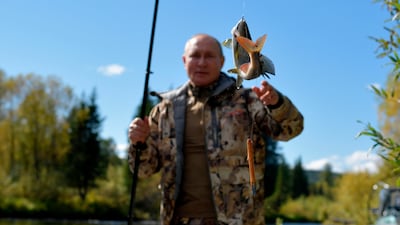
Russian President Vladimir Putin catches his trophy as he fishes at an unknown location in Siberia during his holiday in early September, 2021. AP -

After completing his working trip to Primorye and the Amur Region, Vladimir Putin stopped in Siberia for a few days. AFP -

A collection of Russian President Vladimir Putin's Siberia holiday pictures was released by the Kremlin Press Service via Sputnik on September 26, 2021. AP -
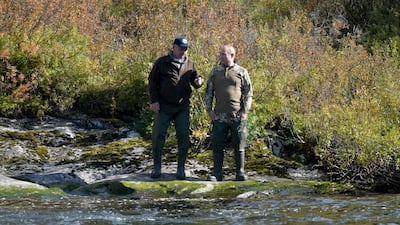
Russian President Vladimir Putin, right, speaks with his Defence Minister Sergei Shoigu in the taiga - In early September 2021, during his Siberia holiday. AFP -

The Kremlin said Russian President Vladimir Putin spent several days hiking and fishing in Siberia in early September. AFP -

Several days after the trip, in the middle of September, Mr Putin announced he was going into self-isolation for 'a few days' after dozens of people in his entourage fell ill with Covid-19. AFP -
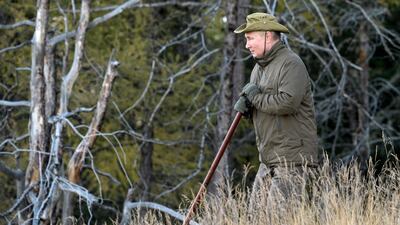
Mr Putin had to cancel his trip to Tajikistan for a security summit as he had to go into isolation following the detection of Covid-19 positive cases in his entourage. AFP -

President Vladimir Putin stops during a walk in the Siberian taiga. AFP -

Mr Putin has cultivated a macho image, appealing to many Russians. AFP -

This is not the first time that Mr Putin has chosen Siberia for a holiday. He last spent a weekend in the snowy taiga in March. AFP


“The record is clearly indicative of warming across Siberia,” said noted UK climatologist and committee member Dr Phil Jones.
Another committee member, Dr Blair Trewin from Australia’s Bureau of Meteorology, said: "Verifying records of this type is important in having a reliable base of evidence as to how our climate's most extreme extremes are changing."
Historical research established from the national records of Arctic countries that there were no known temperatures of 38°C or above at any Arctic locations.
Specifically, after rigorous analysis the committee concluded that no past observations in Canada exceeded that value.
The WMO archive lists the official lowest recorded temperature for areas at or north of the Arctic Circle as minus 69.6°C, recorded on December 22, 1991, at Klinck, Greenland.
It is also the coldest temperature recorded for the Northern Hemisphere.

