

Ethiopian Prime Minister Abiy Ahmed said his soldiers would "destroy" rebels from the northern Tigray region in the latest instalment of state media footage purported to show him at the war front.
"You are comprehensively destroying the enemy. There is no going back without winning," Mr Abiy, winner of the 2019 Nobel Peace Prize, said in a 34-minute clip posted to his office's Twitter page on Saturday.
"We will win, the enemy is dispersing, there are areas we have to control," he said.
"Until we destroy the enemy. There is no rest."
-

A protester waves the Ethiopian flag during a rally against pro-Tigray People's Liberation Front forces in Addis Ababa. All photos: AFP -
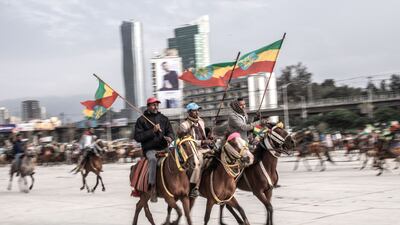
People on horseback wave flags at the rally. -

A drum major of the Republican March Band leads performers during the rally. -
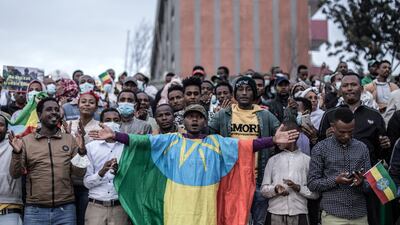
A protester draped in the Ethiopian flag in Addis Ababa. -
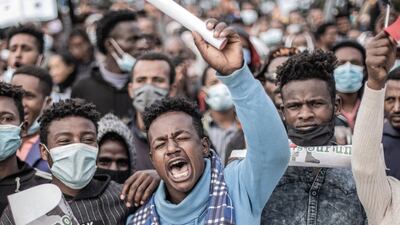
Protesters gather in Ethiopia's capital to rally against pro-TPLF forces. -
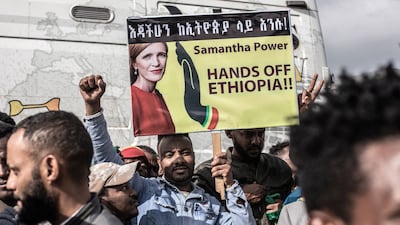
A protester holds a banner depicting the US ambassador to the United Nations, Samantha Power. -
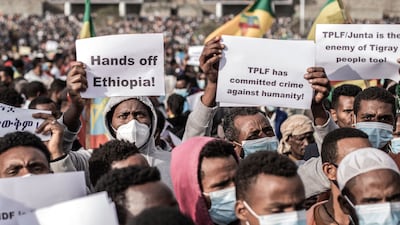
Protesters in Addis Ababa hold signs in support of Ethiopia's armed forces. -
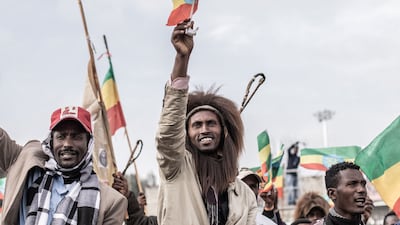
Ethiopian Prime Minister Abiy Ahmed has called for all eligible civilians to join the armed forces. -

Protesters take to the streets as fighting rages in Ethiopia, Africa’s second-most populous nation. -
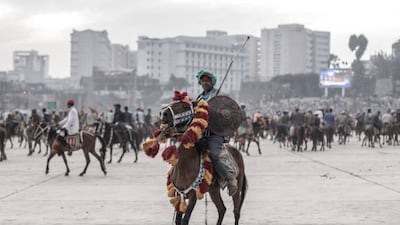
Ethiopia has been wracked by fighting since November, when the prime minister sent troops to topple the TPLF. -
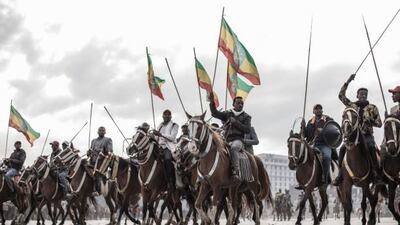
People on horseback wave the Ethiopian national flag during a rally to support armed forces in Addis Ababa.


On Saturday, the US State Department said Secretary of State Antony Blinken was concerned about escalating violence in Ethiopia and called for negotiations to address the crisis there.
Mr Abiy announced last week he would start leading operations against the Tigray People's Liberation Front (TPLF), which once dominated national politics but has been locked in a war with his government for the past year.
The announcement has spurred recruitment in Addis Ababa.
The country's most famous distance runner, Haile Gebreselassie, told AFP he was determined to "sacrifice and stand for Ethiopia".
The TPLF, he said, "is destabilising our country beyond its region".
On Wednesday, state-affiliated media announced that Mr Abiy had delegated regular duties to his deputy.
His decision came after the TPLF reported major territorial gains, claiming to have seized a town 220 kilometres from the capital, Addis Ababa.
The TPLF has aligned itself with other armed groups, including the Oromo Liberation Army, which is active in the Oromia region surrounding the city.
Mr Abiy also said the military had secured control of Kassagita and planned to recapture Chifra district and Burka town in Afar region, which neighbours Tigray, the TPLF's stronghold.
In recent weeks, independent media have largely been denied access to regions where fighting has taken place.
On Saturday, officials in Addis Ababa held a ceremony for athletes and artists heading north to visit troops.
Among those saying they will fight is Feyisa Lilesa, a distance runner and Olympic silver medallist.
The war started in November 2020, when Mr Abiy sent troops into Tigray to topple the TPLF in response, he said, to TPLF attacks on army camps.
Although he promised a swift victory, by late June the TPLF had regrouped and retaken most of Tigray, and it has since pushed into the neighbouring Amhara and Afar regions.
Olusegun Obasanjo, the African Union's special envoy for the Horn of Africa, is leading a diplomatic effort for a ceasefire, but there have been few signs of progress.
International alarm is growing over a possible rebel assault on the capital, with the US, the UK, Germany and Italy all urging their citizens to leave Ethiopia.
France joined the group this week, and on Sunday plans to ferry citizens out on a charter flight.
The Ethiopian government said rebel gains were overstated, blaming what it describes as sensational media coverage and alarmist security advice from embassies for creating panic.
Blinken appeals for peace
On Saturday, US Secretary of State Antony Blinken said he was greatly concerned about the escalation and called for urgent negotiations over the crisis, a US State Department spokesman said.
"Secretary Blinken expressed grave concern about worrying signs of military escalation in Ethiopia and emphasised the need to urgently move to negotiations," Ned Price said in a statement late on Friday.
Mr Price released the statement after a phone call between Kenya's President Uhuru Kenyatta and Mr Blinken.

