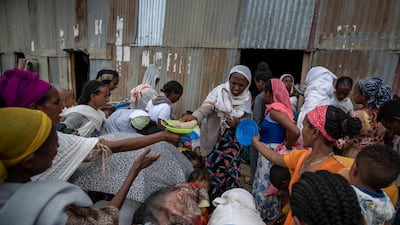
The UN report accuses all forces in the conflict of torturing and killing civilians, and engaging in rape and ethnic targeting. AFP

UN condemns atrocities committed by ‘all sides’ in Tigray conflict


James Reinl
  • English
  • Arabic

As Ethiopia lunges ever closer to an all-out civil war, the UN and local investigators on Wednesday released a joint report accusing all sides fighting in the northern Tigray region of atrocities that may amount to war crimes.

The document, from the UN’s Geneva-based human rights team and the Ethiopian Human Rights Commission, accused all forces in the conflict of torturing and killing civilians, and engaging in rape and ethnic targeting.

It was released one year after Prime Minister Abiy Ahmed sent troops into Tigray to fight separatists there and as the rebels appear poised to advance on the capital Addis Ababa after mounting a stunning reversal of the war in June.

“All parties to the Tigray conflict have committed violations of international human rights, humanitarian and refugee law,” said UN High Commissioner for Human Rights Michelle Bachelet.

“Some of these may amount to war crimes and crimes against humanity.”

The study covers November to June of the year-long conflict which has pitted Tigrayan rebels against the Ethiopian army and its allies — militiamen from the nearby Amhara region and soldiers from neighbouring Eritrea.

Most abuses in that period were committed by Ethiopian and Eritrean forces, but there has been a recent rise in complaints against Tigrayan forces as well, Ms Bachelet said.

Eritrean troops had a “huge responsibility” for many abuses, she added.

Based on 269 interviews, the report revealed multiple accounts of Eritrean soldiers committing acts of mutilation and rape.

In many cases, rape and other forms of sexual violence were used “to degrade and dehumanise the victims”, the report stated.

Researchers said Eritrean soldiers had killed some 100 civilians in Axum and that Ethiopian soldiers had dragged about 70 men from their homes and killed them in three villages in southern Tigray.

They also accused Tigrayan forces of killing some 200 Amhara civilians in the town of Mai Kadra in what may amount to a revenge attack for the slaying of Tigrayans by militia forces from Amhara.

Mr Abiy said he recognised the “important” report but had “serious reservations”. He said it did not accuse the government of genocide or of diverting food aid, and said its findings would be investigated by a civil-military task force.

Eritrea's Information Minister Yemane Meskel, who previously denied any Eritrean involvement in Tigray, said the document was based on a “fallacious narrative on the origins of the conflict” and “cannot be taken seriously”.

Getachew Reda, a spokesman for the Tigray People's Liberation Front (TPLF), said the report had omitted some “heinous crime spots” and accused investigators from the state-backed commission of bias.

Human rights groups, journalists and civil society organisations have documented many more mass killings of civilians that were not mentioned in the document, which does not kick-start a mechanism for prosecuting those behind abuses.

Laetitia Bader, the regional director for Human Rights Watch, said it was “not an exhaustive account” and called for an “independent, international investigative mechanism” that can “preserve evidence and pave the way for genuine accountability”.

The report was released after several days in which TPLF forces, now allied to Oromo Liberation Army (OLA) rebels from another region, made significant territorial gains against Mr Abiy’s government and advanced towards the capital.

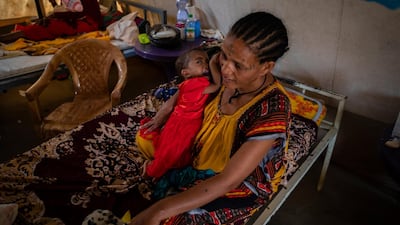
  • Mother Roman Kidanemariam, 35, holds her malnourished daughter, Merkab Ataklti, 22 months old, in the treatment tent of a medical clinic in the town of Abi Adi, in the Tigray region of northern Ethiopia. AP Photo
    Mother Roman Kidanemariam, 35, holds her malnourished daughter, Merkab Ataklti, 22 months old, in the treatment tent of a medical clinic in the town of Abi Adi, in the Tigray region of northern Ethiopia. AP Photo
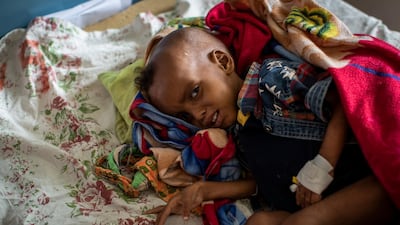
  • Gebre Kidan Gebrehiwet, 2, is treated for malnutrition after fleeing from the town of Abi Adi with his mother, Abeba Tesfay, at the Ayder Referral Hospital in Mekele, in the Tigray region of northern Ethiopia. AP Photo
    Gebre Kidan Gebrehiwet, 2, is treated for malnutrition after fleeing from the town of Abi Adi with his mother, Abeba Tesfay, at the Ayder Referral Hospital in Mekele, in the Tigray region of northern Ethiopia. AP Photo
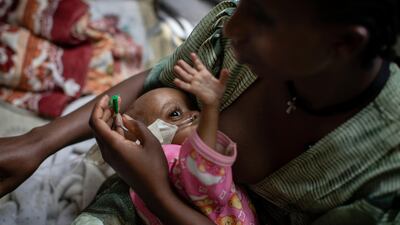
  • Birhan Etsana, 27, from Dengelat, uses a nasogastric tube to feed her malnourished baby, Mebrhit, who at 17 months old weighs just 5.2 kilograms (11 pounds and 7 ounces), at the Ayder Referral Hospital in Mekele, in the Tigray region of northern Ethiopia. AP Photo
    Birhan Etsana, 27, from Dengelat, uses a nasogastric tube to feed her malnourished baby, Mebrhit, who at 17 months old weighs just 5.2 kilograms (11 pounds and 7 ounces), at the Ayder Referral Hospital in Mekele, in the Tigray region of northern Ethiopia. AP Photo
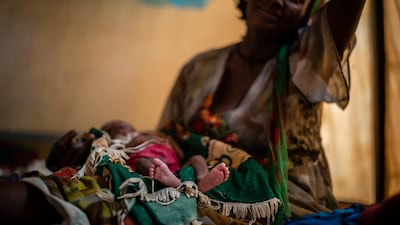
  • Abeba Gebru, 37, from the village of Getskimilesley, sits with her malnourished daughter, Tigsti Mahderekal, 20 days old, in the treatment tent of a medical clinic in the town of Abi Adi, in the Tigray region of northern Ethiopia. AP Photo
    Abeba Gebru, 37, from the village of Getskimilesley, sits with her malnourished daughter, Tigsti Mahderekal, 20 days old, in the treatment tent of a medical clinic in the town of Abi Adi, in the Tigray region of northern Ethiopia. AP Photo
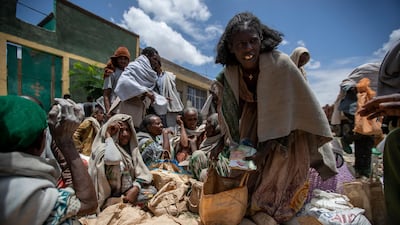
  • An Ethiopian woman scoops up portions of yellow split peas to be allocated to waiting families after it was distributed by the Relief Society of Tigray in the town of Agula, in the Tigray region of northern Ethiopia. AP Photo
    An Ethiopian woman scoops up portions of yellow split peas to be allocated to waiting families after it was distributed by the Relief Society of Tigray in the town of Agula, in the Tigray region of northern Ethiopia. AP Photo
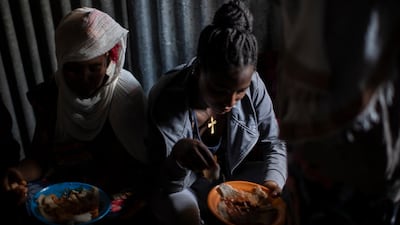
  • Displaced Tigrayan women sit in a metal shack to eat food donated by local residents at a reception center for the internally displaced in Mekele, in the Tigray region of northern Ethiopia. AP Photo
    Displaced Tigrayan women sit in a metal shack to eat food donated by local residents at a reception center for the internally displaced in Mekele, in the Tigray region of northern Ethiopia. AP Photo
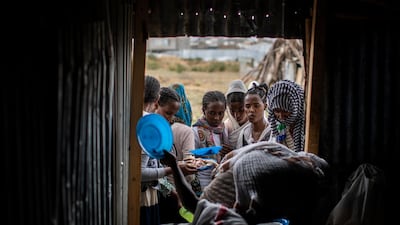
  • A woman stands in line to receive food donations at the Tsehaye primary school, which was turned into a temporary shelter for people displaced by conflict, in the town of Shire, Tigray region. Reuters
    A woman stands in line to receive food donations at the Tsehaye primary school, which was turned into a temporary shelter for people displaced by conflict, in the town of Shire, Tigray region. Reuters
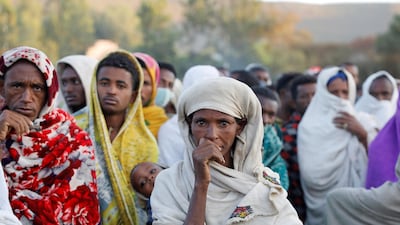
  • Tigrayans stand in line to receive food donated by local residents at a reception center for the internally displaced in Mekele, in the Tigray region of northern Ethiopia. AP Photo
    Tigrayans stand in line to receive food donated by local residents at a reception center for the internally displaced in Mekele, in the Tigray region of northern Ethiopia. AP Photo
  • An Ethiopian woman leaves with a portion of yellow split peas after it was distributed by the Relief Society of Tigray in the town of Agula, in the Tigray region of northern Ethiopia. AP Photo
    An Ethiopian woman leaves with a portion of yellow split peas after it was distributed by the Relief Society of Tigray in the town of Agula, in the Tigray region of northern Ethiopia. AP Photo
  • Displaced Tigrayans queue to receive food donated by local residents at a reception center for the internally displaced in Mekele, in the Tigray region of northern Ethiopia. AP Photo
    Displaced Tigrayans queue to receive food donated by local residents at a reception center for the internally displaced in Mekele, in the Tigray region of northern Ethiopia. AP Photo

OLA spokesman Odaa Tarbii said on Wednesday that Addis Ababa could fall within “months if not weeks” and said the overthrow of Mr Abiy's government was a “foregone conclusion”.

His comments came hours after the government declared a state of emergency on Tuesday and urged residents of Addis Ababa to prepare to defend their neighbourhoods and stop Ethiopia from slipping into Syria-style chaos.

Ms Bachelet said the emergency measures “raise very serious concerns".

“The risks are grave that, far from stabilising the situation, these extremely broad measures will deepen divisions, endanger civil society and human rights defenders, provoke greater conflict and only add to the human suffering already at unacceptable levels,” she said.

Mr Abiy sent troops into Tigray a year ago in response to reported TPLF attacks on army camps. The 2019 Nobel Peace Prize winner promised a swift victory, but by late June, the rebels had retaken most of Tigray and pushed into the neighbouring Afar and Amhara regions.


If you go

The flights
Etihad (etihad.com) flies from Abu Dhabi to Luang Prabang via Bangkok, with a return flight from Chiang Rai via Bangkok for about Dh3,000, including taxes. Emirates and Thai Airways cover the same route, also via Bangkok in both directions, from about Dh2,700.
The cruise
The Gypsy by Mekong Kingdoms has two cruising options: a three-night, four-day trip upstream cruise or a two-night, three-day downstream journey, from US$5,940 (Dh21,814), including meals, selected drinks, excursions and transfers.
The hotels
Accommodation is available in Luang Prabang at the Avani, from $290 (Dh1,065) per night, and at Anantara Golden Triangle Elephant Camp and Resort from $1,080 (Dh3,967) per night, including meals, an activity and transfers.

The burning issue

The internal combustion engine is facing a watershed moment – major manufacturer Volvo is to stop producing petroleum-powered vehicles by 2021 and countries in Europe, including the UK, have vowed to ban their sale before 2040. The National takes a look at the story of one of the most successful technologies of the last 100 years and how it has impacted life in the UAE. 

Read part four: an affection for classic cars lives on

Read part three: the age of the electric vehicle begins

Read part two: how climate change drove the race for an alternative 

Who has lived at The Bishops Avenue?
  • George Sainsbury of the supermarket dynasty, sugar magnate William Park Lyle and actress Dame Gracie Fields were residents in the 1930s when the street was only known as ‘Millionaires’ Row’.
  • Then came the international super rich, including the last king of Greece, Constantine II, the Sultan of Brunei and Indian steel magnate Lakshmi Mittal who was at one point ranked the third richest person in the world.
  • Turkish tycoon Halis Torprak sold his mansion for £50m in 2008 after spending just two days there. The House of Saud sold 10 properties on the road in 2013 for almost £80m.
  • Other residents have included Iraqi businessman Nemir Kirdar, singer Ariana Grande, holiday camp impresario Sir Billy Butlin, businessman Asil Nadir, Paul McCartney’s former wife Heather Mills. 
Hunting park to luxury living
  • Land was originally the Bishop of London's hunting park, hence the name
  • The road was laid out in the mid 19th Century, meandering through woodland and farmland
  • Its earliest houses at the turn of the 20th Century were substantial detached properties with extensive grounds


MATCH INFO

Uefa Champions League semi-final, first leg
Bayern Munich v Real Madrid

When: April 25, 10.45pm kick-off (UAE)
Where: Allianz Arena, Munich
Live: BeIN Sports HD
Second leg: May 1, Santiago Bernabeu, Madrid

SCORES IN BRIEF

Lahore Qalandars 186 for 4 in 19.4 overs
(Sohail 100,Phil Salt 37 not out, Bilal Irshad 30, Josh Poysden 2-26)
bt Yorkshire Vikings 184 for 5 in 20 overs
(Jonathan Tattersall 36, Harry Brook 37, Gary Ballance 33, Adam Lyth 32, Shaheen Afridi 2-36).

Moral education needed in a 'rapidly changing world'

Moral education lessons for young people is needed in a rapidly changing world, the head of the programme said.

Alanood Al Kaabi, head of programmes at the Education Affairs Office of the Crown Price Court - Abu Dhabi, said: "The Crown Price Court is fully behind this initiative and have already seen the curriculum succeed in empowering young people and providing them with the necessary tools to succeed in building the future of the nation at all levels.

"Moral education touches on every aspect and subject that children engage in.

"It is not just limited to science or maths but it is involved in all subjects and it is helping children to adapt to integral moral practises.

"The moral education programme has been designed to develop children holistically in a world being rapidly transformed by technology and globalisation."

TOUR DE FRANCE INFO

Dates: July 1-23
Distance: 3,540km
Stages: 21
Number of teams: 22
Number of riders: 198

MATCH INFO

Liverpool v Manchester City, Sunday, 8.30pm UAE

Updated: November 03, 2021, 2:57 PM