

One person was killed and several injured when an earthquake struck the southern Greek island of Crete on Monday morning.
The quake sent people fleeing into the streets, while schools were evacuated. Repeated aftershocks rattled the area and local media reported damage in villages near the epicentre.
Residents in the area surrounding Heraklion, the island’s biggest city and capital, rushed from their houses after the earthquake.
-

A damaged Greek Orthodox church on the southern island of Crete. The Greek island was hit by a strong earthquake on Monday morning. Photo: AP -

Pupils and their teachers in Heraklion gather in a square for safety following the earthquake. Photo: Reuters. -

Residents get out on the street following an earthquake in Heraklion on the island of Crete, Greece. Photo: Reuters -

Residents gathered on the streets following an earthquake in Heraklion on the island of Crete, Greece. Photo: Reuters -

A military lorry passes a damaged Greek Orthodox church in Arkalochori village. Photo: AP -

A strong earthquake with a preliminary magnitude of 5.8 hit Crete on Monday. The authorities say one person was killed and several more were injured. Photo: AP -

Firefighters look for people in the rubble of a demolished church following the earthquake on Crete. Photo: Reuters -
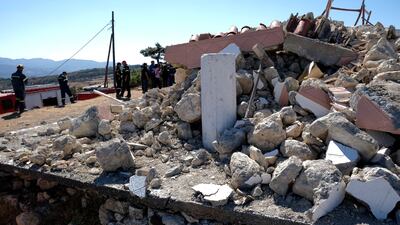
The Greek authorities say one person has been killed and several more have been injured in Monday's earthquake. Photo: AP -
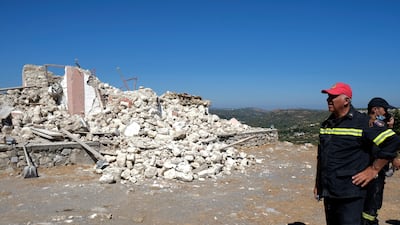
Firefighters stand next to the collapsed Greek Orthodox church of Profitis Ilias in Arkalochori village. Photo: AP -
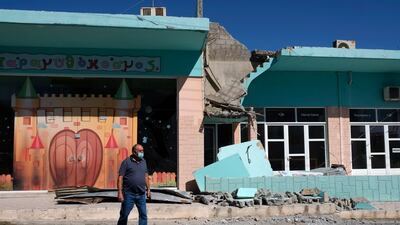
A man stands outside a damaged building after a strong earthquake in Arkalochori village on Crete. Photo: AP -
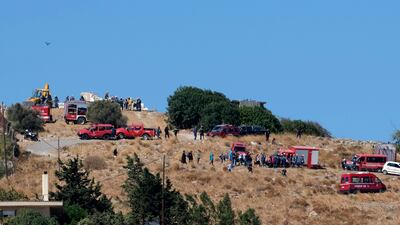
Firefighters get to work after the earthquake in Arkalochori village on the southern island of Crete. Photo: AP


Evangelia Christaki said she and her disabled husband had just enough time to evacuate their house as it shook.
“I grabbed my husband and we rushed out. Everything in the house was falling. Fortunately, our home was not too badly damaged. But the authorities have told us to stay outdoors over the next hours. In any case, we are so scared,” she said.
They were joined outside by her 96-year-old mother-in-law, whose home did collapse.
“The earthquake was strong and was long in duration,” said Heraklion mayor Vassilis Lambrinos. “We have requested that schools are evacuated. The children are out in the playgrounds.”
Greece’s Climate Crisis and Civil Protection Ministry said at least 11 people were injured.
“It's an earthquake that we did not expect. For the moment there are aftershocks of 4.5,” said Efthymis Lekkas, the head of Greece's earthquake protection agency, quoted by the AMNA news agency.
“We are urging people who live in damaged older buildings to remain outdoors. One aftershock can cause a collapse … we are talking about structures built before 1970. Structures built after 1985 are built to a higher standard that can withstand the effect of an earthquake.”
The National Observatory of Athens said the quake struck 346 kilometres south of the Greek capital and at a depth of 10km.
Spiros Georgiou, spokesman for the civil protection agency, said a man was killed in the farming town of Arkalochori when a small church collapsed.
The European-Mediterranean Seismological Centre (EMSC) and the US Geological Survey gave a preliminary magnitude of 6.0, with an epicentre seven kilometres north of the village of Thrapsano.
It is common for different seismological institutes to give varying magnitudes for an earthquake in the initial hours and days after an event.

Civil protection officials said tents were being set up for residents whose homes had been damaged, with capacity for 2,500 people.
Climate Crisis and Civil Protection Minister Christos Stylianides, who has arrived on Crete, said the government would help those who could not spend the night in their homes. Rooms in hotels may be provided.
The fire department said it was flying 30 members of its disaster response units with sniffer dogs and specialised rescue equipment to Crete.
“Those who were trapped have been transported to the hospital and are being treated,” said government spokesman Giannis Oikonomou.

Repeated lower-magnitude tremors followed the initial earthquake, adding to the destruction in villages near the epicentre where the walls of old stone buildings crumbled. The EMSC gave a preliminary magnitude of 4.6 for the strongest one.
Greece lies on a number of fault lines, and is sporadically hit by earthquakes.
The last deadly quake in the country took place on March 3 in the central town of Elassona, killing one person, injuring 10 and causing major damage.
On October 30 last year a magnitude-7.0 quake hit in the Aegean Sea between the Greek island of Samos and the city of Izmir in western Turkey.
Most of the damage was in Turkey where 114 people were killed and more than 1,000 injured.

