
The grounds of Afghanistan’s largest prison, Pul-e-Charkhi, are empty, apart from a few Taliban fighters ambling around.
Many of them, turban-clad, guns now slung over their shoulders, were incarcerated here for killing Afghan security forces or being part of the Taliban. Today they run and secure the prison on the eastern outskirts of Kabul.
They speed down the compound’s gravel roads in green police cars, waving their flags, showing off their weapons.
Previously home to more than 9,000 inmates – according to ICRC figures – distributed between 11 blocks, Pul-e-Charkhi was Afghanistan’s most overcapacity prison, often with more than a dozen people crammed into a small room, its facilities poor and run down.
The prison, which opened in the 1980s, became known as a torture and execution facility. Later, in 2009, the US transferred around 250 detainees there from its Guantanamo Bay detention camp.
But on August 15, footage from Mashal Afghan News – a pro-Taliban broadcaster – emerged, allegedly showing militants surrounding the prison and freeing its inmates, among them ISIS and Al Qaeda fighters. The Taliban guards now manning the jail deny that the group ever freed the prisoners, saying it was the former Afghan government, which “vacated the prison grounds and opened the doors” when the Taliban took control of Kabul.
Several hundred men are still under lock and key, now guarded by the Taliban, but the majority roam free. Some of them have been newly imprisoned for “committing crimes,” the Taliban guards said.
In August 2020, Hekmatullah Hekmat, 25, was part of a prisoner release from Pul-e-Charkhi, initiated by the Afghan government as part of prerequisite to start direct peace negotiations with the Taliban.
-

Qudratullah Nazim, 33, was among them, escaping a death sentence issued by then-president Ashraf Ghani’s government. He says he was - according to the final court order - supposed to be hanged at Pul-e-Charkhi. Stefanie Glinski for The National -
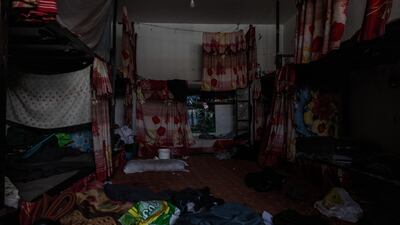
Rooms at the Pul-e-Charkhi prison, where previously up to 14 inmates slept in bunk beds and cushions on the floor. Stefanie Glinski for The National -
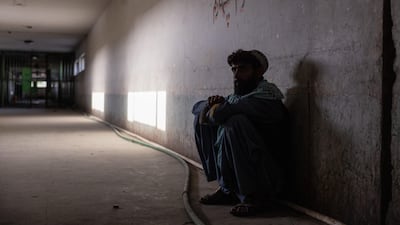
The hallways of the prison are now empty. Stefanie Glinski for The National -
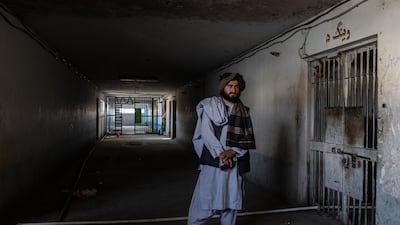
Hekmatullah Hekmat, 25, was part of a prisoner release here, initiated by the Afghan government as part of prerequisite to start direct peace negotiations with the Taliban. He was imprisoned at Pul-e-Charkhi for nearly three years. Stefanie Glinski for The National -
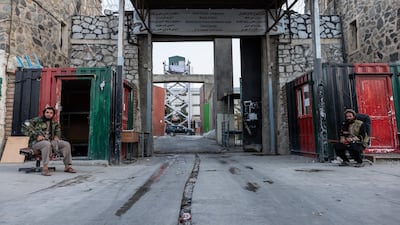
The large gates of the prison remain wide open. Stefanie Glinski for The National -
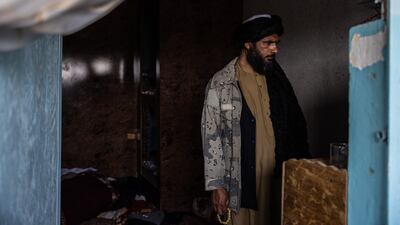
A Taliban fighter inspects an empty room at Pul-e-Charkhi prison. Stefanie Glinski for The National -
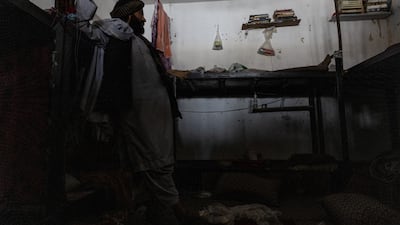
Hekmatullah Hekmat, 25, was part of a prisoner release here, initiated by the Afghan government as part of prerequisite to start direct peace negotiations with the Taliban. He was imprisoned at Pul-e-Charkhi for nearly three years. Stefanie Glinski for The National -

The hallways of the prison are now empty. Stefanie Glinski for The National -
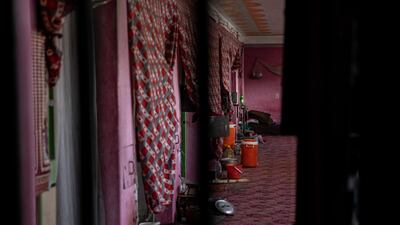
Rooms at the Pul-e-Charkhi prison, where previously up to 14 inmates slept in bunk beds and cushions on the floor. Stefanie Glinski for The National -
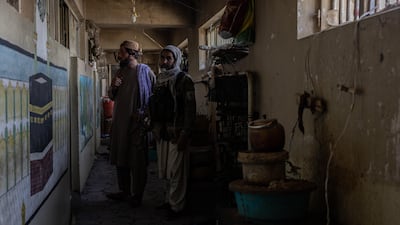
The Kaaba is painted onto the walls of the Pul-e-Charkhi prison. Stefanie Glinski for The National


Back then, each prisoner signed a declaration promising to not join the Taliban again, but Hekmat, who joined the group aged 17 in his native Zabul province, told The National: “I always knew that when I left prison, I would start fighting again."
He added: "They are our enemies,” referring to both the US and former Afghan government, which he calls the “puppet regime”.
“If they come back, we will fight them again. Our country was occupied and I was fighting the foreign forces and their ideology. We are committed to defending our country, religion and people,” he said.
Asked whether he killed people during his previous time as a Taliban fighter, he is circumspect.
“Well, it was war,” he said. “Our friends were also killed, and I was a fighter.”
Walking through the empty, echoing concrete hallways of the large detention centre and into his previous living quarters, Hekmat said that he had been jailed for nearly three years, sharing a room with 13 people. He was captured by the Afghan secret service, the National Directorate of Security’s Zero One Unit, in the northern province of Kunduz.
Lined with bunk beds, each of them divided by thin curtains, as well as the odd bookshelf full of religious literature, the rooms are small and dark – the metal-bar door letting in little sunlight from the hallway’s outside windows. The Kaaba is painted on one of the hallway’s dirty white walls.
When the prison gates opened on August 15, inmates spared no time to pack. Their belongings are still spread all over the rooms’ floors, the leftover food now mouldy, its foul-sweet smell lingering in the stuffy air. Several of the prison shops have been raided, though most belongings seem to have been left behind. Cooking pots are knocked over, tea kettles sit half-empty as people fled in haste.
Qudratullah Nazim, 33, was among them, escaping a death sentence issued by then-president Ashraf Ghani’s government. He said a final court order had been issued for his hanging at Pul-e-Charkhi.
A guerrilla commander operating mostly in Kandahar and Helmand, he had already served more than a decade in prison. Now he walks freely, confidently. He is “happy”, he said, and “proud”.
He claims to have largely been involved in the execution of attacks on foreigners, saying his brother died as a ‘shaheed’, a martyr.
“Of course I killed people,” he told The National, wearing an off-red turban, a camouflage zip-up jacket and tinted glasses.
“The foreigners bombed wedding ceremonies and mosques. They occupied our country,” he said, then claimed the group he is a part of “never did such things”.
Several thousand Taliban fighters were imprisoned at the detention centre, alongside drug addicts, members of ISIS, other criminals and even – in a separate block – women convicted of “moral crimes” such as adultery.
How the jail – with its razor-wired high brick walls and watchtowers – will be used in the future, the guards say they do not know, but Nazim says “people will be punished here too”.
He declines to say what punishment the group could use, but says he hopes that “crimes and corruption [can] be prevented”.
During the Taliban's 1996-2001 regime, the group was known to execute people by public hanging, and stonings were common for “sins” such as adultery.
As evening draws in, some of the Taliban pack up to go home, while others stay to keep watch at night.
Those who leave jump in the back of a pickup police lorry, a Taliban flag attached to its back. They speed through the entrance of the prison, its walls still painted in the colours of the Afghan flag: black, red, green.
The heavy gates of the jail are left wide open.

