

Two years before the swift collapse of the government and army in Afghanistan, Mohammad Fahim Dashty described the protracted talks between the US and the Taliban as self-centred and the “greatest of all mistakes” as they would ultimately give the militants a big momentum to seize more territory.
Many Afghans interpreted Dashty’s words at that time as a bad omen.
On Sunday, Dashty was killed alongside a top commander in the National Resistance Front (NRF) as the hardline Islamist movement made sweeping advances to capture the province of Panjshir, the last pocket of resistance to their rule after 20 years of war. He was 48.
His close friends remember Dashty as one of the most vocal critics of the Taliban and their ideology, which he said was an evil blueprint that could ignite intellectual warfare if it took over Afghanistan.
“In his entire life, he remained a flag-bearer for free speech. He opposed the Taliban because of their radical views and it’s one of the reasons he joined the resistance,” one close friend, who used to work with Dashty at the Massoud Foundation, told The National from the Pakistani capital Islamabad.
He requested anonymity because he still has family members in Panjshir, which the Taliban claim fell to them on Monday, three weeks after they swept into Kabul.
The Massoud Foundation is a non-profit organisation established in Kabul in 2002. It provides services in different areas such as culture, health, training and education, and assistance to children and families of Afghan soldiers killed in the war against the Taliban.
It is named after Ahmad Shah Massoud, who was a senior commander in the resistance against the Soviet occupation between 1979 and 1989, earning the nickname “Lion of Panjshir".
Panjshir has been lauded for holding out against attack, both in the Soviet era and during the Taliban's last rule.
Dashty was born on December 12, 1972, in Panjshir.
He grew up in a family of political activism and resistance against the Soviets, which was a constant topic in his childhood. His uncle is Abdullah Abdullah, Afghanistan's former foreign minister and a key challenger to former presidents Hamid Karzai and Ashraf Ghani in the 2009 and 2014 elections.
There are scant details about his personal life, but a distant relative and a friend in Kabul told The National that “his whole family, including his three children and brothers, are still in Panjshir.”
“There are internet connectivity issues in Panjshir and they don't want to talk to the press due to threats to their lives,” he said.
Dashty studied at the faculty of Law and Political Sciences at Kabul University. Regarded by many of his friends as smart, eloquent and smooth-talking, Dashty saw the downfall of Taliban after the US-led invasion as an opportune time to pursue his dream of having a free press and protecting human rights in a new Afghanistan.
He set up a newspaper in Kabul and became known for supporting journalists, later becoming the leader of the Afghanistan National Journalist Union (ANJU).
-

An Afghan policeman keeps watch during a ceremony to hand over security control in the rugged mountains of the Panjshir valley. AFP -
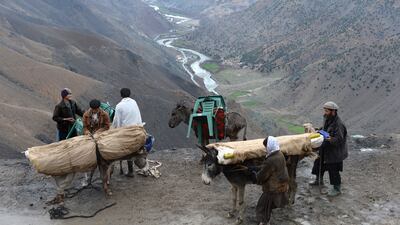
Donkeys are loaded with goods in the Panjshir valley. AFP -
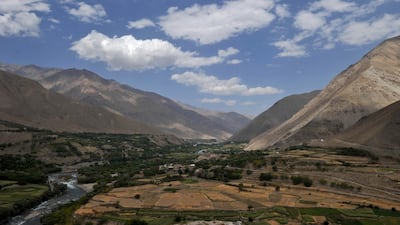
A general view of the valley as seen from Ahmad Shah Massoud's grave. The warlord was nicknamed the Lion of Panjshir for his exploits in resisting Soviet forces. AP Photos -

Panjshir is surrounded by mountains and is hard to reach. Reuters -
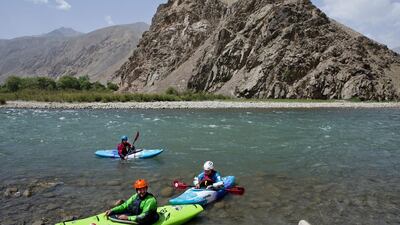
Foreign tourists kayak along the Panjshir River, north of the Afghan capital, Kabul. They are unlikely to be in Afghanistan now. AP Photos -

Abandoned Soviet artillery in Panjshir, left behind after the occupation from 1979 to 1989 and the subsequent fallout. Reuters -
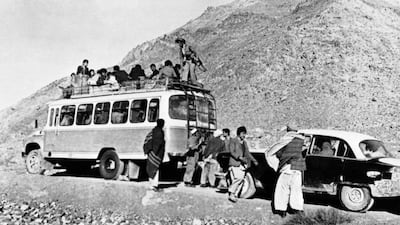
Afghan insurgents search for pro-Soviet regime and party officials among bus passengers in the Panjshir valley, the scene of fierce fighting in January 1981. AP Photo -
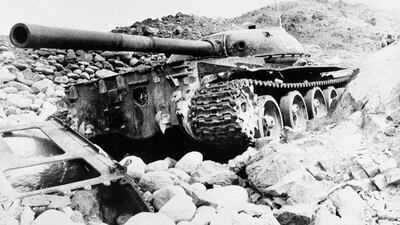
This 1981 picture by an Iranian freelance photographer shows a Russian T-62 Commando tank destroyed in Panjshir valley. Afghan Mujahideen rebels said it was hit by a mine. AP Photo


The journalist turned resistance fighter
Dashty considered Ahmad Shah Massoud as a mentor and inspirational leader. He accompanied him to many of his meetings as a press adviser, including the fatal interview by fake reporters, who assassinated Massoud by setting off a bomb hidden in their filming equipment.
“After Ahmad Massoud, the son of Ahmad Shah Massoud, graduated from King’s College London, Dashty called him and asked if he had a plan for Afghanistan. Dashty wanted to work with the son as he greatly admired the father for the future of the country,” said the close friend.
Dashty was also known for his outspoken comments about US policy in his country and its Special Envoy for Afghanistan, Zalmay Khalilzad, accusing him of corruption and being a weak negotiator with the Taliban.
“He was cynical about Khalilzad,” recalls the close friend. “He never minced his words when talking about him and the Taliban, which he usually described as a terrorist rebel force that should have been disarmed as a precondition for negotiations.”

Dashty quickly gained the trust of Ahmed Massoud, who appointed him as his chief of staff. And a few days before his killing, he was appointed as spokesman for the NRF.
In one of his last media interviews, the spirit of resistance was defiantly alive.
“If we all are killed in the resistance, this is a winning situation for us. The history will write about us, that there are people who stood for their nation to the end,” he said.

