

Britain and the US on Friday sanctioned seven Russian officials on the anniversary of the near-fatal poisoning of jailed Kremlin critic Alexei Navalny, which the West blames on Moscow.
Separately, Washington blacklisted two unnamed Russians and a vessel for their involvement with the Nord Stream 2 pipeline.
The people named in the joint sanctions are all members of Russia's domestic security service, the FSB, the successor to the KGB, and have been accused of planning or carrying out the August 20, 2020, nerve agent attack on Mr Navalny.
They now face asset freezes and travel bans under the second round of reprisals by Britain for the poisoning, after measures were taken against six people and one entity in October 2020.
The US and EU also imposed a round of their own sanctions in March.
Western intelligence agencies have assessed with “high confidence” that FSB officers poisoned Mr Navalny with the nerve agent Novichok last year.
The dissident was flown to Germany for treatment but defiantly returned in January, only to be arrested and sent to a penal colony.
British Foreign Secretary Dominic Raab said the latest sanctions were “sending a clear message that any use of chemical weapons by the Russian state violates international law".
He reiterated western calls for a “transparent criminal investigation” into the poisoning.
“We urge Russia to declare its full stock of Novichok nerve agents,” Mr Raab added, saying there should be no impunity for the use of chemical weapons.
-

Russian opposition leader Alexei Navalny, with his wife Yulia, daughter Daria and son Zakhar. AP, file -
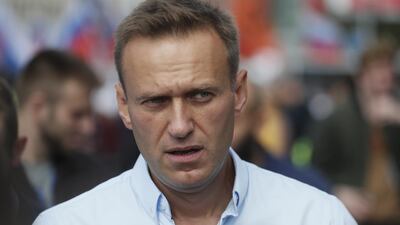
Russian Opposition activist Alexei Navalny attends a rally in support of opposition candidates in the Moscow City Duma elections in downtown of Moscow. EPA, file -
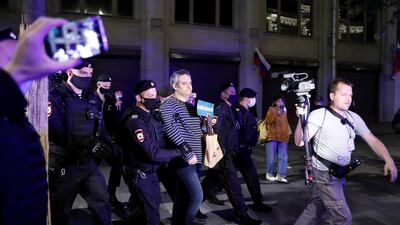
Police officers detain a man during a single-person demonstration in support of Russian opposition leader Alexei Navalny near the presidential administration headquarters in central Moscow. Reuters -
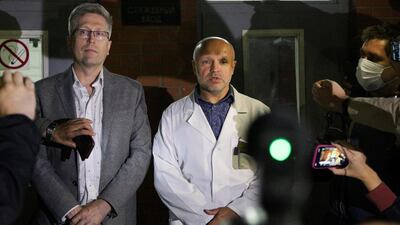
Anatoly Kalinichenko, deputy chief doctor of the Omsk Ambulance Hospital No. 1, right, and Boris Teplykh, head of the department of anaesthesiology and resuscitation of the Pirogov's medical centre, speak to the media at the intensive care unit where Alexei Navalny was hospitalised. AP -
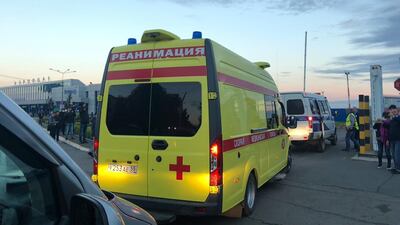
An ambulance carrying Alexei Navalny from the Omsk Ambulance Hospital No. 1, intensive care unit to the airport. Alexei Navalny's press team via AP -
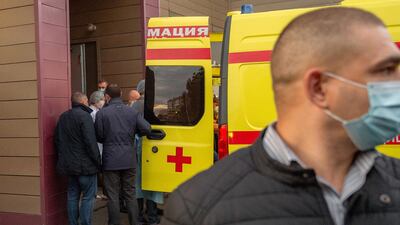
Russian medics put opposition politician Alexei Navalny into an ambulance to transport him from an emergency care hospital to an airport. EPA -

Medics upload Alexei Navalny into a German special medical plane at an airport in Omsk. Alexei Navalny's press team via AP -
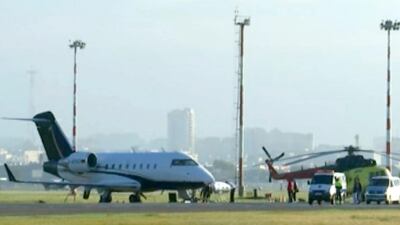
Russian opposition leader Alexei Navalny, centre on stretcher, is transported to a German special medical plane at an airport in Omsk. AP -
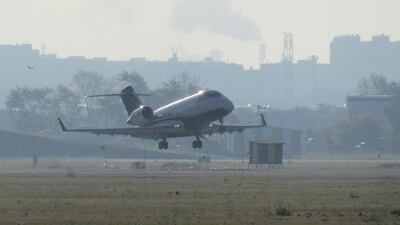
An ambulance aircraft evacuating Russian opposition leader Alexei Navalny for medical treatment in a German hospital takes off. Reuters


Andrea Gacki, director of the US Office of Foreign Assets Control, said that, “Navalny's poisoning was a shocking violation of international norms against the use of chemical weapons and was part of an ongoing campaign to silence voices of dissent in Russia".
The latest additions to the British and American sanctions list include reported FSB operatives Alexey Alexandrov, Vladimir Panyaev and Ivan Vladimirovich Osipov.
The trans-Atlantic allies claim the trio where all present in the Russian city Tomsk when Mr Navalny was poisoned there and were “key figures” in the attempted assassination.
Meanwhile, four other high-ranking officials — including a general, a major general and a colonel in the FSB — were also hit with sanctions.
The US gave few details on those sanctioned for their involvement with the Nord Stream 2 pipeline, which carries gas from Russia to Germany. In a statement, Secretary of State Antony Blinken said the moves represents Washington's “continuing opposition to the Nord Stream 2".
Last month, the US agreed to support a deal with Germany to warn Russia of potential sanctions and support Ukraine's energy sector financially to settle the dispute over the conduit.
The new sanctions further erode ties between Moscow and the West following Russia's annexation of Crimea in 2014, which led to a host of sanctions being imposed.
London's relations with Moscow have been in decline since the 2006 radiation poisoning death in the British capital of former spy Alexander Litvinenko.
He blamed Mr Putin for his death in a posthumous message.
Relations worsened after the 2018 attempted murder of former double agent Sergei Skripal and his daughter in the English city of Salisbury, using Novichok.
That prompted tit-for-tat expulsions of diplomats from both capitals.
Russia hit out at western capitals following the last round of punitive measures announced in March, warning its foes “not to play with fire".

