

Labour's early October annual conference passed in a blur of unity over the October 7 Hamas attack, but in the days since, an exodus of members has gathered pace as the Israel-Gaza war moves to the centre of UK politics, placing the party's leadership under unexpected political pressure.
Saj Ali, councillor for Blackburn and Darwen, was among the first to abandon Labour over Sir Keir Starmer's focus on Israel's right to defend itself. He told The National that he'd quit "within minutes" after a Zoom call with Angela Rayner and 20-odd councillors, who asked her if the party was going to call for a ceasefire.
"We were so annoyed at the way we were spoken to," he said, "there's real tension in the grassroots and constituents all want a ceasefire."
What was a snowball thrown at the leadership then is becoming something of an avalanche among Muslim members of the opposition party.
Late last week two council leaders, Afrasiab Anwar from Burnley and Asjad Mahmood from Pendle both said Mr Starmer should consider his position after a failure to listen to the grassroots calls for a ceasefire.
“I joined the Labour Party because of the values of standing up and speaking out against injustices across the world," Mr Anwar said. "Sadly, Keir Starmer has not stood up for Labour values, [that's] why we are calling upon him to step down.”
In the Labour movement are those determined to push for change from within, not least because the general election looms next year and the party is the favourite to win. Although many were disappointed by the Labour leader's position on Israel, some still believe the party is their best hope to change the UK's thinking on the Palestinian issue.
Marina, 32, joined the Labour Party in October, days after the war began. Her father’s family were Palestinian refugees to Lebanon, but she has lived all her life in the UK. It is the first time she has joined a political party, and believes this is the most effective way to influence UK attitudes to the Palestinian issue.
The prospect of a Labour government in the next general election after 13 years of Conservative rule made her decision easier. “Labour is likely to be in power for the next 10 years, I want to be a member of the party to effect change within the head of it,” she told The National.
On the morning that she spoke to The National, Marina was busy writing a complaint to the party about Keir Starmer’s speech at Chatham House, a foreign affairs think tank, on Tuesday.
The leader sought to unite his party by endorsing a two-state solution in the long term, while rejecting calls for a ceasefire. “While I understand calls for a ceasefire, at this stage I do not believe that is the correct position now,” he said. Instead, he urged for “pauses in the fighting for clear and specific humanitarian purposes" to start “immediately”.
The growing rift within the Labour Party over their leader's stance on Israel has become increasingly visible. Leading Labour figures including Mayor of London Sadiq Khan, and Scottish Labour's Anas Sarwar, have urged him to call for a ceasefire. MP Andy McDonald was suspended after participating in a pro-Palestine rally, in which he called for "peaceful liberty" for Israelis and Palestinians "between the river and the sea".
Conservative MP Paul Bristow was sacked from his position as secretary of state for science, innovation and technology for urging Prime Minister Rishi Sunak, in a letter, to call for a ceasefire.
Mr Starmer's attempts to unify his party's messaging led to the resignation of 30 Labour councillors this week.

Marina declined to give her real name because she fears that talking about Palestine publicly at this time can attract unwanted attention and negatively affect her professional life.
Her family was never politically active on the Palestinian issue in the UK, so her joining the party marks a shift away from them. “My parents never got involved in the Labour Party and were never active on Palestine. In fact, I was encouraged by my parents to say that I was Lebanese and not Palestinian,” she said.
Her parents’ priority was to integrate and to avoid the stigmas of terrorism often misattributed to Palestinians.
“They were in the UK during the Yom Kippur war, they saw that narrative emerge. But they’ve always been pro-Palestinian in their hearts,” she said. It was a fear that she had internalised as a child. “Growing up, once somebody got to know me well, I would then tell them I was Palestinian. I would wait till they got to know that I was a good person,” she said.
Among grassroots members of the Labour Party, there have been claims that the leadership is trying to stifle debate, with nine members quitting from the executive of a local party branch in Glasgow after being told to withdraw a motion calling for a ceasefire.
One of them, Pauline Bryan, a Labour member of the House of Lords, told The National that party members tabled a motion for discussion at a branch meeting calling for a ceasefire and end to “indiscriminate retaliation” against Gaza, as well as condemning Hamas.
They then received an email from party general secretary David Evans saying while the “events in the Middle East will trigger great emotion and debate” he said he will “not let that become a flashpoint for the expression of views that undermine the Labour Party’s ability to provide a safe and welcoming space for all its members”.
The memo said “this includes attempts to table motions at meetings that are prejudicial or grossly detrimental to the Labour Party and risk infringing the Labour Party’s Codes of Conduct on Anti-Semitism and Islamophobia”.
Yet many experts welcomed Mr Starmer’s position. “He is seeking to balance between taking a stance in line with the US and other western powers in firm support of Israel’s right to defend itself from unspeakable Hamas terrorism, while giving more attention to the humanitarian plight of Palestinians and the need to address their legitimate political aspirations,” said Toby Greene, author of Blair, Labour and Palestine, and a visiting fellow at the London School of Economics.
They reference his predecessor, Jeremy Corbyn, whose strong pro-Palestinian stance left the party tainted with claims of anti-Semitism. “He’s succeeded in distancing his party from [Corbyn’s] toxic legacy,” Dr Greene said.
But whether Mr Starmer can control his party over a conflict that has divided communities in the UK remains an open question. “Diversity of opinion is inevitable. The party should try to stay united around recognition of the legitimate rights of both Israelis and Palestinians,” Dr Greene said.
-
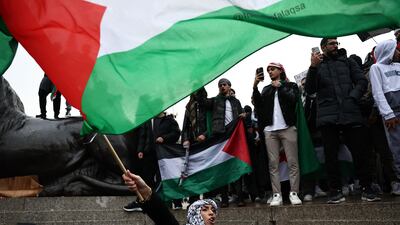
People take part in a March For Palestine in London. AFP -

A demonstrator during a pro-Palestinian rally at the Puerta del Sol square in Madrid. AP -
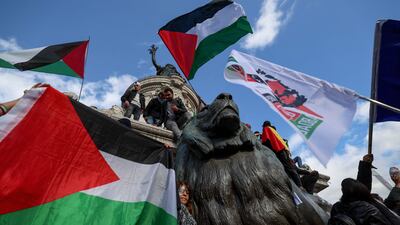
Protestors wave Palestinian flags as they climb on the Monument a la Republique during a demonstration in Paris. AFP -
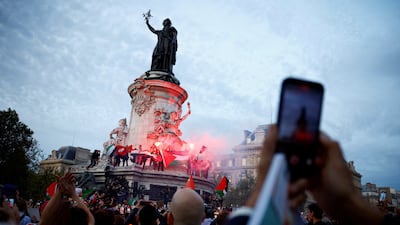
Protestors hold Palestinian flags and red flares during a demonstration at Place de la Republique in Paris. Reuters -

Protestors stand in clouds of tear gas as French police try to disperse demonstrations at the Place de la Republique, in Paris. AFP -
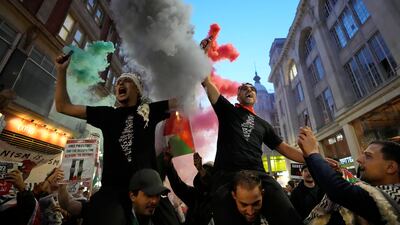
Palestinian supporters light flares at a demonstration in London. AP -
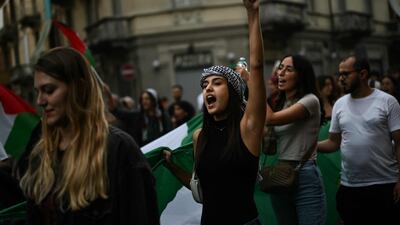
Protesters rally in support of Palestinians, in Turin, north-western Italy. AFP -
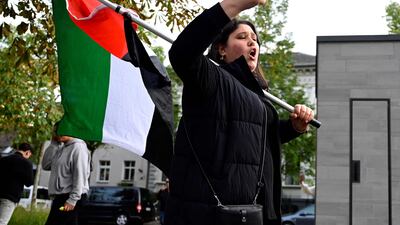
A pro-Palestinian demonstrator makes her point in Berlin. AFP -
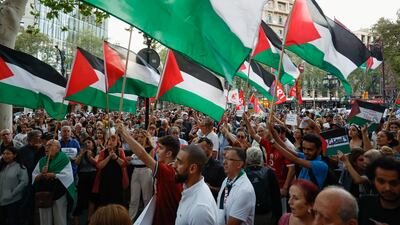
Supporters wave flags at a pro-Palestinian protest in Barcelona, Spain. Reuters -
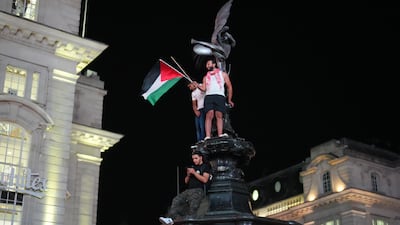
Pro-Palestinian demonstrators climb the statue of Eros in Piccadilly Circus, London. Getty Images -
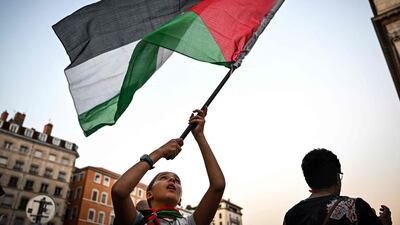
A protester waves a Palestinian flag during a rally in Lyon, France. AFP -

Demonstrators carry Palestinian flags in Munich, Germany. Getty Images -

Palestinian flags are paraded in Barcelona, Spain. AP -
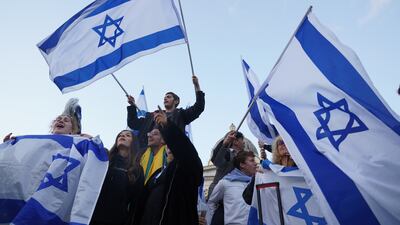
Members of the Jewish community attend a rally in Trafalgar Square in London. PA -

A woman waves a flag during a demonstration in Barcelona. AFP -
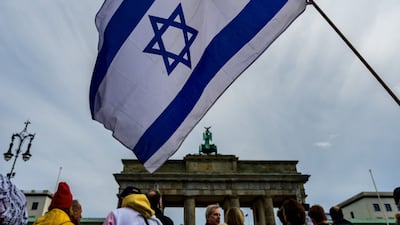
A demonstrator waves an Israeli flag during a rally in front of the Brandenburg Gate in Berlin. AFP -
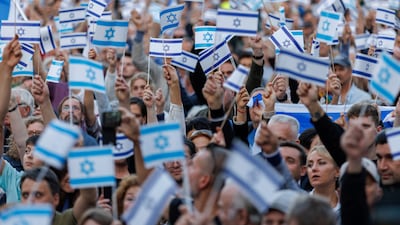
Marchers at a solidarity rally for Israel hold up flags in Nuremberg. AP -

Demonstrators carrying Israeli flags gather in Lyon, France. AP -
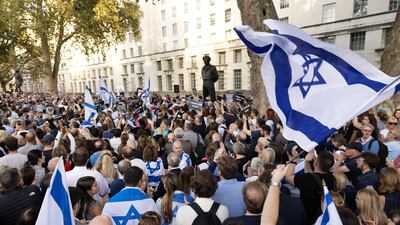
Pro-Israel demonstrators gather near Downing Street, in London. Reuters -

People attend a rally in support of Israel, in Rome. AP -
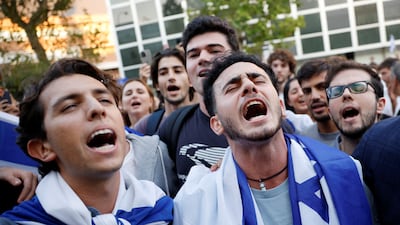
Supporters of Israel outside the Israeli embassy in the Spanish capital, Madrid. Reuters -
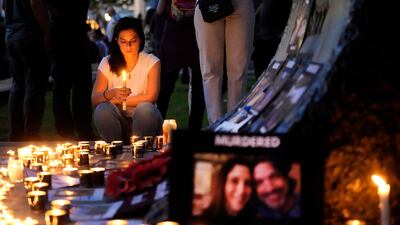
People light candles for Israel in London. AP -
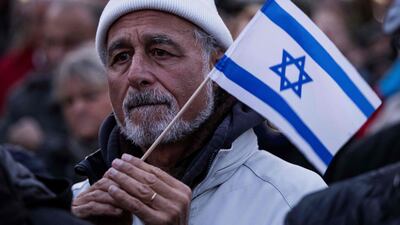
A demonstrator shows his solidarity with Israel in the Swedish capital, Stockholm. AFP


Mr Starmer’s refusal to back a ceasefire, calling instead for a humanitarian pause, may have simply been “misunderstood” by the wider British public – perhaps owing to Mr Starmer’s own lack of clarity.
“He failed to explain the difference between a ceasefire and a humanitarian pause. He should have elaborated on it more,” said Nomi Bar-Yaacov, associate fellow at the Chatham House international security programme.
Some fear that the pendulum has “swung the other way”. “Labour’s current position on Israel is largely driven by the anti-Semitism issue,” said Dr Tony Klug, a former mediator and adviser to the Oxford Research Group. “It needs to recover a more measured position.”
Mr Starmer's invoking of a two-state solution in the long term might appear unconvincing. “He should put substance to his claims, by recognising the Palestinian state, for example,” Dr Klug said.
Historically, the Labour Party was a strong supporter of the creation of Israel, in response to the atrocities that had taken place against Jews in Europe. “It was seen as a phoenix rising from the ashes, and a nation with a socialistic outlook in a region that was largely run by feudal monarchies,” Dr Klug said.
Conservative Margaret Thatcher, while in office, became the first British prime minister to visit Israel, which she viewed as a key ally in the region. As the party sought to improve its relations with Israel in the following years, it also marked the decline of a Conservative tradition of Arabists, some commentators have said.
Today the Palestinian issue has largely become a left-wing cause. Protests outside the Labour London headquarters earlier this month attracted young socialists who were hopeful for a new Labour government but disappointed by Mr Starmer's position on Israel.
The party attracts a considerable Muslim vote who feel marginalised by the Conservatives. Among its members, about 2 per cent are Muslim and just 0.4 per cent are Jewish, according to data from the Party Members Project, co-directed by Prof Webb. In 2017 and 2019, about 9 per cent of the populations of seats that Labour won were Muslim; less than 2 per cent of those won by the Tories were.
Mr Ali – the former councillor – believes this will affect Labour's attempts to regain the Red Wall seats if the party's voters stay at home or even vote Green.
The Israeli-Gaza conflict carries more risks for Labour. “By not calling directly for a ceasefire in Gaza, Labour carries a greater risk of upsetting its supporters than the Conservative Party does,” said Paul Webb, professor of politics at the University of Sussex.
But Mr Starmer may be calculating that those disappointed by his position on Gaza “hardly have anywhere else to go,” Prof Webb added. “They will certainly not find a more amenable political home among Conservatives or Liberal Democrats.”
This limits the possible electoral damage of losing the Muslim vote. “Muslims might simply abstain from voting at the next election, but this is unlikely to swing many – or any – seats to another party,” he said.
Mr Starmer's priority then, will be to "hold a firm line". "It might serve to demonstrate that he is a strong leader who can manage his party," Prof Webb said.
The road to addressing the Palestinian issue may still be long, some fear.
Dr Klug recalled meeting two Labour ministers of state from the Foreign Office in 1975, Roy Hattersley and David Ennals, to discuss the possibility of the creation of a Palestinian state. “They both said the same thing: we are inclined to accept your argument, but the time is not ripe,” said Dr Klug, an early advocate of the two-state solution, which he wrote about in a 1973 Young Fabians pamphlet.
“Apparently the time is still not ripe,” he added.

