


The UAE has been revealed as the world's largest importer of live raptors as the falconry trade continues to grow.
More than 75,000 raptors were legally imported into the country between 1975 and 2020, making up more than 40 per cent of live raptors legally traded worldwide.
A study, published in July in Biological Conservation, suggests the UAE is now at the centre of the world falconry trade, accounting for as many as four in 10 of the world's live raptor imports.
Japan, with 25 per cent of the global total imported, is second.
Qatar, Saudi Arabia and Kuwait were also in the top five, with 7.4 per cent, 3.7 per cent and 3.1 per cent of global imports respectively, highlighting the importance of falconry in the Gulf region.
PhD researcher at the University of Nottingham in the UK
The news comes as the Abu Dhabi International Hunting and Equestrian Exhibition (Adihex) prepares to open on Saturday.
Connor Panter, a PhD researcher at the University of Nottingham in the UK and the first author of the study, said that over time, the falconry industry became globalised as economic growth in many nations increased purchasing power.
Worldwide, the legal wildlife trade is estimated to be worth between $4 billion and $20 billion a year.
"The UAE regards falconry as a 'heritage sport' and there is a growing demand for sports heritage tourism such as falconry," Mr Panter told The National.
"Falconry has huge cultural influence in many countries, including the UAE. Furthermore, in Asia, we are seeing more and more raptors – especially owls – being traded, largely destined for the pet industry and for consumption in certain countries."
The study looked at the documented legal trade of live raptors covered by the Convention on International Trade in Endangered Species of Wild Fauna and Flora (Cites).
The UAE joined Cites in 1974, the year before the treaty came into force, and left at the beginning of 1988, before rejoining in May 1990.
When the UAE rejoined, 107 countries were party to the convention, a number that has since increased to 184.
The study used information from the Cites database, so has data for a country only for the years when it was a member.
Countries that joined later tend to have fewer imports or exports recorded in the figures than countries, such as the UAE, that have been signatories for almost the whole time that the convention has existed.
"By volume the UAE was the highest over the study period," Mr Panter said.
"I would assume that, as falconry is regarded as a heritage sport and [given] its popularity in the UAE, the international trade in live raptors into and out of the UAE will continue."
Mr Panter said it was likely that many of the raptors imported into the UAE were re-exported to other countries, including other Gulf nations. But it was not possible to tell from the Cites data whether this was the case.
The researchers found that 188,149 raptors from 272 species covered by Cites were legally traded internationally between 1975 and 2020.
The most commonly traded type were hybrid falcons, of which 50,366 were recorded, followed by gyrfalcons (30,510), saker falcons (21,679), peregrine falcons (13,390) and northern white-faced owls (6,725).
Of all the raptors traded internationally, 76,793 or 40.8 per cent were imported into the UAE, with most coming from Europe.
When considering only raptors that are diurnal – active in the day – the UAE had a 50.9 per cent share of global imports.
The study indicated that buyers of such diurnal raptors tended to prefer larger birds.
-
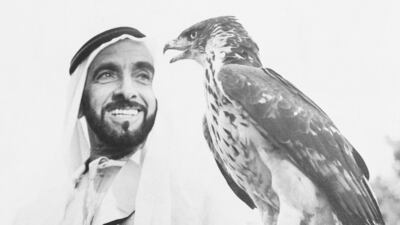
UAE Founding Father, the late Sheikh Zayed bin Sultan Al Nahyan, practises falconry. Photo: Al Ittihad -

Sheikh Zayed during a hunting trip. Photo: Al Ittihad -

Sheikh Mohamed bin Zayed, now UAE President, during a visit to Pakistan in the 1970s. Photo: National Archives -

Sheikh Zayed is among the leaders, including then Ruler of Dubai Sheikh Rashid, at a falconry conference in Abu Dhabi in 1976. Photo: Al Ittihad -
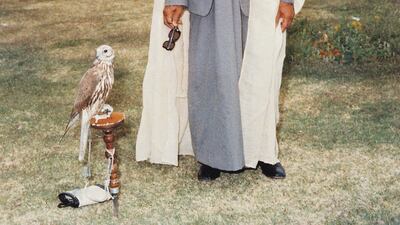
Sheikh Zayed supported the sport of falconry. Photo: Al Ittihad -

Sheikh Zayed with a falcon in Abu Dhabi. Photo: Al Ittihad -

Sheikh Mohamed bin Zayed at a falconers' club in Abu Dhabi. Photo: National Archives -

Sheikh Mohammed bin Rashid, Vice President and Ruler of Dubai, shows a falcon to George W Bush, US president at the time, in 2008. Wam -
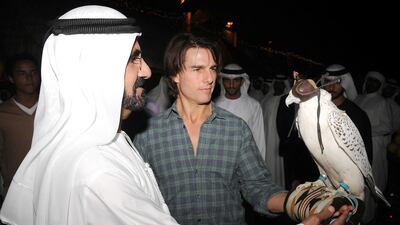
Sheikh Mohammed with Hollywood actor Tom Cruise in 2010. AFP -

Sheikh Zayed meets a falcon breeder in Abu Dhabi in 1976. Photo: Al Ittihad -

Sheikh Zayed during a hunting trip in Abu Dhabi. Photo: Al Ittihad -

Sheikh Mohamed bin Zayed and Bahrain's King Hamad at a falcon hunt in 2018. Mohamed Al Hammadi / Crown Prince Court - Abu Dhabi -

Sheikh Mohamed and Sheikh Mohammed bin Rashid at a meeting in Dubai in 2017. Ryan Carter / Crown Prince Court - Abu Dhabi -
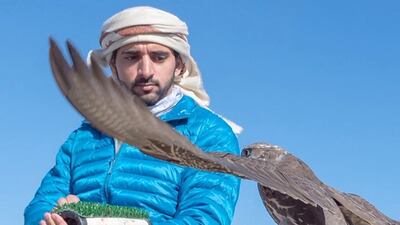
Sheikh Hamdan bin Mohammed, Crown Prince of Dubai, during a hunting trip in Uzbekistan. Photo: Twitter -
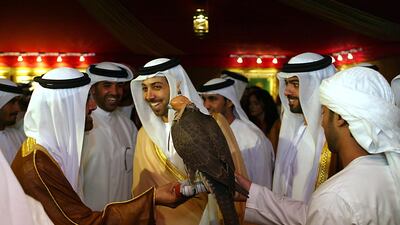
Sheikh Mansour bin Zayed, Deputy Prime Minister and Minister of the Presidential Court, at the opening of the Abu Dhabi International Hunting and Equestrian Exhibition in 2004. AFP


"For diurnal raptors, there was a significant positive relationship between body mass and the number of traded individuals, indicating a preference for larger-bodied diurnal species relative to their smaller-bodied conspecifics," the paper stated.
The trade in live raptors is often likely to involve instances where the birds are not handled or cared for properly, with standards varying between countries.
"In general, falconers take excellent care of their birds, which often hold substantial financial value, especially in the GCC nation states," Mr Panter said.
"It is important to emphasise that the falconry industry should not be tarnished by the actions of a minority of actors."
Mr Panter said there were conservation concerns about the release, intentionally or unintentionally, of falcons, because domesticated birds, often falcon hybrids, could breed with wild birds and affect the genetic make-up of wild populations.
"Despite these cases being reported, these incidents are extremely difficult to monitor and to quantify at a larger scale," he said, adding that the data covers only movements of birds.
Raptors are also traded illegally, with criminals selling birds using social media sites.
Monitoring this trade is difficult because of its secrecy, Mr Panter said.
"Governing authorities should seek to continue monitoring and regulating the sale of wildlife and derivative parts on e-commerce sites and social media platforms," the study said.
Mr Panter said that the illegal smuggling of wildlife has been associated with lower-income countries where unemployment and challenges linked to climate change, such as struggling agriculture, and lack of opportunity results in illicit activities.
While the UAE was the largest importer of live raptors, the UK was the biggest exporter.
It accounts for 34,714 or 18.5 per cent of the total, followed by Germany (24,885), Spain (19,063), Belgium (10,759) and Russia (9,778).
The paper, co-authored by researchers from Bournemouth University and the University of Brighton in the UK, said that there had been a "notable decline" in the number of wild-caught raptors traded globally after the EU introduced the European Wild Bird Trade Ban in 2005.

