


Butehamun’s name appears more often than anyone else’s on the cliffs of Egypt’s Valley of the Kings, scrawled deep into the sun-blasted rock like an ancient graffiti tag.
And had it not been for a propensity to leave his mark, all evidence of his existence would have been lost to history, like so many other ordinary people who lived in that time.
Yet because of this, archaeologists now know more about the fifth-generation scribe than any of the royals he dedicated his life to serving.
Born more than 1,000 years after the construction of the great pyramids of Egypt, Butehamun lived in the age of Hatshepsut, Tutankhamun, Ramses the Great and Nefertiti.
The names of these elites dominate popular imagination of Ancient Egypt – a place of great empire, sprawling palaces and mighty monuments.
Except that everything we have come to believe about the era is wrong, according to the British Egyptologist, historian and archaeologist John Romer, who has dedicated his life’s work to studying the period.
“The truth of it is we know virtually nothing about any of the pharaohs,” he tells The National.
“It’s like trying to read a history of Queen Elizabeth II from a few broken proclamations and then deciding [how she lived her personal life]. I mean it’s that silly.”

What we think we understand about the pharaohs is “the same as you would know if you dug up a modern house in the 20th century and you went in and found all these weird and wonderful gadgets and books”, Romer says.
The popular story of Ancient Egypt was entirely created by 19th-century archaeologists such as Howard Carter, who were the first westerners to “discover” its tombs and monuments.
The argument is the central premise of his new book, A History of Ancient Egypt, Volume 3.
The real Ancient Egypt
“If you ask me about Rameses II, I can tell you virtually nothing, except what the 19th century made up.
“The Egyptology you see on the television, or in most books, is the nonsense from the 19th century of imperialism and great kings, and it’s all a complete fabrication."
The real Ancient Egypt, revealed through a lifetime of Romer's archaeological discoveries and studies, paints a very different picture.
“The kings lived in small mud huts,” he says.
“Palaces in ancient Egypt were one or two-storey mud huts. They were just more mud huts stuck together than usual, and I have a feeling they lived in a community where everybody knew each other. It’s not a western state.

"The idea of an empire first of all grew out of the idea that sometimes you find ancient Egyptian statues in Syria or Greece. People think they had mighty conquests.
"They found an axe in a river in Lebanon and decided that the king who built the pyramids had conquered the Lebanon.
"That view of the world in the late 19th century was what caused two world wars in the 20th century. It has to do with racism, empire, and all the rest of it."
Interest since childhood
Romer, who was born in Morden in London, was based abroad for more than 50 years and now lives in Italy.
Interested in Ancient Egypt since childhood, he studied at the Royal College of Art, where he made stained-glass windows, but felt he could not pursue the craft as a career because “you have to be religious to do that”.
When the University of Chicago was looking for an artist to join its expedition in Egypt, Romer applied and was working in the temple of Ramses III within six weeks of graduating.
“What really knocked me out was the landscape in which the monuments were situated, and that’s what Egyptology doesn’t do. It doesn’t do the place,” he says.
But it is a region he got to know extremely well over the years, where he developed an expertise in Egyptology that he has shared in books, journals and television programmes.
His books, in particular, have had a significant influence on the field.

Romer has spent years writing the Ancient Egyptian trilogy as a definitive guide to an era that stretches thousands of years, from when the first communities of farmers on the lower Nile grouped together to build the four colossal pyramids and create the pharaonic state, all the way to the New Kingdom, the subject of his third and latest volume.
“Even as I was writing 40 or 50 years ago, the first book I ever wrote doubted a lot of this, and, you know, I sort of kept to the party line because it’s quite difficult to explain these sorts of things if you are writing a book about Butehamun,” he says.
“You want to have empires and wives, otherwise it just gets far too complicated.
“But this book hopefully goes to the throat of this because it is wrong. It’s wrong because it gives you a bad idea of history.”
The archaeological evidence suggests the truth is that Egyptian culture was as vulnerable as all others to outside influences.
The book describes a time when those influences began to impinge, preceding the age of Tut, when many designs and decorations started to come from abroad.
“You can see it developing in how they try and cope with that. How the king suddenly has different poses that have been got from other cultures abroad.
“It's as if you're getting a movie still, I mean, in ancient Egyptian terms, every figure in the scene is in a different pose, and it's a real pose. A gesture or a movement, whereas Egyptian art, we think there's people stuck there.
“What happens is you have an amazing realisation in this one reign and it lasts 20 years.
“Then the kings suddenly revert and say we don’t want that. We want our old culture.”
Romer says the book is not telling people what to think about Ancient Egypt, simply presenting them with facts that can be proved.

“What I'm trying to do is to bring a bit of anthropological thinking, you know, instead of this empire rubbish.”
He says his version of history is not revisionist but rather pointing out that what we think we know is plain wrong.
“It’s not saying Thomas Cromwell was a good guy or a bad guy. That's not the point. I’m saying we don’t know who he was,” he says, by way of a more modern example.
Archaeologists do, however, know a surprising amount about Butehamun.
He was a member of a well-known family that lived in the village of Deir el-Medina, helping to control the vast number of jobs integral to the Ancient Egyptian practice of burying and reburying kings.
It was a place with huts and guard posts, with stone that still holds the records of rations. We know he made regular trips to the royal tombs in the wadis over a period of more than 12 years.
As with Romer, Butehamun was fond of the scenery, commenting in one of his graffiti scrawls that he and his gang had “come to see the hills”.
We also know he had a long life and was buried alongside his ancestors in a vault on the hillside next to the village. An inscription written by his own hand on the wall of a local shrine still says: “Yours is the West, it has been made ready for you. All the blessed ones are hidden in it and neither sinners nor the wicked can enter it. The scribe Butehamun has landed in it after an old age, his body being sound and intact. Made by the scribe of the tomb, Ankhefenamun.”
Centennial celebration of King Tutankhamun's tomb discovery in Luxor - in pictures
-
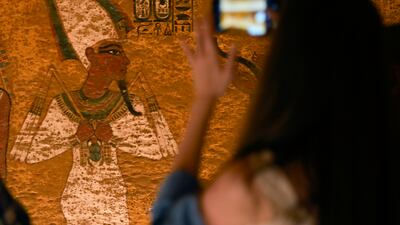
A tourist takes photos inside the tomb chamber of King Tutankhamun in the Valley of the Kings in Luxor. AP Photo -

Tourists visit the tomb of King Tutankhamun as Egypt marks the 100th anniversary of its discovery. EPA -

A mural inside the tomb. EPA -
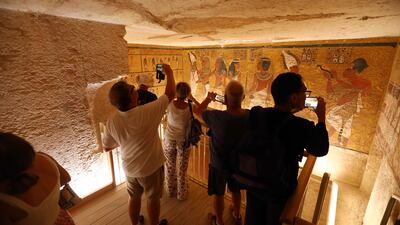
Tourists visit the tomb. EPA -
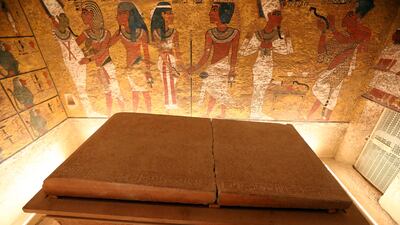
A room inside the tomb. EPA -
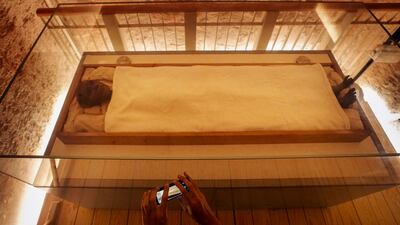
A tourist films Tutankhamun's mummy in his tomb chamber. AP Photo -
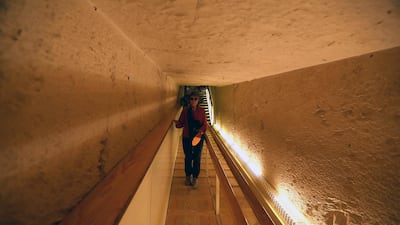
Tourists visit the tomb of King Tutankhamun. EPA -
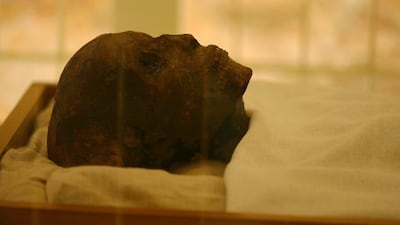
The mummy of King Tutankhamun displayed as Egypt marks the 100th anniversary of its discovery. EPA -

Outside of the tomb. EPA


Most of ancient Egypt we see now is sandblasted, rebuilt, disappeared, Romer says.
“The one place in all of Egypt where you can get with ancient Egyptians is out in the desert. And you walk along these ancient paths they made, which until 40 or 50 years ago nobody walked on. They were still yellow from 2,000 years of patina.
“But this is where Butehamun and his fellow villagers went to bury their people and make new tombs.
“I was one of the first people to walk these paths since Howard Carter and the man who really discovered the village.
“I was walking along by myself, two or three miles out in the desert.
“I saw a big text of Butehamun out in the desert, and at the bottom there will be a little HC for Howard Carter, and under that the name of Jaroslav Cerny, the man who deciphered who they really were.”
'A History of Ancient Egypt, Volume 3: From the Shepherd Kings to the End of the Theban Monarchy', by John Romer is published by Allen Lane.
Editor's Note: This article has been amended to remove a section focusing on a recent controversy that was not addressed in the book.

