


On February 24 last year Russian troops entered Ukraine in what Moscow called a special military operation designed to remove the leadership in Kyiv and pre-empt Ukraine’s integration into Nato. A year on, not only Russia’s apparent plan for a swift victory, but practically every other calculation made by anyone has turned out to be wrong.
Russia appears to have gambled on Ukraine’s capitulation or an easy victory. Neither happened. Ukrainian President Volodymyr Zelenskyy rejected a US offer of exile, choosing to stay and fight, with the immortal line: “Give me ammunition, not a ride.” That the US offered exile at all reflects its own miscalculation that a lightning war would succeed, leaving the US and its allies facing a fait accompli and reluctant to risk a war.
Few believed that Ukraine had a chance of holding Russia at bay, but that is what happened in the early months. Western military planners had not envisaged the return of state-to-state land warfare to Europe, but Russia and Ukraine proved them wrong. Once the fighting began, there seemed to be high hopes on both sides for negotiations that began almost immediately, first on the Belarus border and then in Istanbul. But the talks came to nothing, because – according to observers such as Donald Trump’s Russia adviser, Fiona Hill, the US and UK now wanted Ukraine to fight on in the hope of debilitating Russia.
A conflict fully expected to be over in weeks if not days is now one year old, and the eventual outcome seems less predictable than ever. In many ways, it seems stuck at a crossroads.
Both Russia and Ukraine are said to be planning major spring offensives, although there has been no sign of either yet. After Russia’s prize Kerch Bridge to Crimea was attacked, Moscow started targeting Ukraine’s energy infrastructure, but the feared emergency of whole cities without heat or power in winter has not happened yet.
-
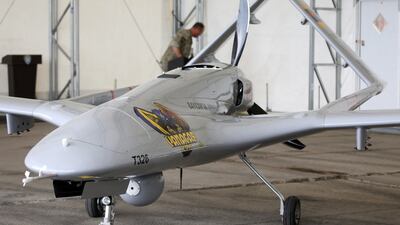
Turkeysold its Bayraktar TB2 armed drones to Ukraine. They can fly at an altitude of 7,500 metres and swoop down to attack targets. AFP -

The US also gave 700 of its Switchblade kamikaze drones. AP -
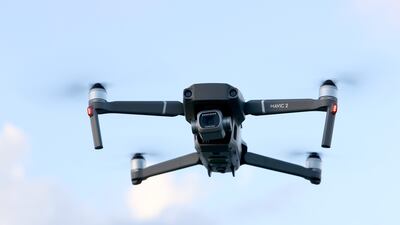
Cheap commercial drones like the DJI Mavic series have been modified in Ukraine. AFP -
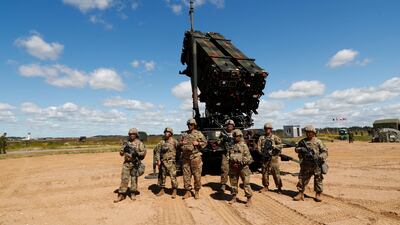
Germany will follow the US in providing a Patriot missile defence system, pictured above, to Ukraine. Reuters -
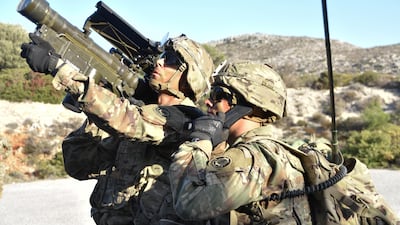
FIM-92 Stinger rockets have been donated to help Ukrainian infantry engage aircraft and drones. The shoulder-launched missiles can shoot down aircraft. Photo: US Army -
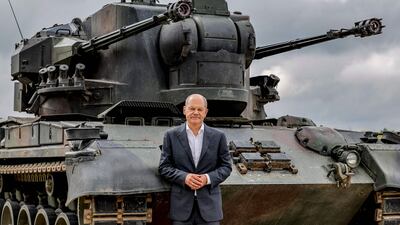
Germany donated 25 Flakpanzer Gepard all-weather-capable self-propelled anti-aircraft gun. AFP -
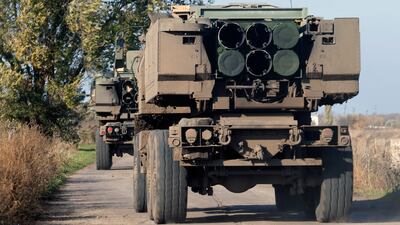
The High-Mobility Artillery Rocket System, or Himars, can simultaneously launch several precision-guided missiles. The US has given Ukraine projectiles with a range of about 130 kilometres. EPA -
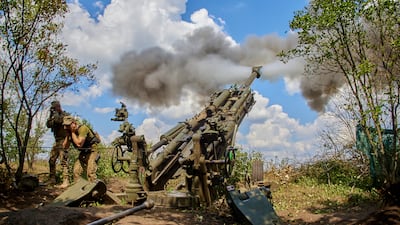
M777 howitzers and about 300,000 shells have been donated to give Ukraine an accurate artillery platform with a range of 50 kilometres. EPA -
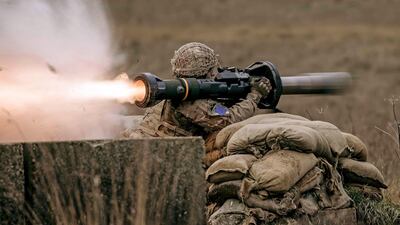
Ukraine has been sent at least 5,000 of the anti-tank weapons known as NLAWs. These shoulder-launched rockets have proved deadly in the field. PA -
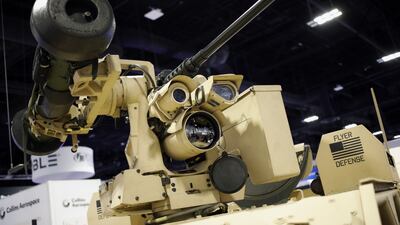
Ukrainian troops have also received thousands of Javelin anti-tank missiles. Bloomberg -
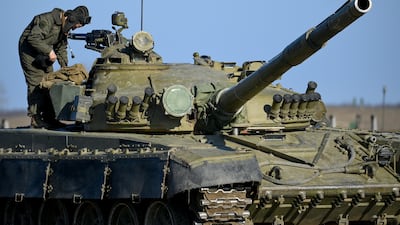
Poland and the Czech Republic sent Russian-made T72 tanks, which Ukraine has used for decades, to ease integration and cut down training time. EPA -
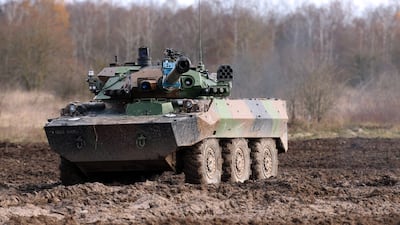
France as announced its plan to give AMX-10 RC “scout tanks” to Ukraine. "This is the first time that western-made armoured vehicles are being delivered in support of the Ukrainian army," a French official said. AFP -
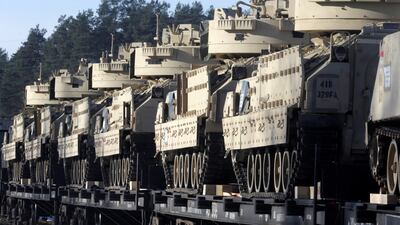
Shortly after the French, the US said it would send Bradley fighting vehicles to provide "a level of firepower and armour that would bring advantages on the battlefield”. Reuters -

The UK sent their phased-out Saxon armoured vehicles. They found new life protecting infantry units in transit and dealing with tough off-road conditions. Getty Images -
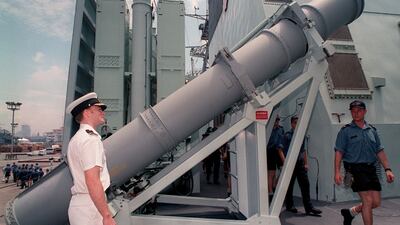
Denmark has supplied Harpoon anti-ship launchers to help Ukraine defend its coasts. AFP -

The US sent 20 Soviet and Russian made Mi-17 helicopters to Ukraine that had initially been bought for the Afghan government in 2010. AP -
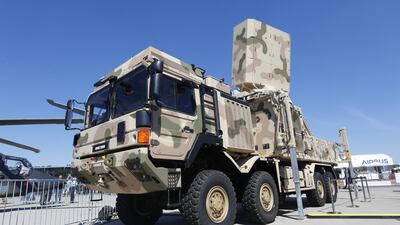
Germany has also supplied its latest version of the IRIS-T air defence system designed to shoot down missiles at altitudes up to 20 kilometres. Getty Images -
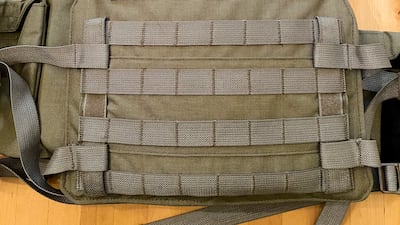
Ukraine has also been given thousands of small arms, bullet proof vests, medical kits, litres of fuel, granades and other weapons systems. Reuters


For their part, the US, EU and UK all imposed swingeing sanctions on Russia, and Germany drastically cut its reliance on Russian gas. But again, the effects are mixed and have decided nothing. Russia has found other markets for its energy, including China; its balance of payments has rarely been better, and Russia has mostly found domestic substitutes to offset the departure of western business. Supporters of sanctions insist that Russia will suffer in the long term, both financially and from a dearth of imported high-tech. As a means of forcing Russia to change policy in the here and now, however, there is little evidence they have worked.
Meanwhile, forecasts of a cold, dark winter in Europe, as a result of scaling back imports of Russian energy, have so far not borne out either. Germany and other countries managed to replenish their gas storage facilities more quickly than expected. Most governments introduced measures to mitigate the effects of high prices, while Germany and some others imposed restrictions on energy use. Widespread power cuts and bankruptcies have so far been avoided, as has large-scale public unrest, with one beneficiary being the booming US LNG industry.
Nor, after a spate of anti-war sentiment early on, and after the announcement in September of a new mobilisation, has the conflict fuelled serious opposition in Russia. By allowing those who could to leave the country, Moscow may have strengthened acceptance of the war at home. In the West, the conflict has given the Nato alliance the new purpose it had sought ever since the collapse of the USSR.
One reason opposition to the war has been muted, both in Russia and in those countries making sacrifices to back Ukraine, may be the limits that both sides seem to have placed on their conduct of hostilities. While Ukraine’s western backers have gradually acceded to Mr Zelenskyy’s pleas for more and heavier weapons, there is a gap between what is promised and what is delivered.

Russia, too, for whatever reason, also appears to be holding back. It has consolidated its gains on the east bank of the Dnieper River, but it appears no longer to be looking to advance further west, if ever it had that intention. For all the accusations that Russia deliberately targets civilians, civilian casualties from Russian air strikes can often be counted on the fingers of one hand, and at least some of them – as Ukraine's defence ministry spokesman was sacked for saying – result from Ukraine’s air defences deflecting the missiles.
There have also been small pieces of progress that hint at more mutual communication than is admitted. There are regular prisoner exchanges. The agreement, brokered by Turkey, for Ukraine to export grain by sea – in return for safe passage for Russian ships, too – has generally held, as has a deal for IAEA inspectors to have access to Ukraine’s nuclear power stations located in Russian-occupied territory.
-
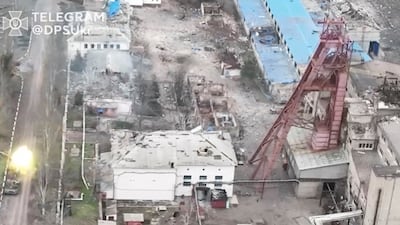
A tank, seen left, fires a round in Soledar, a town in the Donetsk region of eastern Ukraine. Reuters -
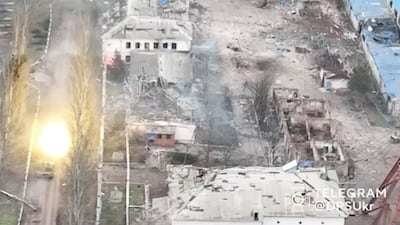
Tank fire in Soledar, Donetsk. Reuters -
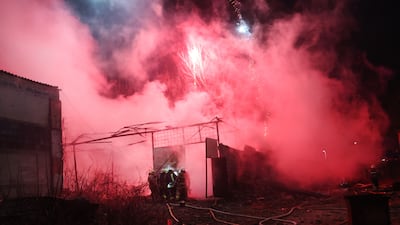
Firefighters work to put out a blaze at a Kharkiv fireworks storage site after it was struck by a Russian missile. Getty -
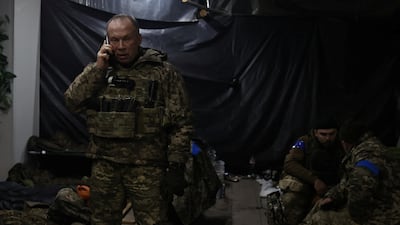
Col Gen Oleksandr Syrskyi, commander of Ukraine's ground forces, visits his troops on the frontline in Soledar, Donetsk. Reuters -
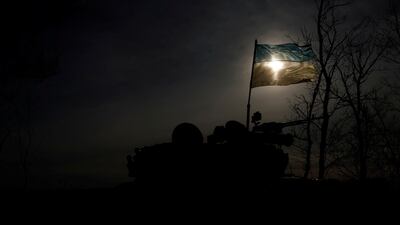
A Ukrainian flag attached to a tank flutters in the wind in Bakhmut. Reuters -
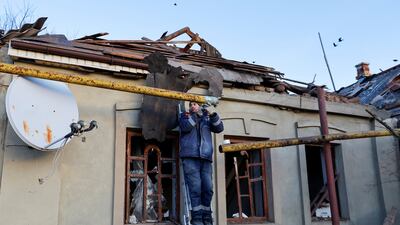
A specialist from an emergency crew works on a residential building in Donetsk that was damaged in recent shelling. Reuters -
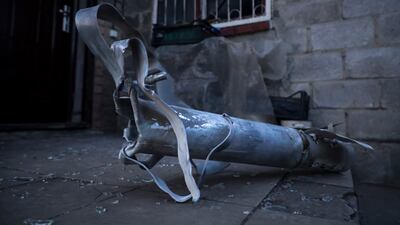
A missile fragment left by shelling in Russian-controlled Donetsk. AP -
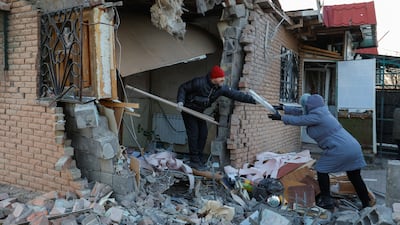
Residents remove debris and carry their belongings out of a building destroyed by recent shelling in Donetsk, Russian-controlled Ukraine. Reuters -
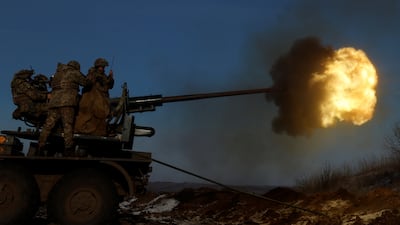
Ukrainian forces fire an anti-aircraft weapon as Russia's attack on the frontline city of Bakhmut continues. Reuters -
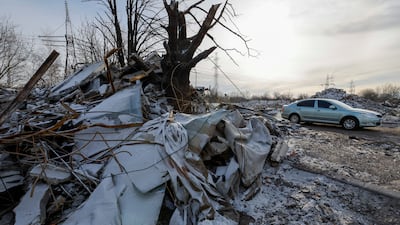
A car drives past a destroyed building purported to have been used as temporary accommodation for Russian soldiers, dozens of whom were killed in a Ukrainian missile strike in Makiivka, Russian-controlled Ukraine. Reuters -
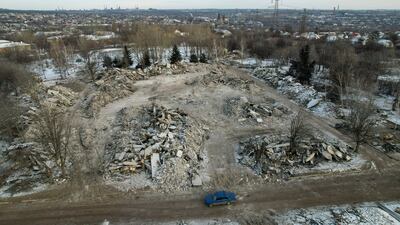
The site of a temporary barracks for Russian soldiers in Makiivka, which was destroyed in a Ukrainian missile attack. Reuters -
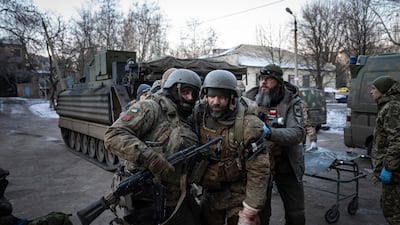
A Ukrainian serviceman carries his injured comrade from the battlefield to a hospital in the Donetsk region. AP -
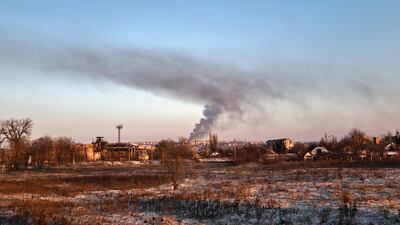
Smoke rises after shelling in Soledar, the site of heavy battles with Russian forces in the Donetsk region. AP


Perhaps most significant of all was the speedy US clarification that a Russian-made missile that landed in Poland had been fired not by Russia but by Ukraine. The US thus ensured that the incident did not become a pretext for Nato allies joining the war as combatants. This was a crucial signal from the US of how much it was, and was not, prepared to support Ukraine, and this was acknowledged by Russia.
The question now is how and when the current logjam in the war might be broken. Any signs that the patience of Ukraine’s backers is being exhausted are still few and far between. The US has cleared more military support for Ukraine, while Germany finally agreed to send Leopard tanks – though how soon is not yet known.
And despite western reports of high Russian casualties, there is little sign of Russia running out of troops or weapons. Still less is there any evidence of Ukraine having any interest in talks. The conditions it has set – a return to the border as it was before 2014 (when Russia took control of Crimea – amount to a statement of determination to continue the fight.
Yet an end to the war could come sooner than many think, and from quarters other than the battlefield. There have been more changes in Mr Zelenskyy’s camp in recent weeks, and more signs of dissent, than in the whole of the war to date. How secure are his policies, or even his position?
At the same time, the earthquake in Turkey and Syria could change the calculus of Turkish President Recep Tayyip Erdogan, who has convened talks on Ukraine in the past and is one of few people with open channels to both Russia and Ukraine. What shifts might the earthquake precipitate in the Black Sea region?
It is often said that the world changed on February 24 last year. But that is not quite true. Some of the world changed: specifically, the Europeans reviewed their security arrangements and the US renewed its commitment to Europe’s defence. But much of the world decided that Ukraine was none of its business, and carried on much as before, leaving Russia less isolated than it might have been.
The result is a war that too few have an interest in ending – which means that there could, alas, be a second anniversary to be analysed and commemorated this time next year – when the background will be additionally complicated by presidential elections in the US, as well as Russia and Ukraine.

