


Fascinating new evidence about life on the Arabian peninsula four millennia ago suggests that people may have undertaken lengthy journeys across the desert even without camels.
Archaeologists believe that donkeys may have supported the crossing of the Empty Quarter between the Dilmun civilisation on the Arabian Gulf coast and Wadi Al Faw, 1,000km to the south-west.
If members of the Dilmun civilisation did undertake these arduous trips during the Bronze Age, it may have been to trade incense with inland communities.
Dr Steffen Laursen, of Moesgaard Museum at Aarhus University in Denmark, the first author of a new study on the period, said it was not certain how the people travelled without camels, but they were likely to have used donkeys.
Doing the donkey work

“In the paper we argued that they must have had trains of donkey caravans in the cold season, but it would still be very challenging,” he said.
“You would have to be able to rely on getting water and grass at much narrower intervals. They must have had a very particular route you could take in the cold season, in the wet season.”
Dr Laursen and Dr Faleh Al Otaibi, a Saudi researcher from King Saud University, have outlined their findings in the journal Arabian Archaeology and Epigraphy.
The identification in Wadi Al Faw of seals and other Dilmun objects, including a fragile and special type of “burial jar” used exclusively by the ancient Dilmunites, suggests that Dilmun traders travelled far inland about 1,000 years before the camel was domesticated.
“In one of the tombs Dr Al Otaibi discovered a distinctive Dilmun burial jar, which is a type only used for a very short period of time in Bahrain and Kuwait and it’s only produced in Dilmun,” Dr Laursen said.

“It’s extremely brittle, so bringing it to Al Faw would have been something people would have done because it was very important. It wouldn’t have been a random container you would stuff trade goods in because it would break very, very easily — it’s eggshell thin.”
Typically, trading activities from this period leave “very few traces”, Dr Laursen said, and the arid and windswept landscape tends to erase what little remains. Also, in this area trade was never as intense as in more populated regions, which is another reason why evidence is sparse.
The Dilmun civilisation existed during the Bronze Age, which lasted from around 3300BC to 1200BC, and was focused on Bahrain and the Arabian Gulf coast of what is now Saudi Arabia, stretching up towards present-day Kuwait.
What motivated epic journeys?

“What we don’t know still and what this study can’t answer is what was the nature of the articles of trade that motivated people to go all the way overland to Wadi Al Faw,” said Dr Laursen.
“It could have been that it was incense, but the evidence points against that … It could also have been precious metals from the mountains of western Saudi Arabia or Yemen.
“Travelling through the extremely inhospitable terrain of inland Arabia was dangerous and probably not something one would venture to do unless the stakes were very high.”
In Wadi Al Faw, society was probably less developed than it was in the state-like Dilmun civilisation, but the area had good water supplies.
“It was probably a green island in an otherwise very, very dry environment,” Dr Laursen said.
“This would have drawn pastoral and nomadic groups in from a lot of places, but there would probably have been someone who tried to claim this area because of its resources, but we’re only just beginning to understand what was going on here in the Bronze Age.”
Dr Laursen has completed two doctorates on the Bronze Age in Dilmun (Bahrain) where, around 2000BC, society underwent many changes, with a single dynastic ruling elite taking control and developing a fortified capital in the north of the island.
Society became much wealthier, building stone-built temples, palaces, a city wall and royal tombs, along with many burial mounds, around 76,000 of which were created over a 500-year period, mostly for the middle and upper classes.
As well as farming, including date plantations, fishing went on and cereals were imported from Mesopotamia in modern-day Iraq. There was also a lucrative trade in other goods from around 2000BC.
The value of trade
The Dilmuns traded extensively with ancient Mesopotamia, and with another of the world’s great early civilisations in the Indus Valley in today’s Pakistan and India.
Other trading partners included the Magan civilisation, which covered coastal and inland areas of the UAE and Oman.
“The wealth of the [Dilmun] economy relied entirely on being a middle market for trading goods from the Oman peninsula, copper ingots coming from the beaches of Abu Dhabi and other goods, such as ivory … coming from the Indus region or Gujarat in western India. Other goods we don’t know that well came into this market from Iran,” Dr Laursen said.
A French-Saudi team under the auspices of the Saudi Heritage Commission is carrying out extensive mapping of the archaeological sites around Wadi Al Faw, and Dr Laursen is confident that more will be unearthed about Bronze Age life there.
Other civilisations, such as the Nabataeans, who existed from the third century BC to 106AD, have left more physical traces in Saudi Arabia and tend to be the primary focus of much archaeological work.
However, Dr Laursen said research on these other periods often also uncovered important material about the Bronze Age.
There are around 4,000 burial tombs around Wadi Al Faw, most unexcavated, and these could, Dr Laursen said, reveal details of the exchange of pottery, metal, beads and minerals over time. They could also, he said, be important for analysing human bones and looking for evidence of where they came from.
“Saudi Arabia is in this very, very intense phase of archaeological exploration with many, many field projects ongoing and I think we can expect a lot of news and our picture of Arabian archaeology will change profoundly because of this,” he said.
“In many cases the Bronze Age archaeology will be a by-catch to bigger projects focusing on more tangible heritage.”
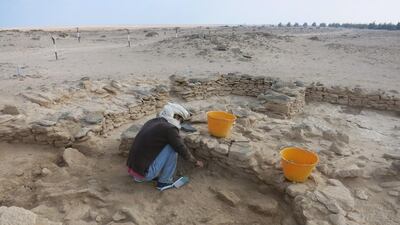
Archaeological finds in the UAE — in pictures
-
-
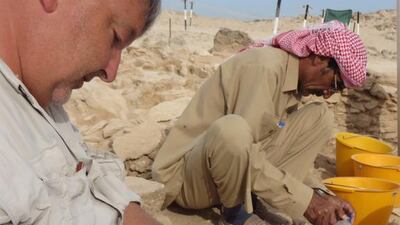
Project director Dr Mark Beech, right, makes notes as a colleague cleans and preserves finds at village MR II. Dr Beech said the dig shines light into life in the Western Region at the time of the Late Stone Age. -
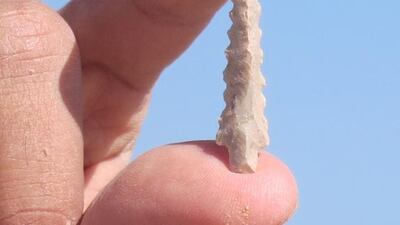
Flint arrowhead found at site MR11, Marawah Island. This type of arrowhead is known as a trihedral point, because of its triangular cross section. It dates to between the 6th to early 5th millennium BC. -
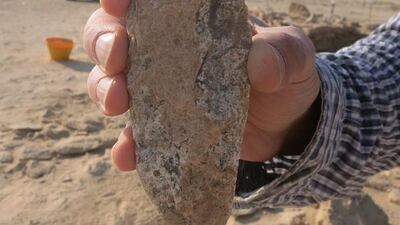
Flint spear found in Room 2 at site MR11, Marawah Island. -
Aerial view of the human skeleton found in Room 2 at site MR11, Marawah Island.



