

She is an internationally renowned conservationist. So when Dr Jane Goodall speaks, the world listens.
And now, in an interview with The National, she has issued a call to the world’s youth: seize the chance to change the course of history.
The acclaimed scientist, whose work in Gombe National Park in Tanzania 60 years ago shaped our understanding of apes, said the world is at a crossroads in how it views critical relationships between nature and humankind.
Since 1991, Dr Goodall’s Roots & Shoots environmental education programme has encouraged children to bring in positive change for people, animals and the environment.
The first intake from schools across Tanzania have held on to those values and are now in positions to make decisions, she said.
“Once young people get involved [with conservation] they become really passionate and are empowered to take action,” Dr Goodall told The National.
“So they can make a difference in trying to make the world a better place.
“They understand we must do something about climate change, the loss of biodiversity, human population growth, poverty, greed and corruption, and when they get together with their peers, they can make a huge difference.
“People lose hope and think they can’t do anything to change the world, but they can.
“If they look at what is happening near them, they can gather their friends to make a difference.”
Traffic, the global wildlife trade monitoring network, said a five-year evaluation showed progress in tackling biodiversity challenges.
In that time, new policies and strategies brought in around the world addressed corruption risks and associated illicit financial flows of wildlife crime.
Initiatives included a guide offered to banks to identify suspicious transactions of wildlife trade, estimated to be worth about $23 billion a year.
Dire consequences of wildlife trafficking
-
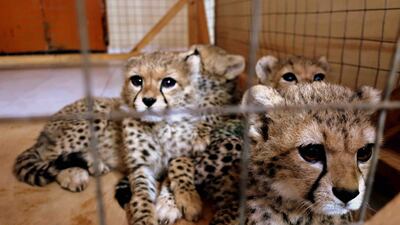
Four cubs confiscated by the Somaliland Ministry of Environment and Rural Development arrive at the CCF Safe House in Hargeisa. Photo: CCF -
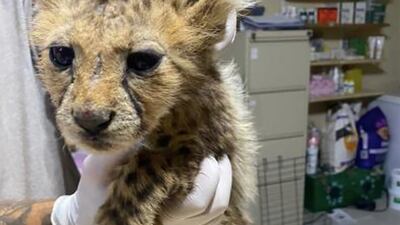
One of 10 cubs rescued by Somaliland Police. Photo: CCF -
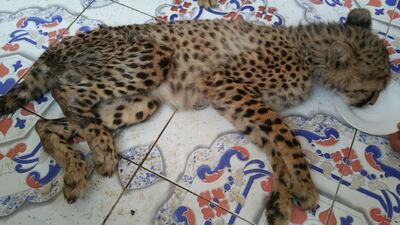
One of the six severely malnourished and dehydrated cubs confiscated from smugglers. The cub was so weak, it could not stand to drink but is now receiving proper veterinary care and nutrition. Photo: CCF -
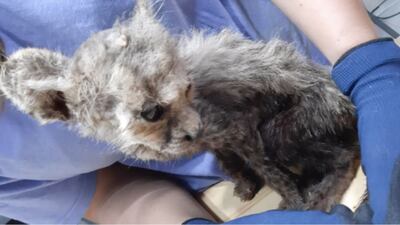
One of the cheetah cubs recovered from smugglers off the coast of Somaliland. Conservations believe the 12 animals were destined from the black market in the Arbian Peninsular. Photo: CCF -
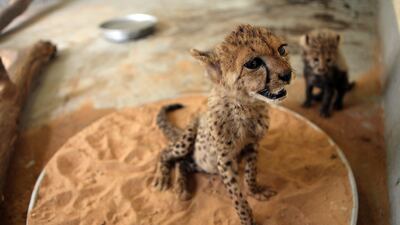
Despite a nationwide ban, exotic animals such as cheetah cubs continue to be sold on social media accounts. Sammy Dallal / The National -
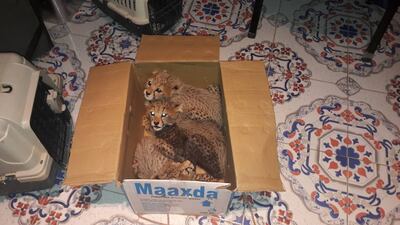
Conservationists in the Horn of Africa claim they are facing a poaching 'epidemic' as demand for cheetahs in the Gulf soars. Photo: CCF -

There are now fewer than 7,500 cheetahs in the wild. Photo: CCF -
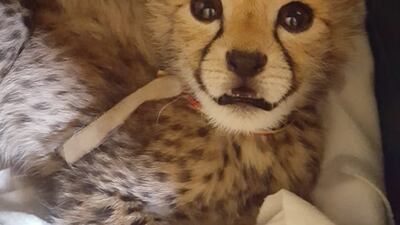
The Cheetah Conservation Fund says it is struggling to keep up with the rehabilitation of the animals as so many are being intercepted. Photo: CCF -
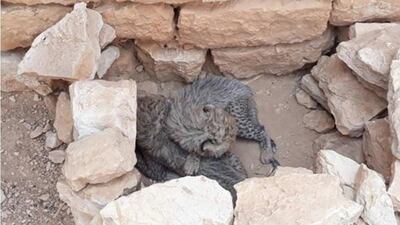
The Cheetah Conservation Fund is the global leader in the research and conservation of the animals. Photo: CCF -

Four cheetah cubs were rescued on the UAE-Saudi Arabia border, with two turned over to Al Ain Zoo by the Ministry of Environment and Climate Change. Reem Mohammed / The National


The illicit trade, with the rise of social media fuelling transactions, has threatened the future of species such as the pangolin, African rhino and elephant, cheetahs and tigers.
Despite progress in wildlife protection, illegal trafficking and the destruction of natural habitats still posed significant risks to animals and human health, Dr Goodall said.
“The treatment of animals, and in particular wildlife trafficking, is a huge problem,” she said.
“It is understood that the Covid-19 pandemic was a result of animals being transported around the world and sold in a wildlife market in China.
“Many studies have been done to show diseases can originate when a pathogen or bacteria jumps from an animal to a human.
“If it bonds with a cell in the human body, it can create a new zoonotic disease.
“That is how the current pandemic supposedly began and was then spread around the world.
“It points to the fact that when we move animals around the world, go deeper into their habitats and bring them into our homes, the exotic pet trade is really dangerous.
“Whether is lions, cheetahs, snakes or whatever, that is a risk of developing a new zoonotic disease that cause another pandemic.”
Species saved from the brink
Conservation programmes such as the recovery of the Arabian oryx after its extinction in the wild in the 1970s were singled out for praise by Dr Goodall.
She said the UAE, which was prominent in those efforts, had a significant role to play in leading the conversation on climate change during Cop 28.
The UN climate summit will take place in November and December in the Emirates, and is an opportunity to address shortfalls in previous statements of intent, she said.
“It shows there is more interest in the UAE now than 20 years ago,” said Dr Goodall.
“There have been lots of promises and speeches at great expense [at previous Cops], but they have rarely been followed through.
“Hopefully that is changing. There are passionate people in the UAE government who really care, and their voices will get louder.
“One of the big problems we face is the destruction of biodiversity and habitats, as we greedily consume more and more resources, leaving even more animals threatened by extinction.
“Intensive farming and the way we grow our crops using pesticides and fungicides is killing the soil, which is terrible for biodiversity, insects and birds.
“Huge swathes of land are now used to grow grain to feed animals. It is shocking to think more land is farmed this way to feed animals rather than humans.”
Staunchly committed to the cause

At 88, Dr Goodall shows no sign of slowing down and still regularly travels around the world speaking about climate change and wildlife protection.
She said she would like to be remembered for her successful Roots & Shoots programme.
“Hundreds of thousands of people have been through the programme and it has changed the world,” Dr Goodall said.
“They have respect for each other, animals and the environment.
“Science is beginning to come up innovative solutions, and more groups are working together to preserve forests, habitats, and to clean up the ocean.
“People are now thinking about their own environmental footprint, and nature is so incredibly resilient.
“Give her a chance and nature will come back and take over an area we have totally destroyed while animals have been brought back from the brink of extinction.
“One of my great hopes is the indomitable human spirit — people who tackle the impossible and refuse to give up and so often succeed.
“They come from all walks of life and are inspirational.”
-
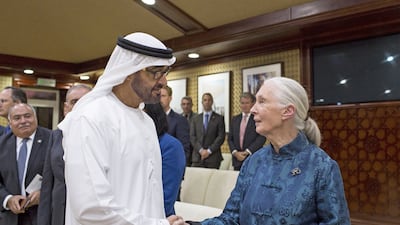
Sheikh Mohammed bin Zayed, who was Crown Prince of Abu Dhabi at the time, thanks Dr Jane Goodall after her lecture at Al Bateen Palace. Ryan Carter / Crown Prince Court -
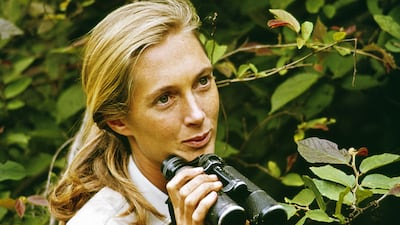
Jane Goodall in December 1965 on location in Gombe Stream National Park, Tanzania. Getty Images -
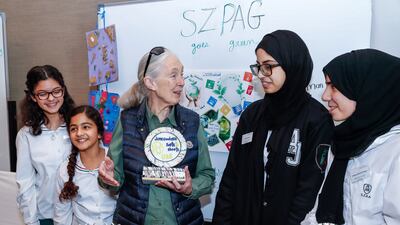
Jane Goodall receives an environmental award from the Sheik Zayed Private Academy in Abu Dhabi. Victor Besa / The National -
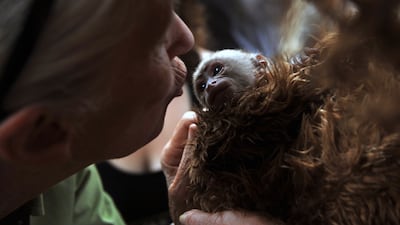
British primatologist Jane Goodall with a baby Cariblanco monkey during her visit to a primate rescue centre in Chile in 2013. AFP -
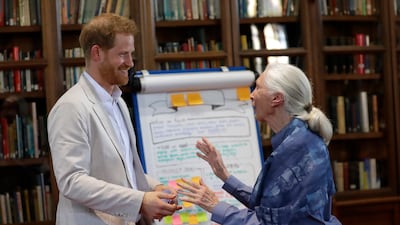
Prince Harry, Duke of Sussex, and Dr Goodall at a Roots & Shoots Global Leadership meeting at Windsor Castle in July 2019. Getty Images -
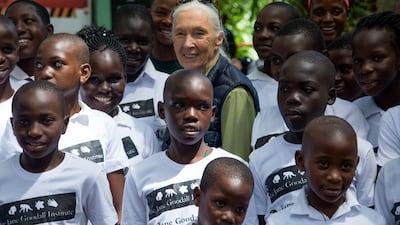
Goodall with children during a visit to the chimp rescue centre in June 2018 in Entebbe, Uganda. AFP -
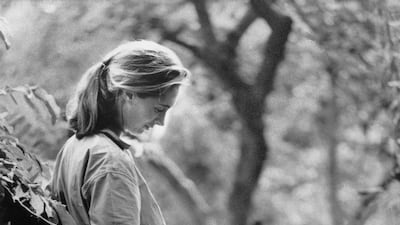
Goodall with one of her research subjects in the Gombe National Park in northern Tanzania. Getty Images -

Conservationist Jane Goodall during an interview with host Jimmy Fallon on The Tonight Show, September 14, 2017. Getty Images -
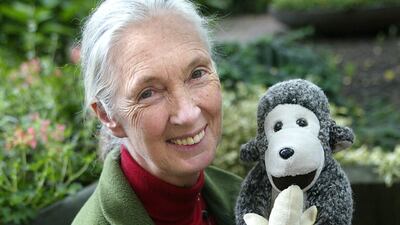
Goodall in the garden of Groningen University at the Sharing the Planet conference in June 2002 in Groningen, Netherlands. Getty Images -
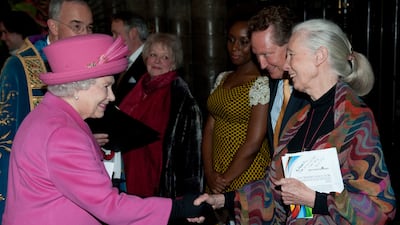
Queen Elizabeth II and Dr Goodall DBE after the annual Commonwealth Day Observance Service in March 2012 in London. Getty Images -

Goodall with the Bambi award 'Our Earth' at the Bambi 2010 Award Winners Board in November 2010 in Potsdam, Germany. Getty Images -
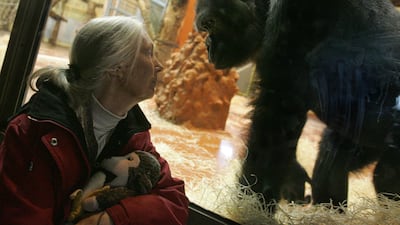
UN peace messenger Goodall waits for a meeting with a gorilla family at the Zoo Park and Botanic Garden in Budapest, Hungary, in 2008. AFP -
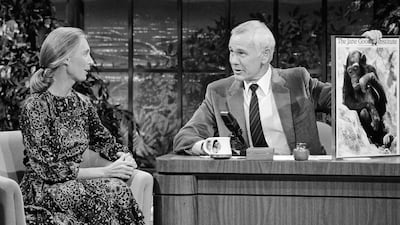
Goodall during an interview with host Johnny Carson on The Tonight Show, January 3, 1984. Getty Images -
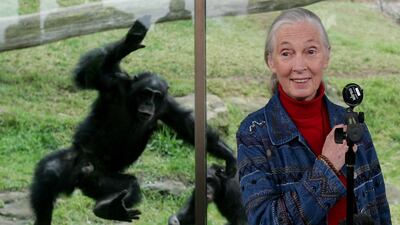
Goodall during a visit to Taronga Zoo in Sydney, Australia, in 2006 to raise awareness of the plight of wild Chimpanzees. Getty Images -

Leonardo DiCaprio and Goodall at the Leonardo DiCaprio Foundation Gala at Jackson Park Ranch in Santa Rosa, California, September 2018. AFP -
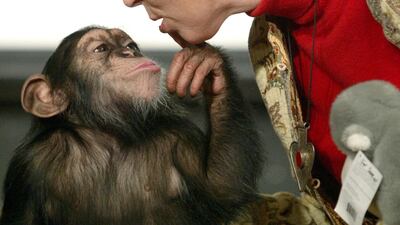
Goodall with Pola, a young chimpanzee, in Budapest Zoo in December 2004, more than 40 years after she began her pioneering study of the primates. AFP -

Jane Goodall married wildlife photographer Hugo Arndt Rodolf, Baron van Lawick, in London on March 28, 1964. Getty Images -
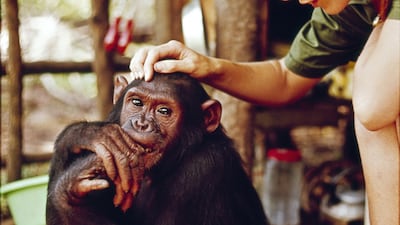
Goodall in the television special Miss Goodall and the World of Chimpanzees originally broadcast on CBS, in December 1965. Getty Images -
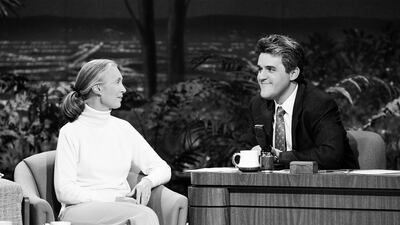
Goodall during an interview with Jay Leno on May 1, 1990. Getty Images -
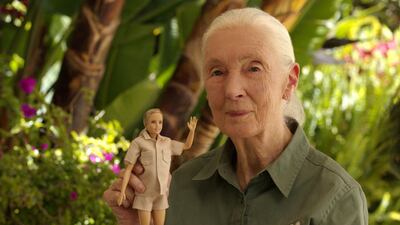
Goodall posing with the new Jane Goodall Barbie doll in Los Angeles. Reuters -
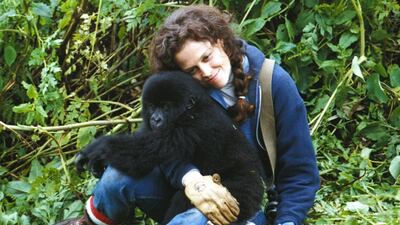
Sigourney Weaver in a scene from the 1988 film Gorillas in the Mist. Photo: Warner Brothers -
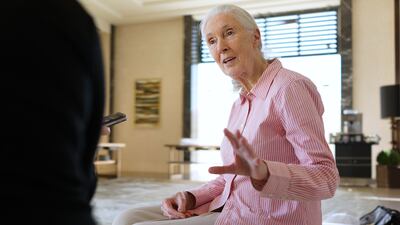
Schoolchildren from across the UAE lined up to get an autograph from Goodall, who in 2016 visited Abu Dhabi to celebrate 25 years of her Roots & Shoots programme. Delores Johnson / The National -
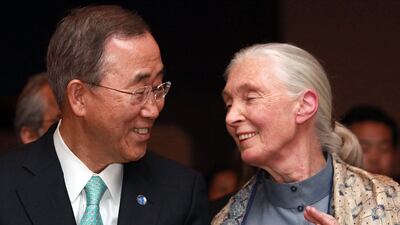
UN Secretary General Ban Ki Moon and Goodall at the United Nations Climate Change Conference and Cop17 conference in Durban on December 7, 2011. AFP -

When Goodall mentioned population sizes, the underlying assumption was that different sections of the world’s population are similarly responsible for the climate crisis. Photo: Emirates Literature Foundation -
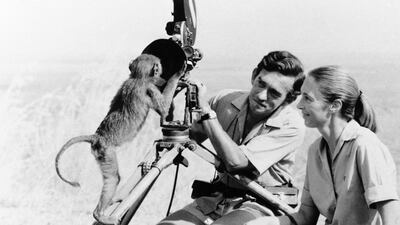
Anthropologist Jane Goodall with husband Hugo van Lawick in 1974. AP -
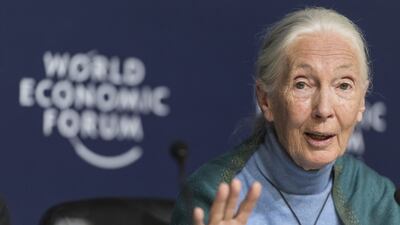
Goodall during the 50th annual meeting of the World Economic Forum in Davos, Switzerland. EPA -
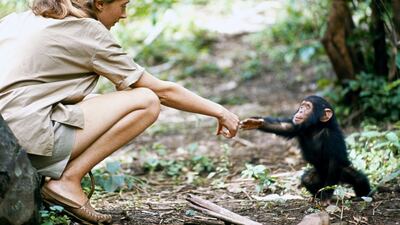
Goodall made numerous scientific breakthroughs in the field of animal behaviour. Photo: National Geographic -
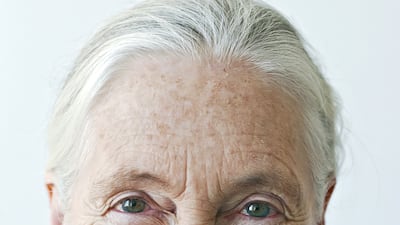
Jane Goodall at the Jane Goodall Institute in Silver Spring, Maryland, in February 2003. Getty Images



