• Iraqis mingle with fans from other countries during the Arabian Gulf Cup being held in Basra, Iraq from January 6 to 19. All photos: Sinan Mahmoud / The National
    Iraqis mingle with fans from other countries during the Arabian Gulf Cup being held in Basra, Iraq from January 6 to 19. All photos: Sinan Mahmoud / The National
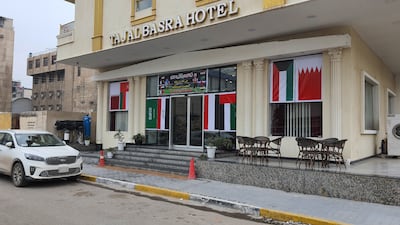
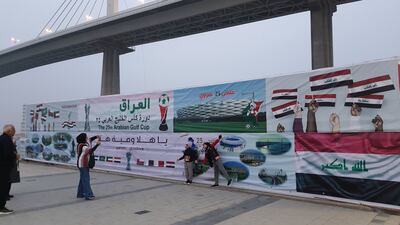
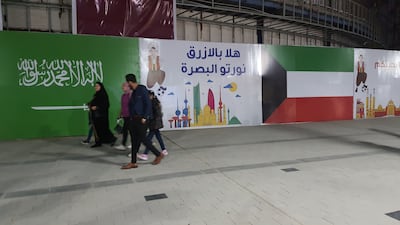
  • The flags of the eight countries taking part in the tournament are displayed all across the southern port city. Sinan Mahmoud / The National.
    The flags of the eight countries taking part in the tournament are displayed all across the southern port city. Sinan Mahmoud / The National.
  • A street vendor sells flags of participating countries at Basra Corniche
    A street vendor sells flags of participating countries at Basra Corniche
  • Omani fan Yahya Al Hashemi, 35, poses for a selfie with an Iraqi fan at Basra Corniche
    Omani fan Yahya Al Hashemi, 35, poses for a selfie with an Iraqi fan at Basra Corniche
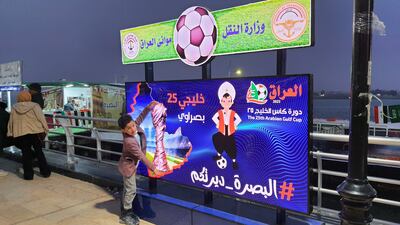
  • A statue of the mascot for the 25th edition of the Gulf Cup, Sinbad the Sailor – one of the region's legendary characters
    A statue of the mascot for the 25th edition of the Gulf Cup, Sinbad the Sailor – one of the region's legendary characters
  • Omani journalist Salah Al Saadi recording Iraqi girls singing on Basra Corniche
    Omani journalist Salah Al Saadi recording Iraqi girls singing on Basra Corniche
  • Football fans crowded the corniche in Basra
    Football fans crowded the corniche in Basra
  • Basra residents are proud to host the tournament after several attempts since 2010, when the security situation started to improve
    Basra residents are proud to host the tournament after several attempts since 2010, when the security situation started to improve
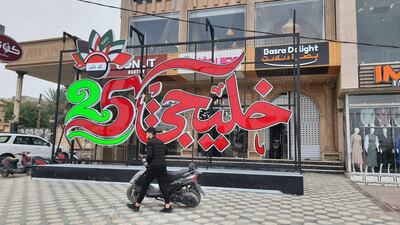
  • Flags of participating countries, hats, sports merchandise and souvenirs are displayed in shops and street stalls in Basra
    Flags of participating countries, hats, sports merchandise and souvenirs are displayed in shops and street stalls in Basra

Excitement and pride in Basra as Iraq hosts Gulf Cup


Sinan Mahmoud
  • English
  • Arabic

These are days that the people of Basra will remember for years to come.

The concerns of daily life in Iraq's southern port city have been overtaken by the excitement of hosting the first Arabian Gulf Cup to be held in the country in more than 40 years.

The 25th edition of the biennial football tournament, which runs from January 6 to January 19, brings together teams from Iraq, the UAE, Saudi Arabia, Kuwait, Bahrain, Oman, Qatar and Yemen — as well as their supporters.

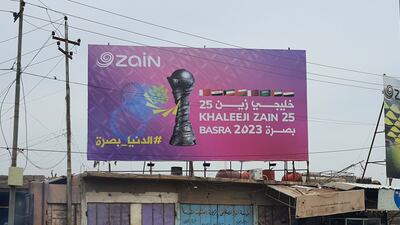
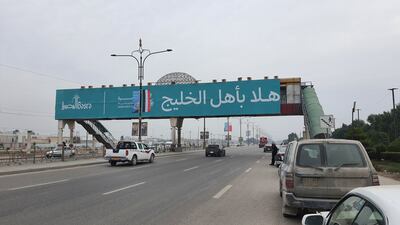
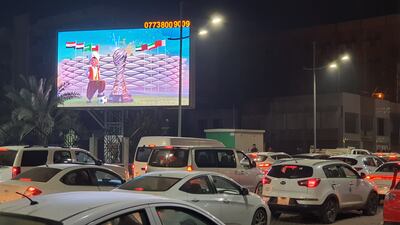
In almost in every corner of Basra there are flags of the Gulf states fluttering in the breeze, billboards welcoming visitors, and posters and statues of the tournament mascot, Sinbad the Sailor.

The streets are infused with a carnival-like atmosphere as local football fans mingle with their peers from Gulf states, all descending on the city’s downtown and filling the streets and cafes with a lively energy.

At night, fans flood the Basra Corniche, chanting and singing their teams’ praises. Iraqis shake hands with visitors, exchanging jokes and posing for selfies.

Vendors sell flags of the participating countries, hats, sports merchandise and souvenirs next to stalls offering a variety of local delicacies and hot drinks, particularly coffee.

Traditional musicians and performers entertain the crowds with music and dance. It is a true celebration of the Gulf region’s rich and diverse culture.

“The atmosphere is really amazing, we are so thrilled to be here,” Yahya Al Hashemi, a fan from Oman, told The National as he and two friends strolled along the Corniche with the Omani flag draped over his shoulders.

For the residents of Basra, the Gulf Cup is more than just a sporting event. It is a chance for the city to show its hospitality and its rich cultural heritage to the rest of the world.

Like many fans from abroad, as well as Iraqi fans from other parts of the country, Mr Al Hashemi and his friends are not staying at a hotel, but have been invited by Basrawis into their homes.

“To be honest, we are surprised with the generosity and decency of the people of Basra,” the 35-year-old businessman and social activist said.

“They didn’t allow us to stay at the hotels; for them it is a shame to have a guest staying at the hotel. You don’t see this in other countries.”

Since his arrival early this week, Mr Al Hashemi has flooded social media, especially on TikTok, with videos showing daily life in Basra, how safe the city is, and encouraging fellow Omanis to visit.

“Omanis were afraid about the situation here, but they are flocking now after seeing our videos that have conveyed the real picture for them,” he said.

  • Ibrahim Mohammed poses next to a hoarding in Basra promoting the Gulf Cup, featuring Sinbad the Sailor, the mascot for the tournament. All photos: Sinan Mahmoud / The National
    Ibrahim Mohammed poses next to a hoarding in Basra promoting the Gulf Cup, featuring Sinbad the Sailor, the mascot for the tournament. All photos: Sinan Mahmoud / The National
  • Basra residents are in high spirits as the southern Iraqi city prepares to host the 25th Arabian Gulf Cup this week
    Basra residents are in high spirits as the southern Iraqi city prepares to host the 25th Arabian Gulf Cup this week
  • The tournament will start on Friday, January 6, 2023, and end on January 19
    The tournament will start on Friday, January 6, 2023, and end on January 19
  • Basra residents watch the arrival of the Omani national team on a screen in the city
    Basra residents watch the arrival of the Omani national team on a screen in the city
  • The tournament will feature eight teams
    The tournament will feature eight teams
  • For many Iraqis, hosting the tournament is a sign of their country's recovery after years of conflict and political and economic crises
    For many Iraqis, hosting the tournament is a sign of their country's recovery after years of conflict and political and economic crises
  • Prime Minister Mohammed Shia Al Sudani, who took office last month, has pledged his government will do everything possible to ensure the tournament in Basra is a success
    Prime Minister Mohammed Shia Al Sudani, who took office last month, has pledged his government will do everything possible to ensure the tournament in Basra is a success
  • Iraq won the tournament when it last played host in 1979, as well as in 1984 and 1988
    Iraq won the tournament when it last played host in 1979, as well as in 1984 and 1988
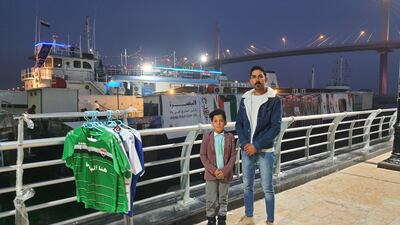
  • Mustafa Mohammed, 30, and his son Ibrahim roam around the Basra Corniche as they enjoy the festive mood before the start of the tournament
    Mustafa Mohammed, 30, and his son Ibrahim roam around the Basra Corniche as they enjoy the festive mood before the start of the tournament
  • A hoarding welcoming Gulf residents on the main road linking Basra International Airport to the city centre
    A hoarding welcoming Gulf residents on the main road linking Basra International Airport to the city centre
  • An electronic board features an advertisement promoting the tournament
    An electronic board features an advertisement promoting the tournament
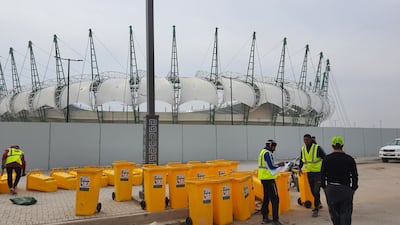
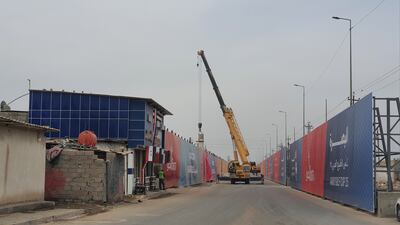
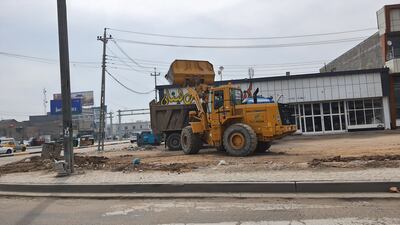
  • Metal and wooden panels are put up around the city before the start of the tournament
    Metal and wooden panels are put up around the city before the start of the tournament
  • The tournament was initially set to take place in December but was postponed to January as it was scheduled too close to the World Cup
    The tournament was initially set to take place in December but was postponed to January as it was scheduled too close to the World Cup

“The most beautiful thing about this event is that it has reunited Iraqis with the people of the Gulf states,” taxi driver Haider Abdullah, 29, told The National.

Eight fans from the city of Tikrit, north of Baghdad, are staying on the second floor of his house. Seven Kuwaiti fans are staying next door.

For Iraq, a successful hosting of the tournament is more important than adding another Gulf Cup championship to the three it has won so far, including in 1979 when the country last hosted the tournament.

It will be a strong sign of recovery after decades of war, political isolation and instability, which prompted Fifa to impose a ban on hosting international matches that was lifted only last year.

“All are keen to make this event a success,” Adnan Dirjal, the head of Iraq’s Football Association, told state TV this week.

“I’m positive that this event will remarkably change the general perspective [about sport in Iraq], even within the government itself, to rebuild confidence with the whole world,” he said.

Basra, on the shores of the Arabian Gulf about 530km south of Baghdad, endured major fighting during the 1980-1988 Iran-Iraq war, a bloody uprising against former dictator Saddam Hussein in 1991 and clashes between government forces and local militias in 2008. More recently, the city witnessed violent demonstrations as part the October 2019 anti-government protest movement, as well as protests over a lack of public services.

For some residents, the money allocated for Gulf Cup preparations would have been better spent on important infrastructure, including electricity and water treatment facilities, which are sorely needed in an area that regularly experiences power failures in scorching summer temperatures.

“It’s nice to have such an event in your hometown, but I think it’s not the perfect time,” said Ammar Abid, 22.

“There are other priorities for us now that they should have focused on instead."

COMPANY%20PROFILE
%3Cp%3E%3Cstrong%3ECompany%20name%3A%3C%2Fstrong%3E%20Switch%20Foods%3Cbr%3E%3Cstrong%3EStarted%3A%3C%2Fstrong%3E%202022%3Cbr%3E%3Cstrong%3EFounder%3A%3C%2Fstrong%3E%20Edward%20Hamod%3Cbr%3E%3Cstrong%3EBased%3A%3C%2Fstrong%3E%20Abu%20Dhabi%2C%20UAE%3Cbr%3E%3Cstrong%3EIndustry%3A%3C%2Fstrong%3E%20Plant-based%20meat%20production%3Cbr%3E%3Cstrong%3ENumber%20of%20employees%3A%3C%2Fstrong%3E%2034%3Cbr%3E%3Cstrong%3EFunding%3A%3C%2Fstrong%3E%20%246.5%20million%3Cbr%3E%3Cstrong%3EFunding%20round%3A%3C%2Fstrong%3E%20Seed%3Cbr%3E%3Cstrong%3EInvestors%3A%3C%2Fstrong%3E%20Based%20in%20US%20and%20across%20Middle%20East%3C%2Fp%3E%0A
Coffee: black death or elixir of life?

It is among the greatest health debates of our time; splashed across newspapers with contradicting headlines - is coffee good for you or not?

Depending on what you read, it is either a cancer-causing, sleep-depriving, stomach ulcer-inducing black death or the secret to long life, cutting the chance of stroke, diabetes and cancer.

The latest research - a study of 8,412 people across the UK who each underwent an MRI heart scan - is intended to put to bed (caffeine allowing) conflicting reports of the pros and cons of consumption.

The study, funded by the British Heart Foundation, contradicted previous findings that it stiffens arteries, putting pressure on the heart and increasing the likelihood of a heart attack or stroke, leading to warnings to cut down.

Numerous studies have recognised the benefits of coffee in cutting oral and esophageal cancer, the risk of a stroke and cirrhosis of the liver. 

The benefits are often linked to biologically active compounds including caffeine, flavonoids, lignans, and other polyphenols, which benefit the body. These and othetr coffee compounds regulate genes involved in DNA repair, have anti-inflammatory properties and are associated with lower risk of insulin resistance, which is linked to type-2 diabetes.

But as doctors warn, too much of anything is inadvisable. The British Heart Foundation found the heaviest coffee drinkers in the study were most likely to be men who smoked and drank alcohol regularly.

Excessive amounts of coffee also unsettle the stomach causing or contributing to stomach ulcers. It also stains the teeth over time, hampers absorption of minerals and vitamins like zinc and iron.

It also raises blood pressure, which is largely problematic for people with existing conditions.

So the heaviest drinkers of the black stuff - some in the study had up to 25 cups per day - may want to rein it in.

Rory Reynolds

Updated: January 17, 2023, 7:03 AM