


Now in its 42nd year, Gitex has grown from a niche, special interest show into one of the world's largest exhibitions of its kind.
The first event was launched as the Gulf Computer Exhibition in December 1981 at the Dubai International Trade and Exhibition Centre.
Designed by British architect John Harris, at the time, the 149-metre Trade Centre was the tallest building in the Gulf.
It was a natural fit for the cutting-edge technology exhibition, which came at a time when almost half of those attending did not own or use computers.
IBM had just introduced its first personal computer, which ran on Microsoft’s nascent MS-DOS operating system, and many people were still unaware of the impact that the microcomputer revolution was about to have on the world.
But during the event, 3,000 visitors from the Arabian Peninsula, explored the latest software and hardware from 46 exhibitors around the world – including Arabic-language software, British Telecom’s Prestel virtual newspaper and the ICL Perq – the first personal workstation with a Graphical User Interface.
The next year, the number of exhibitors grew to 70, and in 1985 the event hosted the launch of IBM's Arabic-language keyboard.
In 1988, the event was renamed the Gulf Information Technology Exhibition — Gitex for short — and launched MacWorld, doubling its exhibition space to two halls.
The event continued to grow over ensuing years, passing 10,000 visitors in 1989, and 350 exhibitors in 1995 — when the event hosted the regional launches of Microsoft Windows 95.
Since then, Gitex has grown from strength to strength, hitting 125,000 visitors during its 25th anniversary, and becoming the world’s third-largest ICT show by 2010.

Along the way it has grown from what Jacky’s Electronics chief operating officer once described to The National as a “techie event”, where people went to buy Ram and motherboards, into a five-day display of the latest innovations in 5G, artificial intelligence, cloud technology, cyber security, FinTech, blockchain, data analytics and smart cities.
It is a journey that mirrors the UAE’s own, as a nation that moved from an adopter of technological innovations into one of the world’s driving forces of the Fourth Industrial Revolution.
This year, the event, now known as Gitex Global, will feature the first public flight of a Chinese tech company's two-seat, vertical take-off and landing flying car.
Between October 10 and October 14, 5,000 companies will occupy two million square feet of exhibition space — a 25 per cent increase on 2021 — divided into 26 halls.
“This year, my office has partnered with Gitex to ensure that we’re not just showcasing technology, but actually inventing and developing technology,” Omar Al Olama, the UAE's Minister of State for Digital Economy, AI and Remote Working System, said of Gitex's evolution.
Scroll through images of last year's Gitex below
-
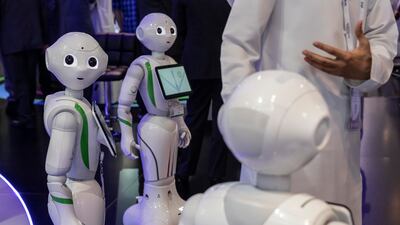
Robots gather on the third day of Gitex 2021 at the World Trade Centre in Dubai. All photos: Antonie Robertson/The National -
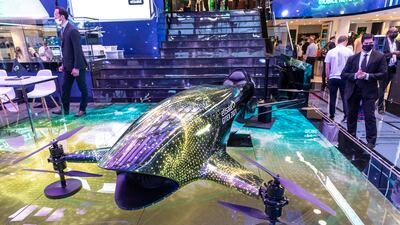
A life-sized speeder drone at the Etisalat stand at Gitex. -
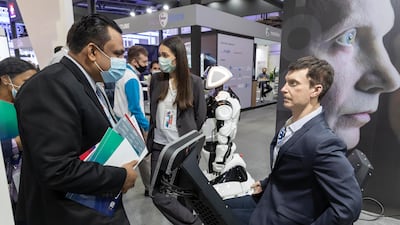
A Russian-designed android robot called Alex. -

An exhibition showing rare, historic Apple computers. -
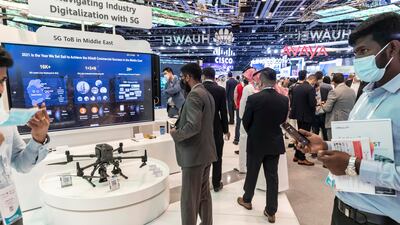
Visitors admire a drone on the third day of Gitex 2021. . -
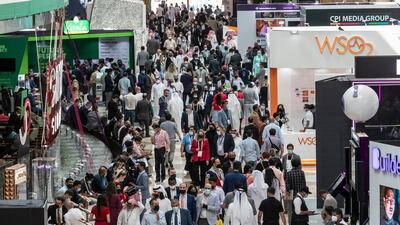
Thousands of visitors attended Gitex 2021 on the third day. -
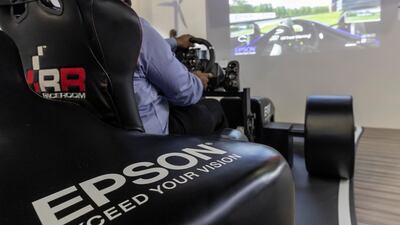
A visitor tries out a simulation of a racing car.



