

On November 4, 1922, an archaeological team led by British Egyptologist Howard Carter excavated the tomb of Tutankhamun in Egypt's Valley of the Kings.
A century later, the National Geographic Museum in Washington is marking the discovery's centennial with an exhibition that brings the tomb, its precious artefacts and all they symbolise to life for a digital era.
The exhibition has drawn from the National Geographic Society's archives to take visitors on a journey into King Tut's Egypt, bringing the archaeological find to life through cinematic storytelling and state-of-the-art projection mapping.
-

Visitors to the National Geographic Museum in Washington take a step into the afterlife at the Beyond King Tut experience. Photo: Katarina Holtzapple / The National -
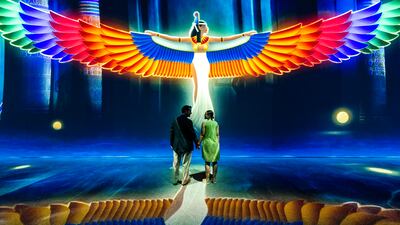
Beyond King Tut is produced by Paquin Entertainment Group and Immersive Experiences. Photo: National Geographic -

Viewers admire a digital recreation of King Tut's famous golden sarcophagus. Photo: Katarina Holtzapple / The National -

Visitors learn about King Tut's life as well as his death in the immersive new exhibition. Photo: Katarina Holtzapple / The National -

The digital recreation of King Tut's tomb includes a scaled-down replica of the Boy King's sarcophagus. Photo: Katarina Holtzapple / The National -

King Tut's final resting place, and its thousands of artefacts, are reimagined in National Geographic's digital exhibition. Photo: Katarina Holtzapple / The National -

National Geographic's modern exhibition creates plenty of photo and Instagram-worthy moments for visitors. Photo: Katarina Holtzapple / The National -

A recreation of King Tut's golden bust. Photo: Katarina Holtzapple / The National -

The afterlife section of the Beyond King Tut experience was informed by the Book of the Dead and religious beliefs from Ancient Egypt. Photo: Katarina Holtzapple / The National -

Visitors move from life into death and afterlife, in National Geographic's Beyond King Tut experience. Photo: Katarina Holtzapple / The National -
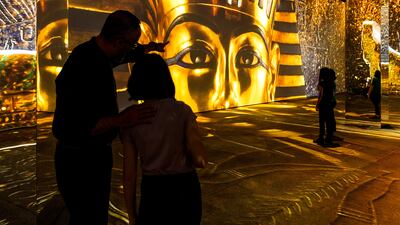
The experience takes visitors on a journey flooded with sights, sounds and intrigue through the world of King Tut. Photo: National Geographic -

King Tut ruled Egypt as pharaoh for 10 years until his death at age 19, about 1324BC. Photo: Katarina Holtzapple / The National


“This is obviously a story that we've been telling for a hundred years at National Geographic, so the narrative we were pretty sure about and have a lot of research we've been doing over the years,” Kathryn Keane, vice president of public programming for the National Geographic Society, told The National.
“So it was great to get experts in projection technology and media production involved in this story, bring it out of the pages of National Geographic magazine and into this immersive environment.”
The journey begins with the 1922 archaeological mission, with background on Carter, the discovery's front-page coverage in The New York Times, and context on colonialism's role in western expeditions throughout the Ottoman Empire and beyond.
From there, like a monochrome Dorothy being dropped into the colourful land of Oz, visitors are plunged into a digitally and sonically immersive experience that starts with a recreation of the tomb itself, leading to display's of Tutankhamun's family life, history and even his favourite board game, Senet.
The grand finale is an intrepid voyage into the afterlife. Created by immersive storytelling company CityLights and voiced by English actor Hugh Bonneville, visitors join King Tut on a vibrant, 20-minute cinematic journey to the sun god Ra.
-
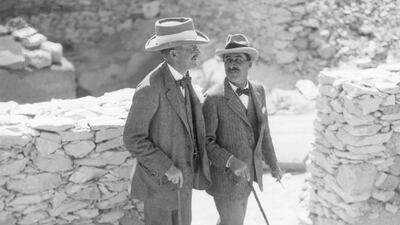
English Egyptologist Howard Carter (1874-1939, right) with the patron of his research, archaeologist and Fifth Earl of Carnarvon George Herbert (1866-1923), at the Valley of the Kings excavation site, Egypt. In 1922 the pair discovered the tomb of King Tutankhamen. Getty Images -

Carter and an Egyptian colleague examining the inner coffin. Photo: The Bodleian Library / University of Oxford -
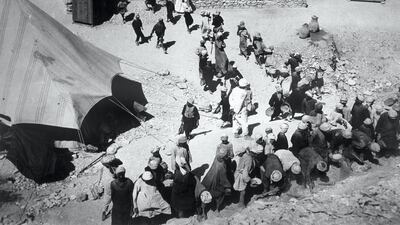
Closing the tomb of Tutankhamun, Valley of the Kings, Egypt, February 1923. The discovery of the tomb in 1922 was one of the most astounding discoveries in archaeology. Tutankhamun was a previously unknown pharaoh whose name had been eradicated from historical records by one of his successors because of his association with the heretical pharaoh Akhenaten, who was Tutankhamun's father-in-law. Consequently his tomb, uniquely, had remained undisturbed by grave robbers. Getty Images -

Objects found in the antechamber. Getty Images -
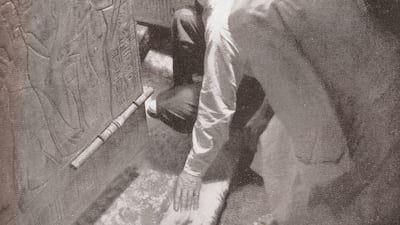
Carter and associates opening the doors of King Tutankhamun's burial shrine in the Valley of the Kings, Egypt; screen print from a photograph, 1923. Getty Images -
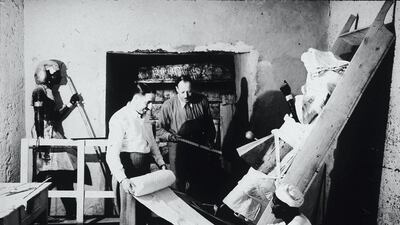
British archaeologists Carter, left, and Arthur Callender, who died in 1937, remove objects from the antechamber of the tomb with help from an Egyptian worker, Thebes, Egypt, 1923. Getty Images -
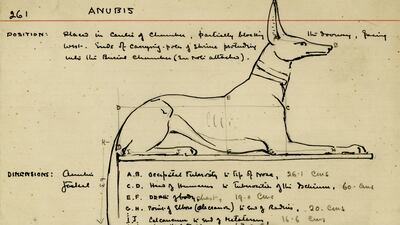
One of Carter’s record cards showing his drawing of the jackal god Anubis with notes and measurements. Photo: Griffith Institute / University of Oxford -
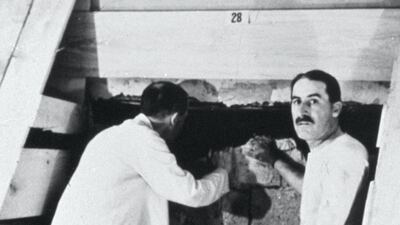
Carter, right, opening the door to the tomb of Tutankhamun in 1922. Getty Images -
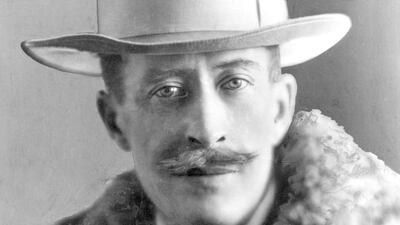
The Earl of Carnavon, who financed the excavation. Getty Images -

An illustration of Howard Carter and the Earl of Carnarvon inside the tomb. Getty Images -

Tutankhamun’s sarcophagus, containing the pharaoh’s gold coffin. Getty Images


Visitors are surrounded by a 360-degree, floor-to-ceiling experience, complete with central mirrors that visually place onlookers into the imagery.
The narrator takes viewers through scenes inspired by ancient religious beliefs, with dramatic music and bright imagery.
“We take a little creative licence, basing our narrative on The Book of the Dead and the common religion of Egyptians at the time and what they thought would have happened to King Tut in the afterlife,” said Ms Keane.
Tutankhamun, nicknamed “The Boy King”, assumed the throne at one nine years old in 1333 BC, ruling for 10 years until his untimely death in 1323 BC. Tutankhamun was then mummified and buried in a tomb filled with artwork, jewellery and other treasures.
Desert sands quickly covered the tomb and it remained mostly hidden for more than 3,000 years, until Carter's archaeological team came along. Carter's expedition uncovered breathtaking artefacts including the famous golden sarcophagus and mummified Boy King himself.
A tour of the recently discovered 4,000-year-old pharaonic tombs near Cairo
If not for that find, Ms Keane noted, the name that has become synonymous with Ancient Egypt may have been lost to history.
“It was world news when it happened in 1922. An intact tomb had never been discovered,” she said. “Even though Tut was a very minor pharaoh … [his tomb] was still full of over 5,000 treasures which have been informing historians and scholars and researchers, and really, captured the imagination of the world ever since.”
A majority of the physical artefacts from Tutankhamun's tomb are in the Egyptian Museum in Cairo, but many of these are in the process of moving to a new home: the Grand Egyptian Museum, located near the Giza Pyramids, which will open this year.
In an era when western museums are facing a reckoning over their possession of looted, stolen or colonised artefacts, the immersive Beyond King Tut exhibition in Washington showcases what museum experiences could look like when historical pieces remain in their homelands.
The Beyond King Tut exhibition will run at the National Geographic Museum in Washington until February 2023 and the SoWa Power Station in Boston until September of this year.
National Geographic will also commemorate the 100th anniversary of the discovery of King Tut’s tomb in November, with content including a televised documentary and a magazine feature.

