

Between Hebron Street and Manger Street in Bethlehem, it's impossible to miss the painting of a peace dove wearing a flak jacket covering a large patch of wall.
The piece, called Armoured Dove, is a commentary on the Palestinian-Israeli conflict and is widely credited to the elusive British artist Banksy.
While it may or may not be a genuine Banksy (more on that later), it also acts as a handy signpost for arguably one of Bethlehem's most intriguing shops: the Palestinian Heritage Centre.
Run by Maha Saca, this gem of a space, which opened in 1991, is part museum, part shop and filled to bursting with historical items that document a Palestinian culture now largely lost.
And it is this modern-day piece of graffiti that, in many cases, drives people towards it.

Saca claims she met Banksy when he created the work. He wandered into the shop to ask her permission to cover the wall, she says. But Saca was not happy with the first design he proposed.
"It was an Israeli soldier," she says. "I said, 'I have enough of those already', and asked for something softer. So he suggested the dove."
People are unsure whether this is all true because the Armoured Dove doesn't appear on Banksy's official website, making provenance hard to verify, but Saca is convinced the artwork is real.
She gives a charming description of a man she thought was homeless, and says she was so concerned about him that she fed him for a week. Only later did she learn the man might have been the elusive artist himself.
“I had no idea who he was but I have a photograph of him,” she says. “But I am sworn to never show it to anyone.”
Even her son-in-law, visiting from America at the time Saca recounts this story, is adamant he has never seen the image.
Was it Banksy? Who knows. Saca may or may not have a priceless artwork on the wall outside her shop, but either way what's inside is unquestionably invaluable.
Baskets, furniture, dresses and jewellery have been collected over 30 years, and Saca is now both a proud guardian of her nation’s heritage and a walking encyclopaedia on Palestinian embroidery.
-

Palestinian Heritage Centre owner Maha Saca, centre, in traditional dress. All photos: Palestinian Heritage Centre -

A modern dress with traditional embroidery found at the centre. -

A modern cushion cover with a pattern from Jenin. -

Traditional Bethlehem bridal headcoverings, decorated with dowry coins. -

Another traditional pattern made into a modern cushion cover. -

Making them is slow and laborious. But the sale of the cushion covers provides an income for women living in Bethlehem refugee camps. -

A modern cushion cover made by the women of Bethlehem's refugee camps. -

A modern dress with traditional embroidery. -

Vibrant patterns are now used to make large cushions. -

A modern cushion cover, with traditional embroidery.


Traditional Palestinian embroidery, also known as tatreez, was added to the Unesco list of intangible cultural heritage in December 2021, and to help prevent its demise, Saca sells modern-day cushion covers and purses covered with its unique markings.
One cushion case has a vaguely floral pattern of mostly green hues that is typical of the region around Bethlehem, while another is densely patterned, as traditionally found in the West Bank's largest city, Hebron.
Not only does this market for modern work help to keep the techniques alive, it also provides much-needed income for Palestinian women in the refugee camps of Azza, Aida and Dehesha.
Saca also stocks rail after rail of dresses. The distinctive cross stitching that decorates traditional Palestinian dress is more that just a pretty design, but rather a visual guide of who the wearer was; her marital status and where she was from.
The shop covers the whole of Palestine, with woven thobes from Jerusalem and Jaffa, and tall bridal headdresses decorated with dowry coins, from Bethlehem.
From Ramallah, she has a white dress covered in delicate red stitches, while another is covered in the flower-like patterns associated with Ramla.
There is a thobe from Safad with distinctive, diamond-shaped patchwork, and colourful dresses smothered in stitches, recognisable from the desert region of the Naqab.
While some of the finest pieces are not for sale, instead kept as an archive, Saca is happy to share her wealth of knowledge about every item, easily trotting out information on where, and from whom, she bought it.
Saca is the guardian of a collection that demonstrates how rich and nuanced Palestinian culture once was, making her one of a number of women across the world fighting to preserve this unique heritage.
That, no matter what way you look at it, is priceless. Banksy would undoubtedly agree, whether he was there or not.
Banksy in Palestine: A look at the street artist's work in Gaza and the West Bank — in pictures
-
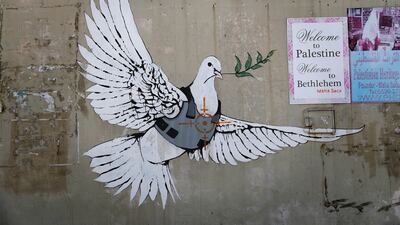
A graffiti by British street artist Banksy showing a dove with a bulletproof vest is seen in the Israeli occupied West Bank town of Bethlehem on March 15, 2017. AFP -
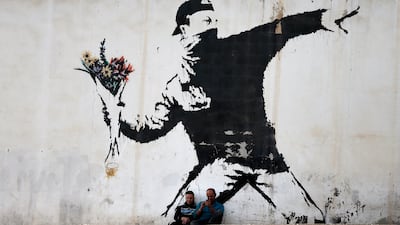
Two men are sitting in front of a famous graffiti of British street artist Banksy, painted on a wall of a gas station in the West Bank city of Bethlehem on December 16, 2015. AFP -
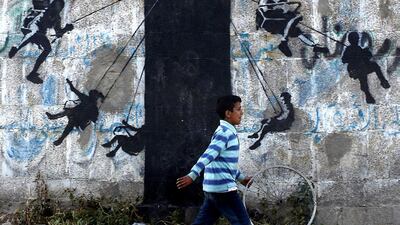
A Palestinian boy walks past a Banksy mural of children using an Israeli army watch tower as a swing ride in Beit Hanoun, Gaza, as seen on April 10, 2015. EPA -
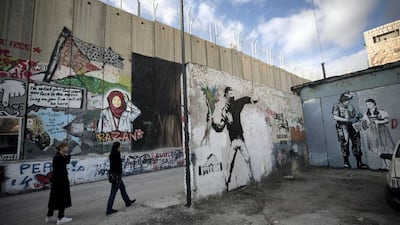
'The Flower Thrower', arguably one of the most famous works by Banksy, depicts a masked Palestinian man throwing a bouquet of flowers, seen in Bethlehem on December 12, 2018. EPA -
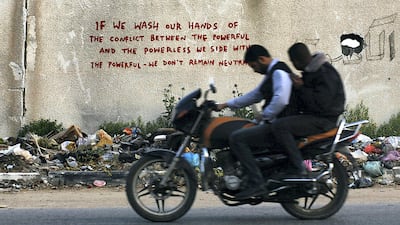
Palestinians ride a motorcycle past words thought to be painted by British street artist Banksy on the wall of destroyed homes in Beit Hanoun town in northern Gaza. Pictured on April 10, 2015. EPA -
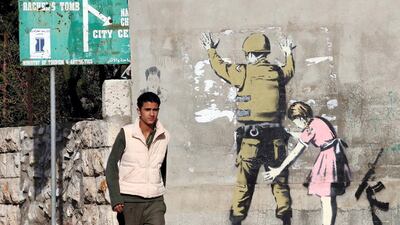
A work by Banksy, seen in Bethlehem in December 2007. The stencilled work has been interpreted to depict a small girl in a dress, thought to be Palestinian, frisking an Israeli soldier. EPA -
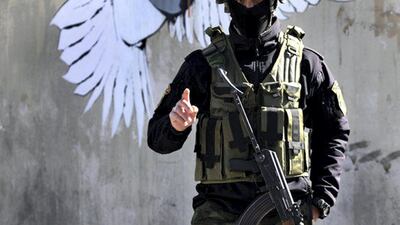
An armed Palestinian policeman stands before 'The Armoured Dove', a graffiti painting by Banksy depicting a peace dove wearing a flak jacket with crosshairs on the bird's chest, painted on a wall at the entrance to the West Bank city of Bethlehem, as photographed on January 6, 2019. EPA -
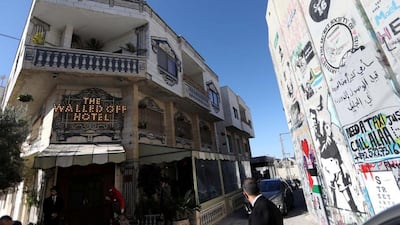
Banksy opened The Walled Off Hotel in Bethlehem in 2017. EPA -
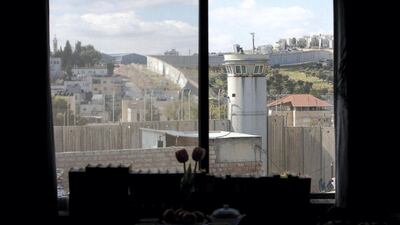
A view through a window inside The Walled Off Hotel. EPA -
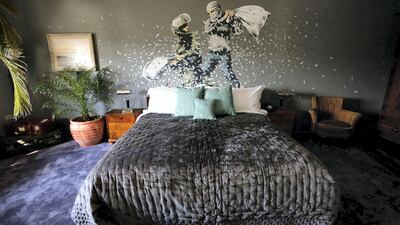
A room at The Walled Off Hotel in Bethlehem with a work by Bansky, depicting an Israeli soldier and a Palestinian protester during a pillow fight. EPA -
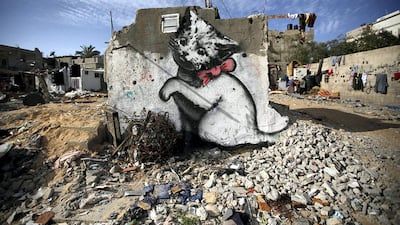
A graffiti mural of a kitten by Banksy, on the wall of the Al Shimbari family's home, which was damaged during the 2014 conflict between Israel and Hamas, in Beit Hanoun in northern Gaza. Seen on February 27, 2015. EPA -
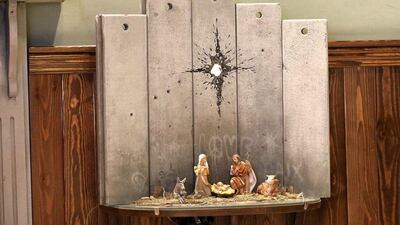
'Scar of Bethlehem' is a modified nativity set that Banksy created for the Walled Off Hotel in Bethlehem in December 2019 . EPA -
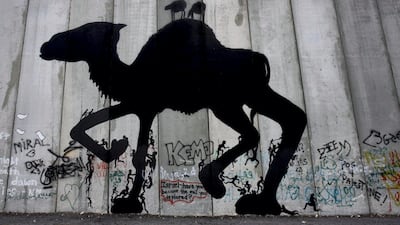
A rumoured work by Banksy, depicting a camel with human figures climbing up and down its legs. Seen on December 4, 2007. EPA -
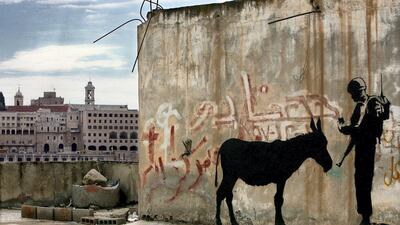
A stencilled work by Banksy, showing an Israeli soldier asking a donkey for its identity card, seen on December 4, 2006. EPA -

A mural by Banksy in Beit Hanoun, as seen in February 2015, depicts a bent figure wearing a head scarf, painted on the door of a home destroyed by the Israeli military in 2014. EPA -

Graffiti thought to be by Banksy, as seen in December 2007 in Bethlehem. The white donkey has what appears to be a small Palestinian village on its bac,k and the black donkey carries on its back what appears to be a modern Israeli town. The work was not signed by Banksy. EPA -
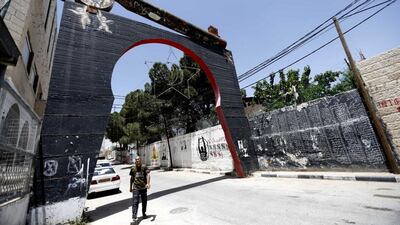
Banksy street art on the entrance to the Aida refugee camp in Bethlehem, as seen on April 18, 2019. EPA -
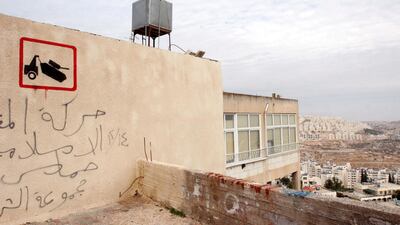
This stencil of a tank being towed away on the wall of a house on a main street in Bethlehem is credited to Banksy, but not signed, as seen December 4, 2007. EPA



