A Gulf Aviation plane lands at Abu Dhabi's airstrip in the early 1960s. Photo: David Riley

Timeframe: a look back at Abu Dhabi's first airport


John Dennehy
  • English
  • Arabic

Cancelled flights, long queues at airports and lost baggage ― it is turning out to be a stressful summer for some holidaymakers.

It is enough to make one yearn for the simpler, more carefree days of aviation, as this photograph shows.

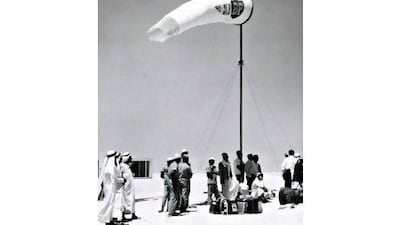
This was Abu Dhabi’s first airport, in the early 1960s. The facilities consisted of a windsock, fuel drum and a fire extinguisher. A rudimentary “no smoking” sign can be seen on the right.

The photograph was taken by David Riley, a British citizen who lived here then, just as a Gulf Aviation flight, most probably from Bahrain, touched down. Gulf Aviation step ladders in the centre of the photograph were used by passengers to disembark. From there, Land Rovers typically took visitors over sand tracks to the town. Just out of shot is the old terminal building.

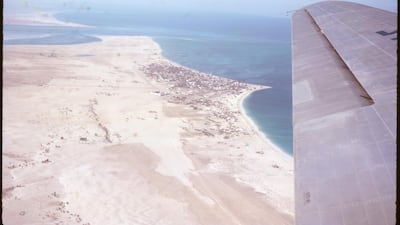
  • An aerial shot of a plane over Abu Dhabi in the early 1960s after taking off from a sand runway close to Sultan bin Zayed the First (Muroor Road) and 17th Street. Photo: David Riley
    An aerial shot of a plane over Abu Dhabi in the early 1960s after taking off from a sand runway close to Sultan bin Zayed the First (Muroor Road) and 17th Street. Photo: David Riley
  • Passengers wait with their suitcases for a flight at Abu Dhabi's sand airstrip. Photo: BP Archive
    Passengers wait with their suitcases for a flight at Abu Dhabi's sand airstrip. Photo: BP Archive
  • On approach to Abu Dhabi's first airfield. The photograph was taken in the mid-1960s. Photo: Michael Stokes
    On approach to Abu Dhabi's first airfield. The photograph was taken in the mid-1960s. Photo: Michael Stokes
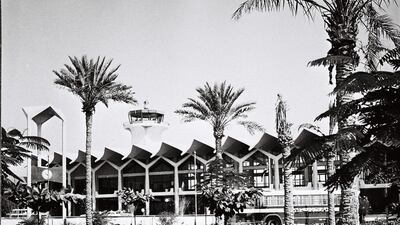
  • Al Bateen Airport, pictured in the 1970s, replaced the sand strip. Photo: Al Ittihad
    Al Bateen Airport, pictured in the 1970s, replaced the sand strip. Photo: Al Ittihad
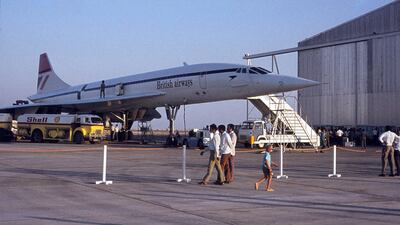
  • Concorde makes an appearance at Al Bateen Airport in August, 1974. The visit was part of a demonstration tour to drum up new customers but also to prove the jet’s capability in hot weather. Photo: Peter Alvis
    Concorde makes an appearance at Al Bateen Airport in August, 1974. The visit was part of a demonstration tour to drum up new customers but also to prove the jet’s capability in hot weather. Photo: Peter Alvis
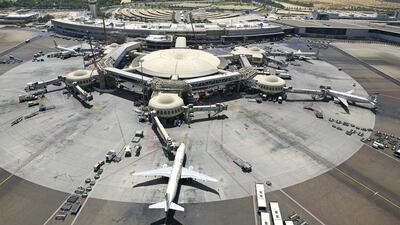
  • Abu Dhabi International Airport opened in 1982. It was designed by French architect Paul Andreu with the idea that planes would surround a satellite, so they could arrive and depart quickly. Photo: Abu Dhabi Airports
    Abu Dhabi International Airport opened in 1982. It was designed by French architect Paul Andreu with the idea that planes would surround a satellite, so they could arrive and depart quickly. Photo: Abu Dhabi Airports
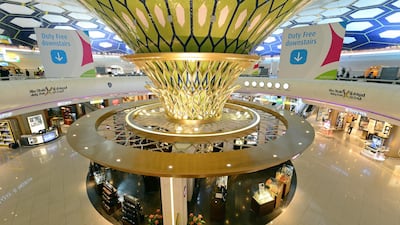
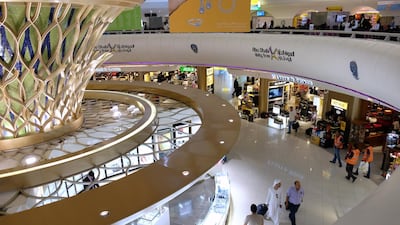
  • The ceiling of Abu Dhabi airport, said to be designed like a palm tree against the sky. Photo: Abu Dhabi Airports
    The ceiling of Abu Dhabi airport, said to be designed like a palm tree against the sky. Photo: Abu Dhabi Airports
  • The circular design of Abu Dhabi airport's terminal placed the gates close to each other so people could access planes quickly. Delores Johnson / The National
    The circular design of Abu Dhabi airport's terminal placed the gates close to each other so people could access planes quickly. Delores Johnson / The National

“It was early evening as I landed and I can still see the sun low in the sky going down over a view of the soft sand, a few palm trees and the occasional barasti house with the Ruler’s Palace [Qasr Al Hosn] in the distance,” Riley says of his first arrival into Abu Dhabi in 1962.

“Some would say it was very ‘romantic'. I must confess I did wonder where I had come to at the time,” he says.

But Riley, who is now back in the UK, says, "I needn’t have worried as it is one of the most enjoyable places I have lived and worked”.

There was only a small expatriate community in Abu Dhabi then. The Club opened in 1962 and construction of the Beach Hotel, Abu Dhabi’s first, finished the same year. The first shipments of oil also left from the emirate in 1962. Riley recalled a few small shops selling basic supplies ― tinned food, cigarettes, condensed milk and rice ― when he first arrived, but at the time a lot of fresh food was flown in on these daily flights from Bahrain.

“Going to the landing strip in the late afternoon to meet the flight from Bahrain was one of the things one did,” says Riley, who worked for the British Bank of the Middle East, which became part of HSBC.

“It was quite common to meet friends there who were in a similar situation. It was also a good opportunity to see who was coming in.”

Riley previously recalled an incident one night when an injured oil worker was taken from a desert camp to Abu Dhabi at night. Because the air strip was not lit, several people drove to the airfield in their Land Rovers and lit it up using their vehicle headlamps, allowing the pilot to take off for Bahrain where the stricken man received life-saving treatment.

But time has moved on. Gulf Aviation has become Gulf Air, while Abu Dhabi’s airport moved to Al Bateen in the late 1960s before shifting to its current off-island location in January, 1982. More than six decades on, Abu Dhabi airport expects at least 10.7 million passengers to pass through its main airport in 2022, more than double last year’s number as business surges back after the Covid-19 pandemic. A huge new terminal ― Midfield ― is also taking shape.

The original terminal building, meanwhile, still stands today in the grounds of Abu Dhabi Media off Sultan bin Zayed the First and Al Salsabeel Street. It is a gentle reminder of simpler aviation times.


The specs: 2018 Nissan 370Z Nismo

The specs: 2018 Nissan 370Z Nismo
Price, base / as tested: Dh182,178
Engine: 3.7-litre V6
Power: 350hp @ 7,400rpm
Torque: 374Nm @ 5,200rpm
Transmission: Seven-speed automatic
​​​​​​​Fuel consumption, combined: 10.5L / 100km

On Instagram: @WithHopeUAE

Although social media can be harmful to our mental health, paradoxically, one of the antidotes comes with the many social-media accounts devoted to normalising mental-health struggles. With Hope UAE is one of them.
The group, which has about 3,600 followers, was started three years ago by five Emirati women to address the stigma surrounding the subject. Via Instagram, the group recently began featuring personal accounts by Emiratis. The posts are written under the hashtag #mymindmatters, along with a black-and-white photo of the subject holding the group’s signature red balloon.
“Depression is ugly,” says one of the users, Amani. “It paints everything around me and everything in me.”
Saaed, meanwhile, faces the daunting task of caring for four family members with psychological disorders. “I’ve had no support and no resources here to help me,” he says. “It has been, and still is, a one-man battle against the demons of fractured minds.”
In addition to With Hope UAE’s frank social-media presence, the group holds talks and workshops in Dubai. “Change takes time,” Reem Al Ali, vice chairman and a founding member of With Hope UAE, told The National earlier this year. “It won’t happen overnight, and it will take persistent and passionate people to bring about this change.”

Ticket prices

General admission Dh295 (under-three free)

Buy a four-person Family & Friends ticket and pay for only three tickets, so the fourth family member is free

Buy tickets at: wbworldabudhabi.com/en/tickets

De De Pyaar De

Produced: Luv Films, YRF Films
Directed: Akiv Ali
Cast: Ajay Devgn, Tabu, Rakul Preet Singh, Jimmy Sheirgill, Jaaved Jaffrey
Rating: 3.5/5 stars

Pari

Produced by: Clean Slate Films (Anushka Sharma, Karnesh Sharma) & KriArj Entertainment

Director: Prosit Roy

Starring: Anushka Sharma, Parambrata Chattopadhyay, Ritabhari Chakraborty, Rajat Kapoor, Mansi Multani

Three stars

Who was Alfred Nobel?

The Nobel Prize was created by wealthy Swedish chemist and entrepreneur Alfred Nobel.

  • In his will he dictated that the bulk of his estate should be used to fund "prizes to those who, during the preceding year, have conferred the greatest benefit to humankind".
  • Nobel is best known as the inventor of dynamite, but also wrote poetry and drama and could speak Russian, French, English and German by the age of 17. The five original prize categories reflect the interests closest to his heart.
  • Nobel died in 1896 but it took until 1901, following a legal battle over his will, before the first prizes were awarded.
MATCH INFO

Jersey 147 (20 overs) 

UAE 112 (19.2 overs)

Jersey win by 35 runs

Updated: July 22, 2022, 6:01 PM