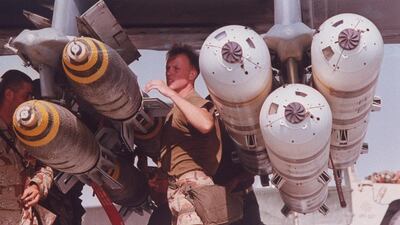
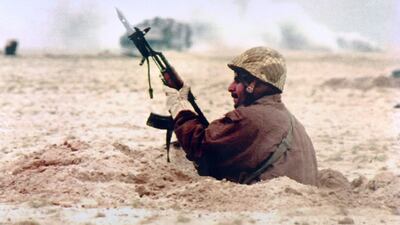
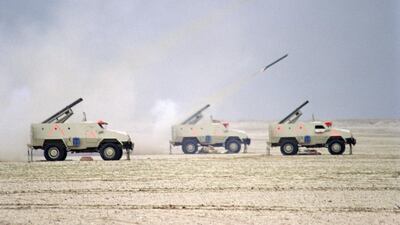
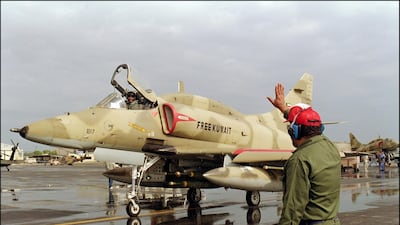
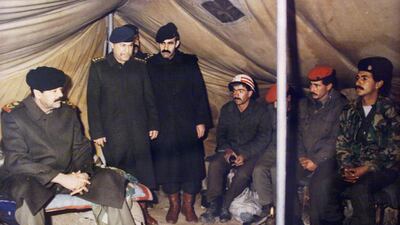
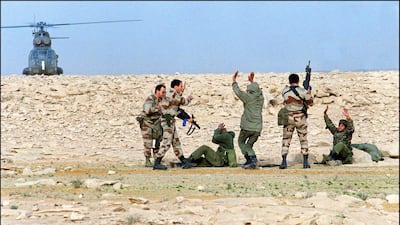
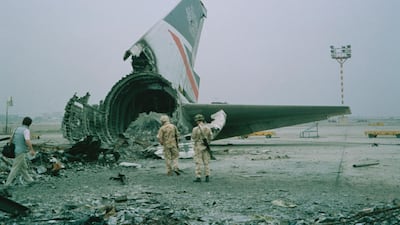
Soldiers from the US 82nd Airborne Division during Operation Desert Shield in Iraq, in 2006, three years after the fall of Saddam Hussein. Getty

Gulf War syndrome: were thousands of Iraqis poisoned by sarin in 1991?


Robert Tollast
  • English
  • Arabic

In the months after the 1991 Gulf War, when Saddam Hussein's forces were pushed out of Kuwait, tens of thousands of Coalition soldiers reported mysterious symptoms.

This number eventually rose to about 100,000 and for decades, scientists wondered what caused what later became known as Gulf War syndrome: fatigue, persistent headaches, muscle pain, confusion and even difficulty speaking.

Some studies even said the soldiers suffered higher rates of motor neuron disease and a type of brain cancer known as glial brain cancer.

On May 14, a milestone study by scientists at the University of Texas concluded that Iraqi weapons storage sites filled with nerve gas and other explosives in central Iraq — and one site not far from the southern town of Nasiriyah, had exposed the soldiers to the deadly chemicals when they were blown up by Coalition jets.

This raises the question: if 100,000 Coalition soldiers could be sickened by these toxic explosions despite being 600 kilometres away, what happened to Iraqis near the ammunition sites?

The mystery of Al Muthanna

The evening of January 19, 1991, was the third night of fear for millions of Iraqis in a month-long Coalition bombing campaign.

The Al Muthanna State Establishment, an industrial complex for chemical weapons production, was near the top of the target list.

For two nights, nearly 30 cruise missiles smashed into bunkers and buildings at the remote site, 80 kilometres north-west of Baghdad. But the biggest bunkers, built with thick reinforced concrete, were impervious.

Coalition jets returned on January 19 with “bunker buster" bombs, each filled with nearly a tonne of powerful explosives, piercing one of the enormous structures.

After the war, about four Iraqi chemical sites — including the three largest ― were identified as having been hit in the air raids.

.
.

Iraq had widely dispersed its arsenal of about 700 tonnes of declared chemical weapons, burying it or storing it alongside regular ammunition — later saying the US bombed about five per cent of the arsenal in 1991, before Saddam Hussein ordered it to be destroyed.

“We now know that the Iraqis really were trying to account for all their chemical weapons when working with UN weapons inspectors in the 90s," says Charles Duelfer, the former deputy head of UN weapons inspection teams through much of the 1990s.

"The problem was their accounting was not very good. For example, they often did not mark chemical rounds differently from normal high explosive or white phosphorus. This was true of artillery and artillery rockets."

In bunker 2 at Al Muthanna as many as 2,500 sarin-filled rockets were destroyed — nearly 17 tonnes of nerve agent, later UN inspections confirmed.

It remains the largest air strike on a nerve agent stockpile in history.

About 50 milligrams of sarin in a cubic metre of air can be lethal, but even a milligram per cubic metre can cause illness, inhaled over the course of one minute.

Scientists have now confirmed even smaller doses can cause lifelong health complications.

.
.

Multiple inquiries struggled to find the cause of Gulf War Syndrome; some believed new vaccines for troops against biological weapons, or pills distributed to protect against chemical attacks could be the culprit.

Others suggested oil fires set ablaze by Saddam’s forces in Kuwait — that caused respiratory illnesses in thousands of Kuwaitis — was another possibility.

Depleted uranium — a metal used in armour-piercing ammunition — could also have sickened the troops, or dangerous pesticides used to control insects on Coalition bases.

Some said it was a toxic cocktail of all of the above.

By 1995, research zoomed in on the bombing of chemical sites.

Models using meteorological data and simulated explosions of chemical weapons at five bases across Iraq showed that nerve agents could have travelled hundreds of kilometres.

Initial studies concluded that Coalition troops were exposed to chemical vapour near a destroyed bunker in southern Iraq known as bunker 73 at Khamisiyah, close to where the forces had advanced.

.
.

There were no reports of civilian casualties near any of the sites, so civilians apparently escaped the toxic clouds.

Meanwhile, because sites like Al Muthanna in central Iraq were 600 kilometres north of the Coalition, the soldiers were thought to be out of harm’s way.

“The intelligence community's assessment was that potential plumes from these sites could not have reached US troops,” a 2004 report by the American government said.

Subsequent inquiries focused on the Khamisiyah explosions that were closer to US forces.

For Robert Haley, a scientist at the University of Texas, these explanations weren’t satisfactory.

Mr Haley and his team noted an intriguing coincidence: when air strikes hit Al Muthanna on 19 January, within 24 hours thousands of chemical alarms used by Coalition forces went off 600 kilometres to the south.

The alarms had picked up low levels of sarin, but it could not have come from Khamisiyah, which was destroyed by US engineers in early March.

Mr Haley’s suspicions were well-founded — inquiries in the early 2000s found the US Department of Defence models of the plumes were based on flawed data.

On May 14 this year, after decades of research, his team released a study on the illnesses, saying that very low doses of the nerve gas, previously thought to be too small to cause harm, were responsible for the Gulf War illness.

Until now, there has been little research on very low doses of sarin, raising the question whether tens of thousands of Iraqis escaped chemical exposure.

The chemical alarms

Mr Haley’s first breakthrough, collaborating with US intelligence analyst James Tuite, looked at newly available meteorological data.

Their meteorological study highlighted how the explosion inside bunker 2 would create extreme heat and upward pressure, sending a hot plume of chemicals about one kilometre into the sky, boosted by exploding weapons of mass destruction rocket fuel, piercing a cold layer of air known as the nocturnal boundary layer (NBL) and taking it into higher, southerly winds.

“Mr Tuite’s finding was that when the blast penetrated the nocturnal boundary layer of cold air near the ground, the high-level winds carried it SSE downwind 600km to our troop positions without coming to the ground due to the NBL barrier until the sun came up the next morning and mixed the layers right over our troop positions. Thus, no chemical weapons exposure of civilian populations in between,” Mr Haley tells The National.

“This is exactly what happened when Chernobyl exploded and the radioactive fallout was first detected the next morning in Sweden. The IAEA actually had airborne and ground sensors along the path that documented only high-level transit with the prevailing high-level winds.”

Carpet-bombing

If this was the case at Al Muthanna, what about other sites?

US models in the early 2000s described the bombing of another sprawling base.

Reports on Al Muhammadiyat are murky. UN inspectors visiting the site eight months after the war found that chemical bombs had been buried between buildings among 40 warehouses, in a complex saturated with a bombardment of 1,200 unguided and 42 laser-guided bombs.

Lines of craters were still visible in satellite imagery 12 years later.

This August 2003 satellite photo shows lines of craters from unguided bombs at Iraq's Al Muhammadiyat chemical weapon storage facility, which was attacked in 1991 with 1,200 laser-guided and unguided bombs, destroying 40 warehouses and numerous bunkers. Google Earth.

“Almost all the structures in the chemical weapons storage area were damaged or destroyed. UNSCOM found damaged and destroyed mustard-filled bombs as well as damaged sarin/cyclosarin-filled bombs. Almost all of these bombs were found outside of the buildings,” a US government report said.

Inspectors found chemical contamination in the ruins.

“The bombs were not subjected to a fire as earlier assessed, causing us to increase our estimate of the release percentage (of chemicals) from 10 to 50 per cent,” a 2001 US report said.

In other words, there was no vertical white-hot plume, as happened at Al Muthanna.

“There’s a difference between a bomb landing on a chemical munition and landing next to it,” says Dan Kaszeta, a former US government chemical weapons expert and RUSI fellow.

“If you don’t have all that right, you get model output that’s not correct.”

Satellite images of the site taken in 2003 show lines of bomb craters across the entire area.

US intelligence later said any of 17 attacks over 15 days were likely to have released sarin but it would be almost impossible to know the exact strikes and the wind direction at the time.

Any one of several Iraqi towns — or empty desert — could have been hit by Al Muhammadiyat’s chemicals.

The amount released, at first feared to be three tonnes, was also in question, because sarin’s purity degrades over time.

The UN believed the bombs were filled with the chemical agent in 1988 and might have degraded to 15 per cent purity by 1991.

“Iraqi sarin was notorious for decomposing quickly,” says Mr Kaszeta.

Factoring in this decrease in purity, US models of Al Muhammadiyat show potential “hazard areas” streaking over the provinces of Karbala and Babil, home to nearly three million Iraqis.

Even if the models were unreliable — as Mr Kaszeta suggests, it would be difficult to discount civilian harm.

“It would be important to note that there were populations of Iraqis much closer to where nerve agent sites were attacked and that they, too, may have had some exposure to nerve agents,” says Alistair Hay, a professor of environmental toxicology at Leeds University and an adviser to the Organisation for the Prohibition of Chemical Weapons (OPCW).

Civilian exposure

There are several difficulties in determining if and how many Iraqi civilians may have been exposed to sarin. One reason is the lack of tracking data, making it hard to trace patterns of symptoms. Another complication is the sheer scale of other health problems linked to the conflict.

One Iraqi surgeon who worked in Baghdad after the 1991 Gulf War contacted by The National — who didn’t wish to speak on the record — said it would be difficult to determine the cause of illnesses linked to pollution in Iraq in the 1990s.

He said there were no indications of significant rises in neurological illnesses but rising breast cancer rates in young women alarmed health workers. Yet the causes were not studied as pollution in Iraq rose and the health system collapsed under sanctions.

One of these pollution sources that could have caused nerve damage similar to sarin exposure, was the presence of lead in refined fuel that was phased out in 2010.

In 1991, three of Iraq’s biggest refineries at Baiji in northern Iraq, Basra in the south and Dora in Baghdad, were bombed by Coalition jets, along with nearby storage tanks.

The resulting clouds of toxic chemicals could have included lead and benzene, both known to cause neurological illness.

“Tracking healthcare is really tricky in Iraq. Health statistics were often absent, incomplete, or had no good baseline data, lack of diagnosis, no data on exposure,” says Wim Zwijnenberg, a researcher who has studied conflict pollution in Iraq.

But even if a rise in neurological illnesses or brain cancer had occurred, it might still be difficult to work out why. A major challenge with investigating Gulf War syndrome has been pinpointing the exact cause.

Mr Haley’s study has been called groundbreaking because it focused on a gene called PON1, which produces an enzyme that combats poisons in the blood.

His team found that Gulf War veterans with a stronger version of the gene who had likely been exposed to sarin suffered a much lower incidence of illness than those with a weaker gene.

Studies in Iraq would therefore need to track down Iraqi sufferers of Gulf War syndrome who may have left Iraq or were internally displaced by the conflicts since 1991.

“There are many overlapping exposures that may have been experienced by local civilians, including pesticides, possibly sarin and oil well fire smoke. It also seems likely that they may have had greater and longer-term exposures to these kinds of environmental mixtures, which could well have produced symptoms and systemic disorders similar to those experienced by veterans, especially in genetically vulnerable individuals,” says Dr Roberta White, who advised a US Congressional inquiry into Gulf War illness.

“This report will stimulate a lot of thinking in this particular area. We've always been concerned, more on toxic industrial chemicals and the impact of that in war,” says Hamish De Bretton Gordon, a Gulf War veteran who remembers hearing the chemical alarms in 1991, an experience which spurred his later career as an expert on chemical weapons.

In some ways, Mr De-Bretton Gordon typifies those who may have been exposed — his main problems after the war, which he describes candidly in his book Chemical Warrior, related to trauma.

For Mr Haley, the research could point to further work on treating exposure to nerve gas.

He warns that several states still possess these banned weapons, so this is not merely a historical issue for survivors.

“The strong evidence for nerve agent in Gulf War illness from our paper emphasises the need for more evidence on issues that would lead to a treatment to reverse the Gulf War syndrome symptoms, he tells The National.


UK's plans to cut net migration

Under the UK government’s proposals, migrants will have to spend 10 years in the UK before being able to apply for citizenship.

Skilled worker visas will require a university degree, and there will be tighter restrictions on recruitment for jobs with skills shortages.

But what are described as "high-contributing" individuals such as doctors and nurses could be fast-tracked through the system.

Language requirements will be increased for all immigration routes to ensure a higher level of English.

Rules will also be laid out for adult dependants, meaning they will have to demonstrate a basic understanding of the language.

The plans also call for stricter tests for colleges and universities offering places to foreign students and a reduction in the time graduates can remain in the UK after their studies from two years to 18 months.

Meghan%20podcast
%3Cp%3EMeghan%20Markle%2C%20the%20wife%20of%20Prince%20Harry%2C%20launched%20her%20long-awaited%20podcast%20Tuesday%2C%20with%20tennis%20megastar%20Serena%20Williams%20as%20the%20first%20guest.%3C%2Fp%3E%0A%3Cp%3EThe%20Duchess%20of%20Sussex%20said%20the%2012-part%20series%2C%20called%20%22Archetypes%2C%22%20--%20a%20play%20on%20the%20name%20of%20the%20couple's%20oldest%20child%2C%20Archie%20--%20would%20explore%20the%20female%20experience.%3C%2Fp%3E%0A%3Cp%3ELast%20year%20the%20couple%20told%20Oprah%20Winfrey%20that%20life%20inside%20%22The%20Firm%22%20had%20been%20miserable%2C%20and%20that%20they%20had%20experienced%20racism.%26nbsp%3B%3C%2Fp%3E%0A%3Cp%3E%22I%20don't%20ever%20remember%20personally%20feeling%20the%20negative%20connotation%20behind%20the%20word%20ambitious%2C%20until%20I%20started%20dating%20my%20now-husband%2C%22%20she%20told%20the%20tennis%20champion.%26nbsp%3B%3C%2Fp%3E%0A%3Cp%3E%3C%2Fp%3E%0A

Richard Jewell

Director: Clint Eastwood

Stars: Paul Walter Hauser, Sam Rockwell, Brandon Stanley

Two-and-a-half out of five stars 

UAE currency: the story behind the money in your pockets
How has net migration to UK changed?

The figure was broadly flat immediately before the Covid-19 pandemic, standing at 216,000 in the year to June 2018 and 224,000 in the year to June 2019.

It then dropped to an estimated 111,000 in the year to June 2020 when restrictions introduced during the pandemic limited travel and movement.

The total rose to 254,000 in the year to June 2021, followed by steep jumps to 634,000 in the year to June 2022 and 906,000 in the year to June 2023.

The latest available figure of 728,000 for the 12 months to June 2024 suggests levels are starting to decrease.

The National Archives, Abu Dhabi

Founded over 50 years ago, the National Archives collects valuable historical material relating to the UAE, and is the oldest and richest archive relating to the Arabian Gulf.

Much of the material can be viewed on line at the Arabian Gulf Digital Archive - https://www.agda.ae/en

Sheer grandeur

The Owo building is 14 storeys high, seven of which are below ground, with the 30,000 square feet of amenities located subterranean, including a 16-seat private cinema, seven lounges, a gym, games room, treatment suites and bicycle storage.

A clear distinction between the residences and the Raffles hotel with the amenities operated separately.

Timeline

2012-2015

The company offers payments/bribes to win key contracts in the Middle East

May 2017

The UK SFO officially opens investigation into Petrofac’s use of agents, corruption, and potential bribery to secure contracts

September 2021

Petrofac pleads guilty to seven counts of failing to prevent bribery under the UK Bribery Act

October 2021

Court fines Petrofac £77 million for bribery. Former executive receives a two-year suspended sentence 

December 2024

Petrofac enters into comprehensive restructuring to strengthen the financial position of the group

May 2025

The High Court of England and Wales approves the company’s restructuring plan

July 2025

The Court of Appeal issues a judgment challenging parts of the restructuring plan

August 2025

Petrofac issues a business update to execute the restructuring and confirms it will appeal the Court of Appeal decision

October 2025

Petrofac loses a major TenneT offshore wind contract worth €13 billion. Holding company files for administration in the UK. Petrofac delisted from the London Stock Exchange

November 2025

180 Petrofac employees laid off in the UAE

Sweet%20Tooth
%3Cp%3E%3Cstrong%3ECreator%3A%20%3C%2Fstrong%3EJim%20Mickle%3Cbr%3E%3Cstrong%3EStarring%3A%20%3C%2Fstrong%3EChristian%20Convery%2C%20Nonso%20Anozie%2C%20Adeel%20Akhtar%2C%20Stefania%20LaVie%20Owen%3Cbr%3E%3Cstrong%3ERating%3A%20%3C%2Fstrong%3E2.5%2F5%3C%2Fp%3E%0A
A new relationship with the old country

Treaty of Friendship between the United Kingdom of Great Britain and Northern Ireland and the United Arab Emirates

The United kingdom of Great Britain and Northern Ireland and the United Arab Emirates; Considering that the United Arab Emirates has assumed full responsibility as a sovereign and independent State; Determined that the long-standing and traditional relations of close friendship and cooperation between their peoples shall continue; Desiring to give expression to this intention in the form of a Treaty Friendship; Have agreed as follows:

ARTICLE 1 The relations between the United Kingdom of Great Britain and Northern Ireland and the United Arab Emirates shall be governed by a spirit of close friendship. In recognition of this, the Contracting Parties, conscious of their common interest in the peace and stability of the region, shall: (a) consult together on matters of mutual concern in time of need; (b) settle all their disputes by peaceful means in conformity with the provisions of the Charter of the United Nations.

ARTICLE 2 The Contracting Parties shall encourage education, scientific and cultural cooperation between the two States in accordance with arrangements to be agreed. Such arrangements shall cover among other things: (a) the promotion of mutual understanding of their respective cultures, civilisations and languages, the promotion of contacts among professional bodies, universities and cultural institutions; (c) the encouragement of technical, scientific and cultural exchanges.

ARTICLE 3 The Contracting Parties shall maintain the close relationship already existing between them in the field of trade and commerce. Representatives of the Contracting Parties shall meet from time to time to consider means by which such relations can be further developed and strengthened, including the possibility of concluding treaties or agreements on matters of mutual concern.

ARTICLE 4 This Treaty shall enter into force on today’s date and shall remain in force for a period of ten years. Unless twelve months before the expiry of the said period of ten years either Contracting Party shall have given notice to the other of its intention to terminate the Treaty, this Treaty shall remain in force thereafter until the expiry of twelve months from the date on which notice of such intention is given.

IN WITNESS WHEREOF the undersigned have signed this Treaty.

DONE in duplicate at Dubai the second day of December 1971AD, corresponding to the fifteenth day of Shawwal 1391H, in the English and Arabic languages, both texts being equally authoritative.

Signed

Geoffrey Arthur  Sheikh Zayed

Formula%204%20Italian%20Championship%202023%20calendar
%3Cp%3EApril%2021-23%3A%20Imola%3Cbr%3EMay%205-7%3A%20Misano%3Cbr%3EMay%2026-28%3A%20SPA-Francorchamps%3Cbr%3EJune%2023-25%3A%20Monza%3Cbr%3EJuly%2021-23%3A%20Paul%20Ricard%3Cbr%3ESept%2029-Oct%201%3A%20Mugello%3Cbr%3EOct%2013-15%3A%20Vallelunga%3C%2Fp%3E%0A
The five pillars of Islam

1. Fasting

2. Prayer

3. Hajj

4. Shahada

5. Zakat 

Company Profile

Company name: Yeepeey

Started: Soft launch in November, 2020

Founders: Sagar Chandiramani, Jatin Sharma and Monish Chandiramani

Based: Dubai

Industry: E-grocery

Initial investment: $150,000

Future plan: Raise $1.5m and enter Saudi Arabia next year

Titan Sports Academy:

Programmes: Judo, wrestling, kick-boxing, muay thai, taekwondo and various summer camps

Location: Inside Abu Dhabi City Golf Club, Al Mushrif, Abu Dhabi, UAE

Telephone:  971 50 220 0326


It Was Just an Accident

Director: Jafar Panahi

Stars: Vahid Mobasseri, Mariam Afshari, Ebrahim Azizi, Hadis Pakbaten, Majid Panahi, Mohamad Ali Elyasmehr

Rating: 4/5

UAE currency: the story behind the money in your pockets
if you go
TALE OF THE TAPE

Floyd Mayweather

  • Height 
  • Weight
  • Reach
  • Record

Conor McGregor

  • Height 
  • Weight
  • Reach
  • Record
Notable salonnières of the Middle East through history

Al Khasan (Okaz, Saudi Arabia)

Tamadir bint Amr Al Harith, known simply as Al Khasan, was a poet from Najd famed for elegies, earning great renown for the eulogy of her brothers Mu’awiyah and Sakhr, both killed in tribal wars. Although not a salonnière, this prestigious 7th century poet fostered a culture of literary criticism and could be found standing in the souq of Okaz and reciting her poetry, publicly pronouncing her views and inviting others to join in the debate on scholarship. She later converted to Islam.


Maryana Marrash (Aleppo)

A poet and writer, Marrash helped revive the tradition of the salon and was an active part of the Nadha movement, or Arab Renaissance. Born to an established family in Aleppo in Ottoman Syria in 1848, Marrash was educated at missionary schools in Aleppo and Beirut at a time when many women did not receive an education. After touring Europe, she began to host salons where writers played chess and cards, competed in the art of poetry, and discussed literature and politics. An accomplished singer and canon player, music and dancing were a part of these evenings.


Princess Nazil Fadil (Cairo)

Princess Nazil Fadil gathered religious, literary and political elite together at her Cairo palace, although she stopped short of inviting women. The princess, a niece of Khedive Ismail, believed that Egypt’s situation could only be solved through education and she donated her own property to help fund the first modern Egyptian University in Cairo.


Mayy Ziyadah (Cairo)

Ziyadah was the first to entertain both men and women at her Cairo salon, founded in 1913. The writer, poet, public speaker and critic, her writing explored language, religious identity, language, nationalism and hierarchy. Born in Nazareth, Palestine, to a Lebanese father and Palestinian mother, her salon was open to different social classes and earned comparisons with souq of where Al Khansa herself once recited.

Essentials

The flights
Emirates, Etihad and Malaysia Airlines all fly direct from the UAE to Kuala Lumpur and on to Penang from about Dh2,300 return, including taxes. 
 

Where to stay
In Kuala Lumpur, Element is a recently opened, futuristic hotel high up in a Norman Foster-designed skyscraper. Rooms cost from Dh400 per night, including taxes. Hotel Stripes, also in KL, is a great value design hotel, with an infinity rooftop pool. Rooms cost from Dh310, including taxes. 


In Penang, Ren i Tang is a boutique b&b in what was once an ancient Chinese Medicine Hall in the centre of Little India. Rooms cost from Dh220, including taxes.
23 Love Lane in Penang is a luxury boutique heritage hotel in a converted mansion, with private tropical gardens. Rooms cost from Dh400, including taxes. 
In Langkawi, Temple Tree is a unique architectural villa hotel consisting of antique houses from all across Malaysia. Rooms cost from Dh350, including taxes.

COMPANY%20PROFILE
%3Cp%3E%3Cstrong%3ECompany%20name%3A%3C%2Fstrong%3E%20Sav%3Cbr%3E%3Cstrong%3EStarted%3A%3C%2Fstrong%3E%202021%3Cbr%3E%3Cstrong%3EFounder%3A%3C%2Fstrong%3E%20Purvi%20Munot%3Cbr%3E%3Cstrong%3EBased%3A%3C%2Fstrong%3E%20Dubai%3Cbr%3E%3Cstrong%3EIndustry%3A%3C%2Fstrong%3E%20FinTech%3Cbr%3E%3Cstrong%3EFunding%3A%3C%2Fstrong%3E%20%24750%2C000%20as%20of%20March%202023%3Cbr%3E%3Cstrong%3EInvestors%3A%3C%2Fstrong%3E%20Angel%20investors%3C%2Fp%3E%0A
ANALYSTS’ TOP PICKS OF SAUDI BANKS IN 2019

Analyst: Aqib Mehboob of Saudi Fransi Capital

Top pick: National Commercial Bank

Reason: It will be at the forefront of project financing for government-led projects


Analyst: Shabbir Malik of EFG-Hermes

Top pick: Al Rajhi Bank

Reason: Defensive balance sheet, well positioned in retail segment and positively geared for rising rates


Analyst: Chiradeep Ghosh of Sico Bank

Top pick: Arab National Bank

Reason: Attractive valuation and good growth potential in terms of both balance sheet and dividends

Company%20profile
%3Cp%3E%3Cstrong%3ECompany%20name%3A%3C%2Fstrong%3E%20Fasset%0D%3Cbr%3E%3Cstrong%3EStarted%3A%20%3C%2Fstrong%3E2019%0D%3Cbr%3E%3Cstrong%3EFounders%3A%3C%2Fstrong%3E%20Mohammad%20Raafi%20Hossain%2C%20Daniel%20Ahmed%0D%3Cbr%3E%3Cstrong%3EBased%3A%3C%2Fstrong%3E%20Dubai%0D%3Cbr%3E%3Cstrong%3ESector%3A%20%3C%2Fstrong%3EFinTech%0D%3Cbr%3E%3Cstrong%3EInitial%20investment%3A%3C%2Fstrong%3E%20%242.45%20million%0D%3Cbr%3E%3Cstrong%3ECurrent%20number%20of%20staff%3A%3C%2Fstrong%3E%2086%0D%3Cbr%3E%3Cstrong%3EInvestment%20stage%3A%3C%2Fstrong%3E%20Pre-series%20B%0D%3Cbr%3E%3Cstrong%3EInvestors%3A%3C%2Fstrong%3E%20Investcorp%2C%20Liberty%20City%20Ventures%2C%20Fatima%20Gobi%20Ventures%2C%20Primal%20Capital%2C%20Wealthwell%20Ventures%2C%20FHS%20Capital%2C%20VN2%20Capital%2C%20local%20family%20offices%3C%2Fp%3E%0A
'Worse than a prison sentence'

Marie Byrne, a counsellor who volunteers at the UAE government's mental health crisis helpline, said the ordeal the crew had been through would take time to overcome.

“It was worse than a prison sentence, where at least someone can deal with a set amount of time incarcerated," she said.

“They were living in perpetual mystery as to how their futures would pan out, and what that would be.

“Because of coronavirus, the world is very different now to the one they left, that will also have an impact.

“It will not fully register until they are on dry land. Some have not seen their young children grow up while others will have to rebuild relationships.

“It will be a challenge mentally, and to find other work to support their families as they have been out of circulation for so long. Hopefully they will get the care they need when they get home.”

Sole survivors
  • Cecelia Crocker was on board Northwest Airlines Flight 255 in 1987 when it crashed in Detroit, killing 154 people, including her parents and brother. The plane had hit a light pole on take off
  • George Lamson Jr, from Minnesota, was on a Galaxy Airlines flight that crashed in Reno in 1985, killing 68 people. His entire seat was launched out of the plane
  • Bahia Bakari, then 12, survived when a Yemenia Airways flight crashed near the Comoros in 2009, killing 152. She was found clinging to wreckage after floating in the ocean for 13 hours.
  • Jim Polehinke was the co-pilot and sole survivor of a 2006 Comair flight that crashed in Lexington, Kentucky, killing 49.
Ms Yang's top tips for parents new to the UAE
  1. Join parent networks
  2. Look beyond school fees
  3. Keep an open mind
The five new places of worship

Church of South Indian Parish

St Andrew's Church Mussaffah branch

St Andrew's Church Al Ain branch

St John's Baptist Church, Ruwais

Church of the Virgin Mary and St Paul the Apostle, Ruwais


MATCH INFO

Qalandars 109-3 (10ovs)

Salt 30, Malan 24, Trego 23, Jayasuriya 2-14

Bangla Tigers (9.4ovs)

Fletcher 52, Rossouw 31

Bangla Tigers win by six wickets

Dust and sand storms compared

Sand storm

  • Particle size: Larger, heavier sand grains
  • Visibility: Often dramatic with thick "walls" of sand
  • Duration: Short-lived, typically localised
  • Travel distance: Limited 
  • Source: Open desert areas with strong winds

Dust storm

  • Particle size: Much finer, lightweight particles
  • Visibility: Hazy skies but less intense
  • Duration: Can linger for days
  • Travel distance: Long-range, up to thousands of kilometres
  • Source: Can be carried from distant regions
Kandahar%20
%3Cp%3E%3Cstrong%3EDirector%3A%3C%2Fstrong%3E%20Ric%20Roman%20Waugh%3C%2Fp%3E%0A%3Cp%3E%3Cstrong%3EStars%3A%C2%A0%3C%2Fstrong%3EGerard%20Butler%2C%20Navid%20Negahban%2C%20Ali%20Fazal%3C%2Fp%3E%0A%3Cp%3E%3Cstrong%3ERating%3A%3C%2Fstrong%3E%202.5%2F5%3C%2Fp%3E%0A
Kill%20
%3Cp%3E%3Cstrong%3EDirector%3A%3C%2Fstrong%3E%20Nikhil%20Nagesh%20Bhat%3C%2Fp%3E%0A%3Cp%3E%3Cstrong%3EStarring%3C%2Fstrong%3E%3A%20Lakshya%2C%20Tanya%20Maniktala%2C%20Ashish%20Vidyarthi%2C%20Harsh%20Chhaya%2C%20Raghav%20Juyal%3C%2Fp%3E%0A%3Cp%3E%3Cstrong%3ERating%3A%3C%2Fstrong%3E%204.5%2F5%3Cbr%3E%3C%2Fp%3E%0A
'The worst thing you can eat'

Trans fat is typically found in fried and baked goods, but you may be consuming more than you think.

Powdered coffee creamer, microwave popcorn and virtually anything processed with a crust is likely to contain it, as this guide from Mayo Clinic outlines: 

Baked goods - Most cakes, cookies, pie crusts and crackers contain shortening, which is usually made from partially hydrogenated vegetable oil. Ready-made frosting is another source of trans fat.

Snacks - Potato, corn and tortilla chips often contain trans fat. And while popcorn can be a healthy snack, many types of packaged or microwave popcorn use trans fat to help cook or flavour the popcorn.

Fried food - Foods that require deep frying — french fries, doughnuts and fried chicken — can contain trans fat from the oil used in the cooking process.

Refrigerator dough - Products such as canned biscuits and cinnamon rolls often contain trans fat, as do frozen pizza crusts.

Creamer and margarine - Nondairy coffee creamer and stick margarines also may contain partially hydrogenated vegetable oils.

In numbers: PKK’s money network in Europe

Germany: PKK collectors typically bring in $18 million in cash a year – amount has trebled since 2010

Revolutionary tax: Investigators say about $2 million a year raised from ‘tax collection’ around Marseille

Extortion: Gunman convicted in 2023 of demanding $10,000 from Kurdish businessman in Stockholm

Drug trade: PKK income claimed by Turkish anti-drugs force in 2024 to be as high as $500 million a year

Denmark: PKK one of two terrorist groups along with Iranian separatists ASMLA to raise “two-digit million amounts”

Contributions: Hundreds of euros expected from typical Kurdish families and thousands from business owners

TV channel: Kurdish Roj TV accounts frozen and went bankrupt after Denmark fined it more than $1 million over PKK links in 2013 

Updated: July 09, 2022, 10:26 AM