



Farah Al Qasimi’s latest exhibition, General Behaviour, is being held in a site well known to the artist: the Abu Dhabi Cultural Foundation.
Growing up, she says, the site was a cultural refuge in an education that otherwise discredited it.
“The lack of acknowledgement at my school that the arts are a crucial part of a kid's development was irresponsible,” she says.
“But I was very lucky in that my mom recognised that part of my education was missing, and so the Cultural Foundation became a place that signified a certain kind of fulfilment and acknowledgement for me. I saw that there is joy to be found in experiencing things, and there's joy to be found in witnessing people do what they love.”
Her mother’s hunch proved right: Al Qasimi got a BA from Yale and then an masters in fine arts from its art school, and has since become a highly successful photographer, with works collected by the Museum of Modern Art, Tate Modern and the Guggenheim Abu Dhabi.
Now, returning to the Cultural Foundation 20 years later, Al Qasimi said she felt a responsibility to show work "that I would also have responded to as a child".

The exhibition separates her work into four categories, progressing chronologically through the artist’s oeuvre, with two videos in bespoke booths (one is scented). It was curated by Aysha Al Hemeiri, Noor Al Mehairbi and Zuhoor Al Sayegh from the Cultural Foundation's exhibition team, and was designed by Maha Al Hammadi.
Her photographs show everyday scenes in the UAE, in homes, malls and shops, and are attuned to how the world presents itself visually: she trains her camera on clashing patterns, competing colours, juxtapositions between reality and artifice. Mannequins are frequent subjects; humour is a common tool.
“The Amazon Department Store” of a neon-lit Dubai store, declares the shopfront of one photograph, with “the” and “department store” in almost minuscule font, and “Amazon” in the well-known company’s signature font. One hopes the Amazon infringement lawyers never take a wander through Deira.
“I wanted to celebrate this sense of publicness that happens mostly in commercial settings,” she says. “In the Emirates, there are public spaces, like mosques, but there's a gender divide in a mosque that doesn't exist as much in a mall or in an open-air commercial area. For me, the show is a way to celebrate that exuberance, and also to look at it critically.”
Al Qasimi’s early success in New York, where she now lives, and her choice of subject matter meant that she was often problematically positioned as an explainer of the UAE for an international audience — a window on to a domestic life that can be kept hidden. Here, works that might have stood out as exotic in the US can be read more calmly as expressions of intimacy, or simply of visual interest.
The sombre work Baba at Home (2017) shows her father seated on an over-stuffed sofa. Behind him the shiny swag of the balloon curtain sags luxuriously in folds ― a structural lassitude that finds its visual echo in the creases of her father’s copper-coloured kandura. Patterns and folds, of curtains, dresses, kanduras, sheilas and shower curtains, are given the same attention as lines on a face, coalescing into patterns of stripes and suggesting a world of softness and numerous perceptual stimuli.

Reflections are used to layer the picture plane. In A’s Reflection, a 2019 image of two plants — one a fake plant in a print, the other dried — has a spectral portrait just noticeable on the glass of the framed image: a young girl illuminated from below. In Furniture Market, Stray Cat (2018), a shop window selling a Baroque reproduction living-room set is partially obscured by the reflection of the outside world — the concrete buildings of 1980s-era Abu Dhabi — while a cat bends its head to eat something on the sidewalk, the unidentifiable foodstuff crooked in its mouth.
Walter Benjamin, writing in 1930s Frankfurt, was fascinated by shop windows. For him, the arrival of glass signalled the move from the stuffy private salons of the bourgeoisie to a world where everything was on display — a development that went hand in hand with the advent of consumer capitalism. Al Qasimi shares a similar interest in reflections and commodities, but for her the pairing isn’t as straightforward: glass exposes as much as it occludes, entering a new interpretation into the image.
Al Qasimi also pinpoints a sentiment that is the inverse of transparency: the move to dissemble, whether because of aspiration (“The Amazon Department Store”) or simply a desire to adorn things, such as the car driver who fancied a leather seat in Trompe l’Oeil Car Seat (2019).
The strange, the anonymously authored and the locally celebrated are the backbones of this show. And though the retrospective tracks only a short timeframe for the young artist — the oldest work in the show dates from 2012, and most were done since 2018 — change is still evident, a shift from an Abu Dhabi of her youth to another one where the visual landscape is more unified, sleeker. Some of what she's captured in her images, such as the mural of a cascading waterfall of Mina Zayed, which she photographed at the plant souq in 2018, have since been taken down.

“There’s nostalgia attached to a certain kind of loss, and it feels particularly important for me to document these parts of our country before they disappear, such as the buildings and public sculptures and store signs that feel authored by somebody and not necessarily aligned with one reigning aesthetic," she says.
"Recognising that difference means also recognising the deeper understanding that it's at risk of being taken away.”
Despite Al Qasimi’s roots at the Cultural Foundation, the cacophony of impressions and adornments also feels somehow out of place there, almost dwarfed by the soaring atrium. The work is hung on a background of wallpaper and fake cornicing, as Al Qasimi has done before, and this indeed is where her work reads best: in the claustrophobia of competing perceptual stimuli, an overload of excess, where the sudden blank spot — or even crease-less or fold-less expanse of fabric — hovers like a ghostly void.
Within the tasteful Cultural Foundation, General Behaviour has to work hard to let in its messier reality.
Farah Al Qasimi: General Behaviour is on view at the Cultural Foundation until September 20, 2022
Embryonic Coat embodies vibrant signature style of Emirati artist Mohamed Ahmed Ibrahim — in pictures
-
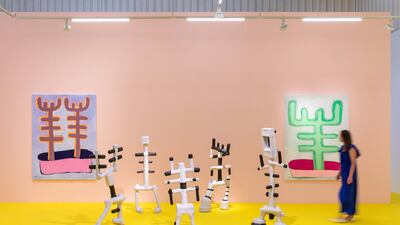
An installation view of Embryonic Coat, a solo show by Mohamed Ahmed Ibrahim running at Lawrie Shabibi gallery in Alserkal Avenue, Dubai. All photos: The artist, Lawrie Shabibi, Ismail Noor of Seeing Things -
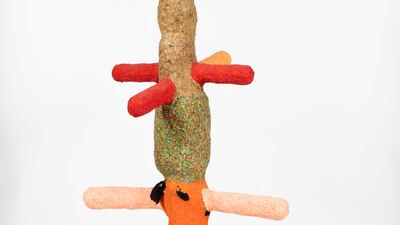
Mohamed Ahmed Ibrahim, 'Trunk', 2020, cardboard, papier mache, leaves, 164 x 58 x 45cm. -
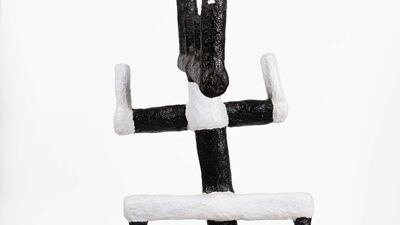
Mohamed Ahmed Ibrahim, 'Standing Body 2', 2020, cardboard, papier mache, 152 x 70 x 51cm. -
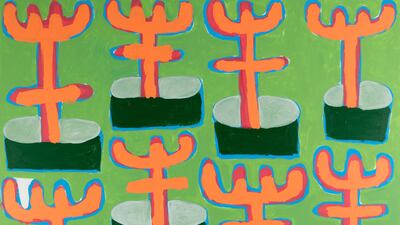
Mohamed Ahmed Ibrahim, 'My Garden's Details', 2021, acrylic on canvas, 250 x 200cm. -

Mohamed Ahmed Ibrahim, 'Assemblage Symbols', 2021, cardboard assemblage, 39 x 25cm. -
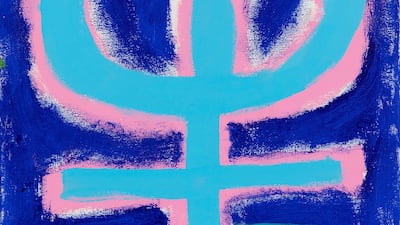
Mohamed Ahmed Ibrahim, 'My Garden's Details', 2021, acrylic on canvas, 40 x 30cm. -
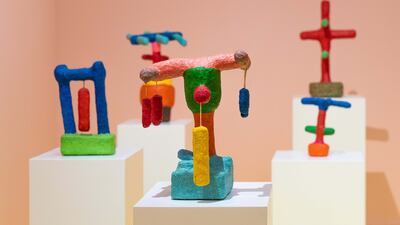
Embryonic Coat offers a vibrant artscape. -

The Khor Fakkan-born artist, 60, is one of the UAE’s pioneering art figures. -

Embryonic Coat is running concurrently with the artist's installation for the National Pavilion UAE at the 59th Venice Biennale. -
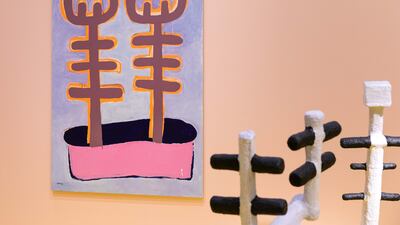
Embryonic Coat is Ibrahim’s third solo exhibition at Lawrie Shabibi. -
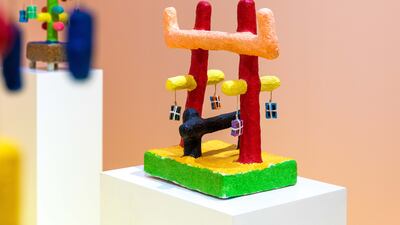
The solo show is emblematic of the signature style, mediums and artistic 'voice' he has developed over decades. -

Similar to the protective encasing or membrane formed around a seed or embryo, as outlined by the title Embryonic Coat, this show itself is a capsule of Ibrahim’s oeuvre, how it has progressed and evolved from birth to present.



