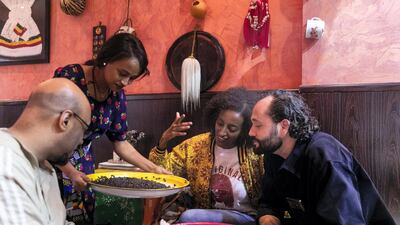
Things to know about the Somali community in the UAE


Thoraya Abdullahi
  • English
  • Arabic

More than 50,000 Somalis call the UAE home, with some having arrived before the union of the Emirates in 1972. This includes my parents, who were among those who moved to the UAE early on to seek job opportunities and raise their children.

In the early 1990s, my father served in the military in Abu Dhabi, where I was born in a hospital, Al Corniche. My mother was among the first Somali businesswomen in the UAE to begin buying goods and selling them back home, which has now become a common practice.

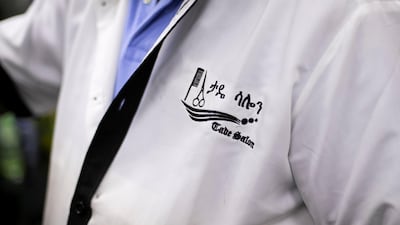
For a long time, the Somali community in the UAE made its mark through businesses and cultural celebrations, and we have tended to settle near each other in areas such as Dubai’s Gold Souq or Abu Dhabi’s Musaffah.

Members of the UAE's thriving Somali community can be found living around the Gold Souq in Deira, Dubai. Antonie Robertson / The National

As my mother will attest, Somalis like the Gold Souq because of the easy access to Somali shops and restaurants. We have lived in the Deira district of Dubai for more than 20 years and I have witnessed its evolution over that time.

Here are a few other things to know about the Somali community in the UAE.

We have an entrepreneurial spirit

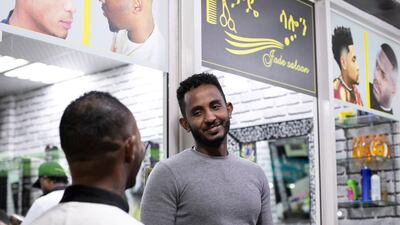
According to my father, the UAE was brimming with potential in the early 1990s and has opened up many doors for members of the Somali community, including my parents. This is particularly true in Dubai, where there are more than 100 Somali businesses, including gold and textile shops, hotels and money exchange facilities.

Cargo shipment operations between Dubai and Somalia are also strong. From excess baggage to air cargo and sea freight, Somalis contribute to Dubai's busy commercial corridors, with the geographical proximity of the two countries playing a vital role in boosting trade.

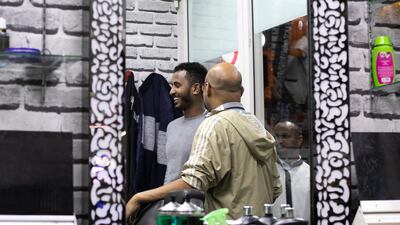
As well as facilitating trade between countries, these businesses have also become a social hub, where women and men stop to chat with friends about recent events. So be prepared to wait a while if you are visiting these establishments, or pull up a chair and involve yourself in a lengthy debate.

We are committed to preserving our culture

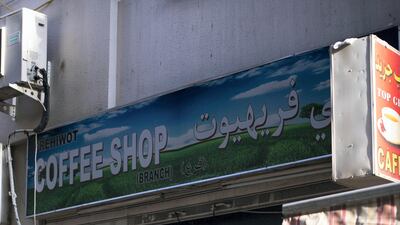
Culture has a robust social element in our community. Somali men are a common sight in coffee shops on popular streets in the UAE, where they watch sport and chat with passers-by. My father is no different, often frequenting Al Ghurair Centre in Dubai for an evening's discussion with his friends, where topics range from their children to the job market and inevitable disagreements over politics.

Al Ghurair Centre in Deira is a popular hang-out place for Somalis. Photo: Al Ghurair Centre

There is a strong sense of family in Somali culture and that is no different in the UAE. We place a lot of importance on helping each other and protecting and sustaining our traditions, often relying on each other for financial assistance or advice.

Somali culture and traditions are celebrated with parties and Somali dances on July 1 to mark the country’s independence, as Somalia became a republic in the 1960s. In addition to independence celebrations, I recall visiting Somali festivals several times with my family, where I was introduced to the country’s rich musical heritage and poetry. Because of our storytelling traditions, my country is often called The Nation of Poets.

Somalia is a Muslim country, so many of its social norms are influenced by Islamic traditions. For example, children regularly attend Quranic recitations. When I was young, I was sent to my cousin's house to learn and memorise the Quran. In addition to having great discussions about Islamic practices, we also celebrated when one of us was successful in memorising the Quran. These memories are still a topic of discussion.

These classes are now conducted in community mosques, where Somali mothers gather and guide their children to keep our traditions and values alive.

Our Arabic accents sound Emirati

Having been born in the UAE, many of us have adopted the Khaleeji dialect via our schooling and local friends. While I am guilty of preferring to speak English, my Arabic sounds very Emirati.

In particular, when I speak to family and friends from different parts of the Middle East, my tendency to favour Emirati terms, including the word asoolaf, which means speaking, can cause confusion.

Somalia joined the Arab League in 1974, but my parents tell me stories of a time when Somalia used to write in Arabic script, before adopting Latin characters. There are certain letters still pronounced in the Arabic way, however. For example, the letter C is pronounced as the Arabic letter "Ain", and X is pronounced as "Hhaa".

Delicious Somali food is easy to come by

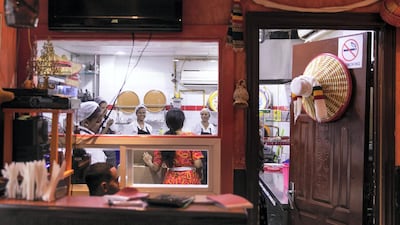
Somali restaurants in the UAE make an important contribution to keeping Somali food and traditions alive. Whether for special occasions such as Eid, birthdays and family reunions, we often gather around a hot Somali meal, complemented by a side of banana with our rice.

Especially in the evenings, my mother would often visit Dubai's Gold Souq to pick up fresh samosas, traditional pastries and Somali shah, a tea that is similar to karak, to help us create memories that are long-lasting and delicious.

Discovering Addis Ababa in Deira: inside the UAE's vibrant Ethiopian quarter — in pictures

What vitamins do we know are beneficial for living in the UAE

Vitamin D: Highly relevant in the UAE due to limited sun exposure; supports bone health, immunity and mood.Vitamin B12: Important for nerve health and energy production, especially for vegetarians, vegans and individuals with absorption issues.Iron: Useful only when deficiency or anaemia is confirmed; helps reduce fatigue and support immunity.Omega-3 (EPA/DHA): Supports heart health and reduces inflammation, especially for those who consume little fish.


Tips to stay safe during hot weather
  • Stay hydrated: Drink plenty of fluids, especially water. Avoid alcohol and caffeine, which can increase dehydration.
  • Seek cool environments: Use air conditioning, fans, or visit community spaces with climate control.
  • Limit outdoor activities: Avoid strenuous activity during peak heat. If outside, seek shade and wear a wide-brimmed hat.
  • Dress appropriately: Wear lightweight, loose and light-coloured clothing to facilitate heat loss.
  • Check on vulnerable people: Regularly check in on elderly neighbours, young children and those with health conditions.
  • Home adaptations: Use blinds or curtains to block sunlight, avoid using ovens or stoves, and ventilate living spaces during cooler hours.
  • Recognise heat illness: Learn the signs of heat exhaustion and heat stroke (dizziness, confusion, rapid pulse, nausea), and seek medical attention if symptoms occur.
The specs: 2019 Lincoln MKC

Price, base / as tested: Dh169,995 / Dh192,045

Engine: Turbocharged, 2.0-litre, in-line four-cylinder

Transmission: Six-speed automatic

Power: 253hp @ 5,500rpm

Torque: 389Nm @ 2,500rpm

Fuel economy, combined: 10.7L / 100km

ENGLAND SQUAD

Goalkeepers Henderson, Pickford, Pope.

Defenders Alexander-Arnold, Chilwell, Coady, Dier, Gomez, Keane, Maguire, Maitland-Niles, Mings, Saka, Trippier, Walker.

Midfielders Henderson, Mount, Phillips, Rice, Ward-Prowse, Winks.

Forwards Abraham, Barnes, Calvert-Lewin, Grealish, Ings, Kane, Rashford, Sancho, Sterling.

Conflict, drought, famine

Estimates of the number of deaths caused by the famine range from 400,000 to 1 million, according to a document prepared for the UK House of Lords in 2024.
It has been claimed that the policies of the Ethiopian government, which took control after deposing Emperor Haile Selassie in a military-led revolution in 1974, contributed to the scale of the famine.
Dr Miriam Bradley, senior lecturer in humanitarian studies at the University of Manchester, has argued that, by the early 1980s, “several government policies combined to cause, rather than prevent, a famine which lasted from 1983 to 1985. Mengistu’s government imposed Stalinist-model agricultural policies involving forced collectivisation and villagisation [relocation of communities into planned villages].
The West became aware of the catastrophe through a series of BBC News reports by journalist Michael Buerk in October 1984 describing a “biblical famine” and containing graphic images of thousands of people, including children, facing starvation.

Band Aid

Bob Geldof, singer with the Irish rock group The Boomtown Rats, formed Band Aid in response to the horrific images shown in the news broadcasts.
With Midge Ure of the band Ultravox, he wrote the hit charity single Do They Know it’s Christmas in December 1984, featuring a string of high-profile musicians.
Following the single’s success, the idea to stage a rock concert evolved.
Live Aid was a series of simultaneous concerts that took place at Wembley Stadium in London, John F Kennedy Stadium in Philadelphia, the US, and at various other venues across the world.
The combined event was broadcast to an estimated worldwide audience of 1.5 billion.

Dengue%20fever%20symptoms
%3Cp%3EHigh%20fever%20(40%C2%B0C%2F104%C2%B0F)%3Cbr%3ESevere%20headache%3Cbr%3EPain%20behind%20the%20eyes%3Cbr%3EMuscle%20and%20joint%20pains%3Cbr%3ENausea%3Cbr%3EVomiting%3Cbr%3ESwollen%20glands%3Cbr%3ERash%26nbsp%3B%3C%2Fp%3E%0A
Other workplace saving schemes
  • The UAE government announced a retirement savings plan for private and free zone sector employees in 2023.
  • Dubai’s savings retirement scheme for foreign employees working in the emirate’s government and public sector came into effect in 2022.
  • National Bonds unveiled a Golden Pension Scheme in 2022 to help private-sector foreign employees with their financial planning.
  • In April 2021, Hayah Insurance unveiled a workplace savings plan to help UAE employees save for their retirement.
  • Lunate, an Abu Dhabi-based investment manager, has launched a fund that will allow UAE private companies to offer employees investment returns on end-of-service benefits.
Credit Score explained

What is a credit score?

In the UAE your credit score is a number generated by the Al Etihad Credit Bureau (AECB), which represents your credit worthiness – in other words, your risk of defaulting on any debt repayments. In this country, the number is between 300 and 900. A low score indicates a higher risk of default, while a high score indicates you are a lower risk.

Why is it important?

Financial institutions will use it to decide whether or not you are a credit risk. Those with better scores may also receive preferential interest rates or terms on products such as loans, credit cards and mortgages.

How is it calculated?

The AECB collects information on your payment behaviour from banks as well as utilitiy and telecoms providers.

How can I improve my score?

By paying your bills on time and not missing any repayments, particularly your loan, credit card and mortgage payments. It is also wise to limit the number of credit card and loan applications you make and to reduce your outstanding balances.

How do I know if my score is low or high?

By checking it. Visit one of AECB’s Customer Happiness Centres with an original and valid Emirates ID, passport copy and valid email address. Liv. customers can also access the score directly from the banking app.

How much does it cost?

A credit report costs Dh100 while a report with the score included costs Dh150. Those only wanting the credit score pay Dh60. VAT is payable on top.

Mercer, the investment consulting arm of US services company Marsh & McLennan, expects its wealth division to at least double its assets under management (AUM) in the Middle East as wealth in the region continues to grow despite economic headwinds, a company official said.

Mercer Wealth, which globally has $160 billion in AUM, plans to boost its AUM in the region to $2-$3bn in the next 2-3 years from the present $1bn, said Yasir AbuShaban, a Dubai-based principal with Mercer Wealth.

Within the next two to three years, we are looking at reaching $2 to $3 billion as a conservative estimate and we do see an opportunity to do so,” said Mr AbuShaban.

Mercer does not directly make investments, but allocates clients’ money they have discretion to, to professional asset managers. They also provide advice to clients.

“We have buying power. We can negotiate on their (client’s) behalf with asset managers to provide them lower fees than they otherwise would have to get on their own,” he added.

Mercer Wealth’s clients include sovereign wealth funds, family offices, and insurance companies among others.

From its office in Dubai, Mercer also looks after Africa, India and Turkey, where they also see opportunity for growth.

Wealth creation in Middle East and Africa (MEA) grew 8.5 per cent to $8.1 trillion last year from $7.5tn in 2015, higher than last year’s global average of 6 per cent and the second-highest growth in a region after Asia-Pacific which grew 9.9 per cent, according to consultancy Boston Consulting Group (BCG). In the region, where wealth grew just 1.9 per cent in 2015 compared with 2014, a pickup in oil prices has helped in wealth generation.

BCG is forecasting MEA wealth will rise to $12tn by 2021, growing at an annual average of 8 per cent.

Drivers of wealth generation in the region will be split evenly between new wealth creation and growth of performance of existing assets, according to BCG.

Another general trend in the region is clients’ looking for a comprehensive approach to investing, according to Mr AbuShaban.

“Institutional investors or some of the families are seeing a slowdown in the available capital they have to invest and in that sense they are looking at optimizing the way they manage their portfolios and making sure they are not investing haphazardly and different parts of their investment are working together,” said Mr AbuShaban.

Some clients also have a higher appetite for risk, given the low interest-rate environment that does not provide enough yield for some institutional investors. These clients are keen to invest in illiquid assets, such as private equity and infrastructure.

“What we have seen is a desire for higher returns in what has been a low-return environment specifically in various fixed income or bonds,” he said.

“In this environment, we have seen a de facto increase in the risk that clients are taking in things like illiquid investments, private equity investments, infrastructure and private debt, those kind of investments were higher illiquidity results in incrementally higher returns.”

The Abu Dhabi Investment Authority, one of the largest sovereign wealth funds, said in its 2016 report that has gradually increased its exposure in direct private equity and private credit transactions, mainly in Asian markets and especially in China and India. The authority’s private equity department focused on structured equities owing to “their defensive characteristics.”

IF YOU GO
 
The flights: FlyDubai offers direct flights to Catania Airport from Dubai International Terminal 2 daily with return fares starting from Dh1,895.
 
The details: Access to the 2,900-metre elevation point at Mount Etna by cable car and 4x4 transport vehicle cost around €57.50 (Dh248) per adult. Entry into Teatro Greco costs €10 (Dh43). For more go to www.visitsicily.info

 Where to stay: Hilton Giardini Naxos offers beachfront access and accessible to Taormina and Mount Etna. Rooms start from around €130 (Dh561) per night, including taxes.

UAE central contracts

Full time contracts

Rohan Mustafa, Ahmed Raza, Mohammed Usman, Chirag Suri, Mohammed Boota, Sultan Ahmed, Zahoor Khan, Junaid Siddique, Waheed Ahmed, Zawar Farid

Part time contracts

Aryan Lakra, Ansh Tandon, Karthik Meiyappan, Rahul Bhatia, Alishan Sharafu, CP Rizwaan, Basil Hameed, Matiullah, Fahad Nawaz, Sanchit Sharma

Profile of VoucherSkout

Date of launch: November 2016

Founder: David Tobias

Based: Jumeirah Lake Towers

Sector: Technology

Size: 18 employees

Stage: Embarking on a Series A round to raise $5 million in the first quarter of 2019 with a 20 per cent stake

Investors: Seed round was self-funded with “millions of dollars” 

Scores

Wales 74-24 Tonga
England 35-15 Japan
Italy 7-26 Australia

New UK refugee system


  • A new “core protection” for refugees moving from permanent to a more basic, temporary protection
  • Shortened leave to remain - refugees will receive 30 months instead of five years
  • A longer path to settlement with no indefinite settled status until a refugee has spent 20 years in Britain
  • To encourage refugees to integrate the government will encourage them to out of the core protection route wherever possible.
  • Under core protection there will be no automatic right to family reunion
  • Refugees will have a reduced right to public funds
The Vile

Starring: Bdoor Mohammad, Jasem Alkharraz, Iman Tarik, Sarah Taibah

Director: Majid Al Ansari

Rating: 4/5

What it means to be a conservationist

Who is Enric Sala?

Enric Sala is an expert on marine conservation and is currently the National Geographic Society's Explorer-in-Residence. His love of the sea started with his childhood in Spain, inspired by the example of the legendary diver Jacques Cousteau. He has been a university professor of Oceanography in the US, as well as working at the Spanish National Council for Scientific Research and is a member of the World Economic Forum’s Global Future Council on Biodiversity and the Bio-Economy. He has dedicated his life to protecting life in the oceans. Enric describes himself as a flexitarian who only eats meat occasionally.

What is biodiversity?

According to the United Nations Environment Programme, all life on earth – including in its forests and oceans – forms a “rich tapestry of interconnecting and interdependent forces”. Biodiversity on earth today is the product of four billion years of evolution and consists of many millions of distinct biological species. The term ‘biodiversity’ is relatively new, popularised since the 1980s and coinciding with an understanding of the growing threats to the natural world including habitat loss, pollution and climate change. The loss of biodiversity itself is dangerous because it contributes to clean, consistent water flows, food security, protection from floods and storms and a stable climate. The natural world can be an ally in combating global climate change but to do so it must be protected. Nations are working to achieve this, including setting targets to be reached by 2020 for the protection of the natural state of 17 per cent of the land and 10 per cent of the oceans. However, these are well short of what is needed, according to experts, with half the land needed to be in a natural state to help avert disaster.

White hydrogen: Naturally occurring hydrogenChromite: Hard, metallic mineral containing iron oxide and chromium oxideUltramafic rocks: Dark-coloured rocks rich in magnesium or iron with very low silica contentOphiolite: A section of the earth’s crust, which is oceanic in nature that has since been uplifted and exposed on landOlivine: A commonly occurring magnesium iron silicate mineral that derives its name for its olive-green yellow-green colour

Updated: July 01, 2022, 6:02 PM