



As her new teammates begin their warm-up ahead of training at the ICC Academy, Maryam Omar shows scant concern for the fact her interview is running a little overtime.
The 29-year-old all-rounder is playing for South Coast Sapphires, one of the six teams in a new, T20 franchise cricket tournament being played in Dubai.
It has meant being lobbed together with 15 cricketers from various points around the globe, some of whom might be eminently recognisable off the television, others far less so.
In a pre-training chat, she speaks with unbridled zest – as well as a distinct Australian twang – about a wide range of topics.
From her introduction to the sport from way beyond its mainstream. About a family who remain not-entirely convinced by this weird sport. About leaving home and travelling to the other side of the world to pursue her passion.
And even about the stay-cool, fast-wicking sports hijab that is visible under her Sapphires cap.
“For sport, I like it a little tighter so I can run and dive around, and do all that cool stuff,” Maryam said. “It is breathable, too, so it does not get too hot.
“With hijabs, it is religion based. Some girls take it by choice. I decided to wear it when I was 15, and my parents were very supportive of it.
“It meant I had to adapt to the environment. Kuwait is pretty hot, and we play outdoors. We don’t have any indoor facilities as yet. I am getting used to the temperatures, and managing my energy and fluid levels.
“One positive thing with the hijab is I don’t get sunburnt. The only thing is I get a crease around my face. When I take it off I have really white ears and a brown face.”
The FairBreak Invitational, which will reach its conclusion on May 15 at Dubai International Stadium, is a one-of-a-kind tournament in cricket. Its claim to being the most diverse competition in the sport is unarguable.
The roster of 90 players is drawn from more than 30 countries, with such cricketing backwaters as Botswana, Rwanda and Bhutan all represented.
Maryam is a global grand tour all on her own, a Palestinian who was born and brought up in Kuwait, which is now the country she represents as an international cricketer.
She first learnt cricket while at a Pakistani school in the country, and opted to complete her masters in engineering in Australia after falling in love with the sport.

Her first experience of the game came in 2010, when she was 17, after Kuwait’s national cricket board targeted a number of schools to try to attract girls to play.
“Luckily for me, my mum [Salwa] was in the same school,” she said.
“My sports teacher came and told me that Kuwait Cricket was looking for girls to play in the Under 19 Asia Cup, and I said, ‘What is cricket?’
“I used to play other sports like basketball, swimming and martial arts. My mum just said, ‘Just give it a go. Why not? You might end up playing for national side one day'.
“I rocked up and was the only Arab in the side. I thought it might be hard for me to learn the game, but the coaches were so supportive.
“They helped me grow as a person and as a cricketer. I have loved the game ever since and never looked back.”
Attending a Pakistani school, she did have a vague awareness of cricket, but she says even the rudiments of the game were difficult to grasp at first.
“I used to see boys rolling their arm around, and I might have heard of cricket, but I never knew it was a big thing,” she said.
“My sports teacher told me it was the national sport in Pakistan, and that everyone loves it in Pakistan.
“They approached mum and said, ‘She is a really good athlete, you can transfer those skills into different sports, so she could pick it up really easily'.
“I said I’d give it a go. I played for two years for the Kuwaiti side without understanding the rules much. I was really just an expert fielder, like, ‘See ball, catch ball.’
“And every time I caught a ball, I thought it was a wicket for myself. I was celebrating every little thing - which was nice, obviously.
“It was just the start for me in cricket. I was learning the rules as I went. Even now, I am still learning. I was just so fortunate I was able to make that move to Australia to help develop myself as a cricketer.”
She became aware Australia was arguably cricket’s No 1 destination by dint of the fact her coaches in Kuwait – all Pakistanis and Indians – raved about it.
Her first sight of women playing the sport was via TV in a cricket equipment shop in Kuwait, which was tuned into Australia’s domestic T20 competition, the WBBL.
“I was like, ‘There is actually franchise cricket around the world [for women]?’ That is when a dream started to form for me. I wanted to play in the Big Bash.
“At my level, obviously there are a lot of challenges and a lot of competition. But I am all up for competition. I like to take on a challenge. It helps push me further.”
-
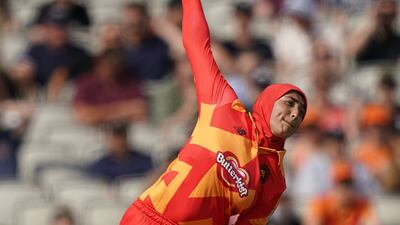
Birmingham Phoenix's leg-spinner Abtaha Maqsood bowls during The Hundred match at Old Trafford wearing a hijab. -
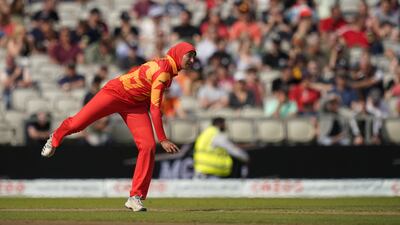
Birmingham Phoenix's Abtaha Maqsood picked up two wickets during The Hundred match against Manchester Originals at Old Trafford on Sunday, July 25, 2021. -
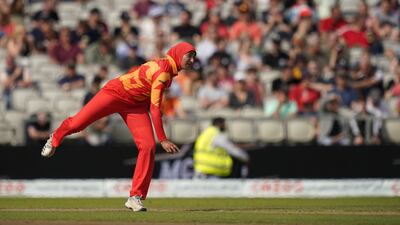
Birmingham Phoenix's Abtaha Maqsood during The Hundred match at Old Trafford. PA -
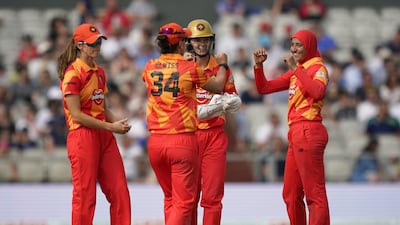
Birmingham Phoenix's Abtaha Maqsood celebrates with team-mates after taking the wicket of Manchester Originals' Eleanor Threlkeld.


She dovetailed cricket with studying for an engineering degree in Kuwait. When she was offered the chance to complete her studies at the Melbourne campus of the Central Queensland University, she jumped at it.
“My father [Osama] was never willing to compromise on education,” she said.
“He said, ‘Look, you can do your thing [cricket] so long as you keep a good record at university and get As.’ I took that as a challenge.
“I managed to do that, got straight As, and got a scholarship to continue my masters degree in Australia. I said, ‘God is talking to me right now. This is for my cricket.’
“I decided to take that opportunity to develop myself as a cricketer. I am really passionate and mad about cricket.
“I took it as a new challenge, having to leave my family back at home and start a new life in Australia. But I was so focused on the game. That is what kept me going.”
As a full-time engineer in Melbourne, she is thankful to supportive employers for being able to travel back to the Middle East to play for Kuwait – as she did in Oman last month – and for the FairBreak tournament in Dubai. Juggling work and play can be costly, though.
“Obviously there is no compromise on work, but I do my hours then go to training,” she said.
“Not being a paid professional, there are times when I struggle with leave and sponsoring myself.
“It is a challenge for any player at the associate level. It is only going to push the game further if players like us make those compromises. We want to make it easier for the players to come.”
She wants to blaze a trail, but not everyone has been keen to follow just yet. So far her sisters - Amal, Zuhoor and Budoor – have been reluctant about the merits of cricket.
“None of them play sports - they actually think it’s for boys,” Maryam said.
“It is against social norms. Where we come from, sports are not a thing. But things are changing. I am trying to push boundaries as much as I can and push barriers, and be the change, because we need things to change.
“My sisters call me the tomboy, because it is something we don’t really do back at home. They are into shopping, fashion, food. I’m slightly different. Or a lot different, really.”
As such, when she told her family she had been recruited to play with and against the leading players in the world in the FairBreak tournament, it was met with ambivalence.
“They are really mad about football, so I try to tell them it’s equal to Fifa in football, but [father Osama] still doesn’t relate to it,” she said.
“He’s like, ‘Yeah, whatever, just do your thing.’ But mum is very supportive as well. It is good to have a strict dad because I have learnt to manage my time and push my limits.
“My mum was always the one I had to talk to so she could talk to my dad to support me even further. Even though she doesn’t understand the rules she says, ‘If there’s a game, just send me the link and I’ll watch. I’ll support you whatever.’”

