‘Between the Sky and the Earth’ exhibition breaks traditional narrative about UAE


Joyce Karam
  • English
  • Arabic

High-rise buildings and bleak desert landscapes — these are the images that often come to mind when outsiders think of the UAE.

But those scenes were thin on the ground at “Between the Sky and the Earth: Contemporary Art from the UAE”, an exhibition in Washington featuring artists living in the Emirates.

It was curated by Munira Al Sayegh of the Middle East Institute’s (MEI) Art Gallery, and has attracted hundreds of visitors since it opened in December.

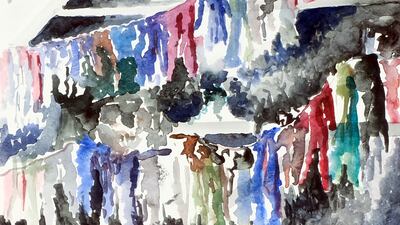
  • 'Neighbours, 2018' by Mohammed Kazem. Photo: Mohammed Kazem
    'Neighbours, 2018' by Mohammed Kazem. Photo: Mohammed Kazem
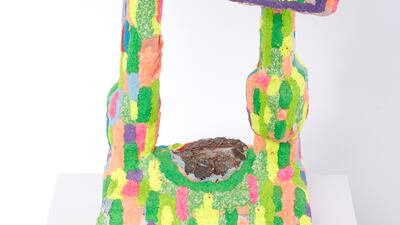
  • 'Bouquet 2, 2018' by Mohamed Ahmed Ibrahim. Photo: Mohamed Ahmed Ibrahim
    'Bouquet 2, 2018' by Mohamed Ahmed Ibrahim. Photo: Mohamed Ahmed Ibrahim
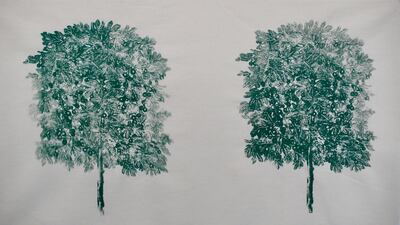
  • 'Higos, 2021' by Solimar Miller. Photo: Solimar Miller
    'Higos, 2021' by Solimar Miller. Photo: Solimar Miller
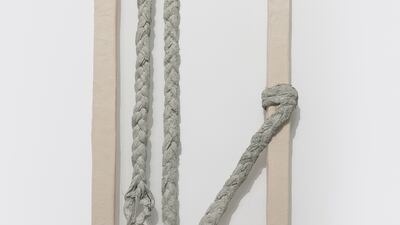
  • 'Reem Dream X, 2015' by Alaa Edris. Photo: Alaa Edris
    'Reem Dream X, 2015' by Alaa Edris. Photo: Alaa Edris
  • 'The Day We Met Thomas (Diptych), 2021' by Hashel Al Lamki. Photo: Hashel Al Lamki
    'The Day We Met Thomas (Diptych), 2021' by Hashel Al Lamki. Photo: Hashel Al Lamki
  • 'To Tame and Contain, 2021' by Afra Al Dhaheri. Photo: Afra Al Dhaheri
    'To Tame and Contain, 2021' by Afra Al Dhaheri. Photo: Afra Al Dhaheri

The show's paintings, photos and sculptures reflect a changing UAE, with one foot in the past and the other in the future. The 12 artists featured in the show embody a generational leap in the Emirati art scene.

“It really challenges the standard narratives that are dominant about the UAE,” Lyne Sneige, director of the Arts & Culture Centre at MEI, told The National.

Ms Sneige sees the intimate and reflective nature of the featured work as “a counter to that rapid urbanisation” while also being “a very personal outlook on the society".

The works featured in the show focus on themes including urbanisation, cultural shifts and empty spaces.

A photograph by Emirati artist Lamya Gargash depicts an abandoned home, one of the forgotten spaces in Emirati society, capturing its emptiness and desolation in a society in transition.

Urbanisation is a subtle theme in a canvas painting called Neighbours by second-generation Emirati artist Mohammed Kazem, which shows laundry day at a labour compound. The landscape mirrors many street corners in the UAE, with well-known urban marvels fading into the backdrop of a story taking place in a working-class neighbourhood.

A similar theme comes through in Tarek Al Ghoussein photograph Abu Dhabi Archipelago (Massnoua 3), in which a man sweeps an empty street across from a vacant building. The work elicits an examination of identity within a context of inaccessibility and loss.

'Am I Driving Safely?' by Augustine Paredes. Photo: Augustine Paredes

Solimar Miller's The Trees of the Emirates series, meanwhile, turns away from urbanisation to focus on nature. The colourful trees, with their intricate detail, evoke the love of the natural world that is so palpable in the Emirates despite the country's embrace of technology and the future.

A big public favourite is Focal Illusion by Ebtisam Abdulaziz, a multidisciplinary artist and writer. The painting is a colourful display that employs themes of Islamic geometry in its use of layers and mathematical structures, interweaving the past, present and future in a single piece.

“The exhibit reflects the diverse art ecosystem in the UAE,” Ms Sneige said.

And this message has resonated with American audiences, particularly as April is Arab-American heritage month in the US.

As the exhibition concluded, Ms Sneige described it as “a labour of love” and a prelude to more regional shows to come.


'States, 2016' by Alaa Edris. Photo: Alaa Edris
If you go

The flights
Etihad (etihad.com) flies from Abu Dhabi to Luang Prabang via Bangkok, with a return flight from Chiang Rai via Bangkok for about Dh3,000, including taxes. Emirates and Thai Airways cover the same route, also via Bangkok in both directions, from about Dh2,700.
The cruise
The Gypsy by Mekong Kingdoms has two cruising options: a three-night, four-day trip upstream cruise or a two-night, three-day downstream journey, from US$5,940 (Dh21,814), including meals, selected drinks, excursions and transfers.
The hotels
Accommodation is available in Luang Prabang at the Avani, from $290 (Dh1,065) per night, and at Anantara Golden Triangle Elephant Camp and Resort from $1,080 (Dh3,967) per night, including meals, an activity and transfers.

The burning issue

The internal combustion engine is facing a watershed moment – major manufacturer Volvo is to stop producing petroleum-powered vehicles by 2021 and countries in Europe, including the UK, have vowed to ban their sale before 2040. The National takes a look at the story of one of the most successful technologies of the last 100 years and how it has impacted life in the UAE. 

Read part four: an affection for classic cars lives on

Read part three: the age of the electric vehicle begins

Read part two: how climate change drove the race for an alternative 

Who has lived at The Bishops Avenue?
  • George Sainsbury of the supermarket dynasty, sugar magnate William Park Lyle and actress Dame Gracie Fields were residents in the 1930s when the street was only known as ‘Millionaires’ Row’.
  • Then came the international super rich, including the last king of Greece, Constantine II, the Sultan of Brunei and Indian steel magnate Lakshmi Mittal who was at one point ranked the third richest person in the world.
  • Turkish tycoon Halis Torprak sold his mansion for £50m in 2008 after spending just two days there. The House of Saud sold 10 properties on the road in 2013 for almost £80m.
  • Other residents have included Iraqi businessman Nemir Kirdar, singer Ariana Grande, holiday camp impresario Sir Billy Butlin, businessman Asil Nadir, Paul McCartney’s former wife Heather Mills. 
Hunting park to luxury living
  • Land was originally the Bishop of London's hunting park, hence the name
  • The road was laid out in the mid 19th Century, meandering through woodland and farmland
  • Its earliest houses at the turn of the 20th Century were substantial detached properties with extensive grounds


Updated: April 29, 2022, 6:00 PM