
Hydroponics is upending the conventional approach to farming and the good news is that you don’t even have to get your hands dirty.
By removing soil from the process and placing the roots directly in nutrient-rich water, food can be grown in almost any controlled environment, allowing for precise adjustments to key growing factors while using 70 to 90 per cent less water than conventional farming.
The word “hydroponic” is of Greek origin — “hydro” meaning “water” and “ponic” meaning “work”.
The idea is that the water does the work on its own.
-
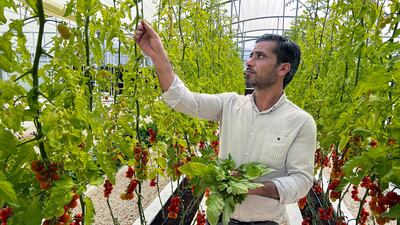
Bahjat Sawalmeh cuts the leaves of tomatoes grown using aeroponics at Faisal Farm in Jerash, Jordan. All photos: Reuters -

Mr Sawalmeh, who is farm manager, says aeroponics save 90 per cent of water resources, compared with traditional farming methods. -
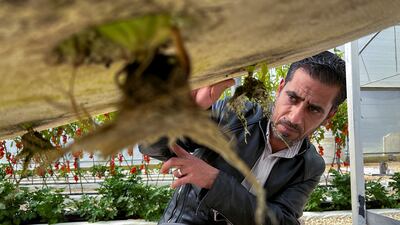
Jordan is considered to be one of the poorest countries in terms of water resources. -

The country's agricultural sector consumes 52 per cent of its scarce water resources. -

Experts have called for tougher regulations on the types of crops grown, in addition to encouraging farmers to make use of water conservation systems.


Driven by innovation, investment and an idealistic new breed of tech-savvy farmer-entrepreneurs, the number of hydroponic crop-farming businesses in the US has nearly doubled over the last decade.
Easier being green
Investors forked over close to a billion dollars towards controlled-environment agriculture (CEA) from 2019 to 2020, Pitchbook Data reported.
In effort to bring jobs back to the impoverished Appalachia region of the US, the Morehead, Kentucky-based AppHarvest is banking on the next generation of farmers with its AgTech Educational Outreach Programme, focusing on young people who may not have previously considered working in agriculture.
“This is an opportunity to build a long-term career in a [sector] that's growing,” said Travis Parman, chief communications officer for AppHarvest.
The five-year-old company also plans to open three new indoor hydroponic farms this year, while expanding their workforce from 500 employees to more than 1,000.
Hybrid hydro
AppHarvest uses large greenhouses with natural sunlight and rainwater collected from their own roof, which is stored in a reservoir the size of 70 Olympic-sized swimming pools before being funnelled into a closed-loop irrigation system.
This set-up allows for a high level of precision and control when it comes to giving plants the optimum conditions for growth.
The company estimates that, given the advantages, its original flagship farm will produce more than 18 million kilograms of tomatoes this year.
“We're able to get about 30 times the yield using about 90 per cent less water than traditional agriculture on an acre-per-acre basis,” Mr Parman said.
“With climate disruption and changing weather patterns, it's becoming increasingly difficult for farmers, in an open-field environment, to have reliable growing seasons.
“Some of them are suffering extreme drought, some are suffering from wind shear that decimates crops, some are suffering from floods … we need to be able to control the environment much more and farm many more months out of the year.”
Couch potatoes
Mr Parman said that when people realise that they can actually farm using their phone or iPad with real robots and no dirt, agriculture takes on a whole new meaning.
“We have a robotics programme as well, where we're doing some prototype testing with robotic harvesting,: Mr Parman told The National.
“It's creating an ecosystem here so that we can really build a hub in the US for controlled-environment agriculture.”
Urban hacks
Connor Harbison recently founded Atlas Urban Farms in Boston. The start-up engages in advocacy and education, hosting unique, hands-on hydroponic experiences for people interested in urban farming hacks — like how to turn a recycled yoghurt container into a self-watering hydroponic device.
His seedling company also brings hydroponic farming directly to the consumer by installing small hydroponic systems in homes, on college campuses and even in workplaces.
“I kept coming back to this idea of an urban food supply,” Mr Harbison said.
“My thinking was, if we use vertical farming, where you can have a very small footprint but grow a tonne of food, why don't we just build one of those in every single neighbourhood, and then we won't have food deserts and we won't have to emit a ton of carbon to get food from A to B.”
The ultimate key to success is getting food as close to the consumer as possible.
“That's how agriculture has been done for most of human history,” said Mr Harbison.
-

Among olive groves that were once a front line between ISIS and Iraqi forces, Yunis Salman and a few fellow farmers are harnessing what they believe should be the future of Middle East agriculture: the power of the sun. All photos: Reuters -

Solar panels installed last year between his family's 1,500 olive trees help to power water pumping and irrigation, providing enough for production and several hours of electricity each day for their home. -

Mr Salman believes solar power should be the future of agriculture and energy in the Middle East, where stifling summers are getting longer and hotter. -

Fighting around Mosul in 2016-2017 destroyed vast amounts of infrastructure, including in this rich agricultural area where buildings have been flattened by air strikes. -

Water sprinklers on a farm that uses solar panels. -

At little cost beyond the initial solar panels set-up, his farm produces 40 tonnes of olives a year.


Rain on the parade
Crop ecologist Heiner Lieth, a professor at the University of California, Davis, agrees that the future of hydroponics and CEA in the US is technological innovation, increased efficiency and continued growth, but says that traditional field production is here to stay.
This is due to the relatively lower production costs, which result in a cheaper product when compared to superior-quality hydroponically grown fruits and vegetables.
“They’re both going to be here,” Dr Lieth said.
“There are always going to be some people who are purely driven by price, who will pay as little as they can because their economic status is keeping them there.
“And there are always people who are doing really well who say, ‘I want pesticide-free, I want it to taste great, I want a lot of it and I don't care what it costs.’”
This story appeared in our Weekend section on March 11.

