


Looking over Wimbledon Park from a window of the All England Club, landscape designer Andy Wayro reveals grand ambitions for the expansion of tennis’s spiritual home.
“This will hopefully outlive all of us, and our grandchildren,” he said. “We are creating the championships of the future.”
With a wary eye on their rivals at the US, French and Australian Opens, the hosts of Wimbledon say a revamp is needed to cement the tournament's place as the most prestigious Grand Slam.
But the plan for 39 new courts, including an 8,000-seater stadium, and a refashioned public park is dividing opinion closer to home, as a decision looms on whether construction can begin.
Although the tournament is a jackpot for local businesses, who lost out when Covid-19 scuppered the 2020 tournament, some residents in wealthy south-west London feel they are being overlooked in Wimbledon’s quest for global dominance.
The planning dispute pits the club against critics in Wimbledon who object to the years-long building works, the felling of 300 trees and the reworking of a park designed in the 18th century by Lancelot “Capability” Brown.

Club officials, who are proud of their green credentials, say many of the condemned trees are in poor condition and that removing a modern golf course will actually restore Brown’s vision of the park.
But speaking on the edge of the lake in Wimbledon Park, Chris Baker, the director of the Capability Brown Society, said opponents of the plans were “in the trenches” to fight the expansion.
“If that’s not vandalism and actually ruining the landscape, I don’t know what is,” said Mr Baker, who described the new show court as a “monster stadium”.

Some locals question whether Wimbledon should really feel threatened by the other Slams, when its traditions of grass lawns, bowls of strawberries and queuing in the summer sunlight already give it a distinctive English atmosphere.
But organisers are keen to bring Wimbledon’s qualifying rounds on site, mirroring the other three Slams and silencing grumbles from players about the current qualifying venue in Roehampton.
“We have quite a lot of complaints,” said Justin Smith, an architect and Wimbledon’s head of estate development.
Although Roehampton is only a few kilometres away, the amenities there “aren’t really adequate and they’re not really up to the standards that the players expect,” said Mr Smith.

Green ambitions
Club officials are determined not to appear as heartless developers, insisting that they are the ones protecting Wimbledon Park’s historic landscape.
They are especially proud of their environmental record, after the plans received a near-perfect score in an analysis of “urban greening” in London.
Designers are mindful of flood risks due to climate change, with the tennis grounds “sitting in a bowl” beneath higher areas of land, as Mr Wayro described it. The club aims to reach net-zero carbon emissions by 2030.
After the golf club was bought out in 2018, Wimbledon’s architects scoured old documents to clue up on the park’s history, a quest which at took them at one stage to an archive in Canada.
The golf course, reduced to nine holes last year, already resembles a building site with cordons of tape around protected trees, and cones marking out the site of the proposed stadium.
The muddy fairway would need to be reseeded before it can be turned into perfectly-manicured tennis courts, with the new facilities not scheduled to open before 2028.
Many of the condemned trees are not historic oaks from Brown’s day, but 20th-century additions which were planted to frame the golf course and are “slightly at odds with some of the veterans”, said Mr Wayro.
Designers hope to bring in seeds from other Capability Brown gardens around England, and scatter the trees in a more natural-looking pattern than the straight lines required by golfers.
The overhaul would also involve desilting Brown’s lake – something never done in 240 years – and adding a boardwalk around it, moves which designers say would help local water sports and neatly mark out areas of the water.
The park would gain a bat cave as part of a biodiversity drive, and architects say the deeper lake and longer grass would reduce the flood risk.
Although matches on the 39 courts will be by invitation only, the former members-only golf course will be opened as public parkland for most of the year.
“There’s something magical about tennis in an English garden. We now have the opportunity to have tennis in an English parkland,” Mr Wayro said.
Far from spoiling the park, the redesign is about “taking away some of the things that have been introduced that aren’t great,” he argues.

Local opposition
Golf club members voted in favour of a buyout four years ago – with TV presenter Piers Morgan and Britain’s former top civil servant Gus O’Donnell said to be among the golfers in line for a windfall.
But not all locals are persuaded by the club’s brochure of benefits. Formally submitted last year, the club’s planning application has been through three rounds of consultations and received hundreds of objections.
About 700 residents toured the park by invitation from the club, which says much of the construction would take place elsewhere, although some lorries would still need to descend on the area.
Mr Baker said the plans would alter a landscape that had barely changed in 240 years, since Brown designed the garden on the instructions of the Spencer family, the ancestors of Diana, Princess of Wales.
Brown’s vista would be “ruined completely and destroyed” if the plans go ahead, said Mr Baker, with the 8,000-seater court altering the skyline.
-

A view of the outside courts and centre court at the All England Lawn Tennis and Croquet Club in Wimbledon, London. All photos: Getty Images -
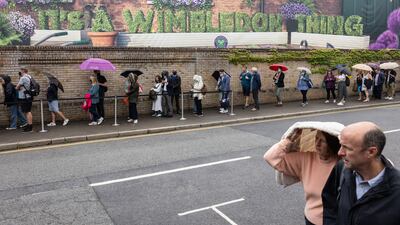
Fans queue to enter Wimbledon on day one of The Championships, the world's oldest tennis tournament, in 2021. -

The UK's Andy Murray, a Wimbledon champion, serves to his opponent under the closed retractable roof of Centre Court in 2021. -
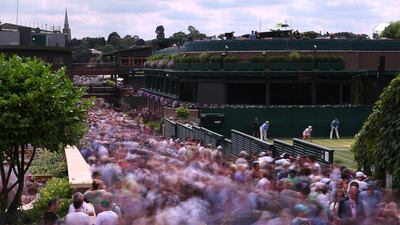
Fans stream past court 18 during The Championships in 2019. -
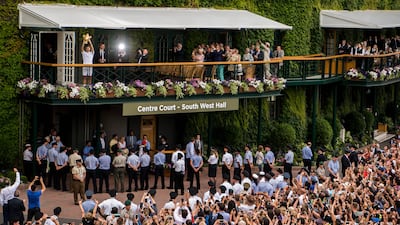
Spectators applaud and take photographs as Switzerland's Roger Federer celebrates his record eighth Wimbledon men's singles title on the balcony of Centre Court in 2017. -
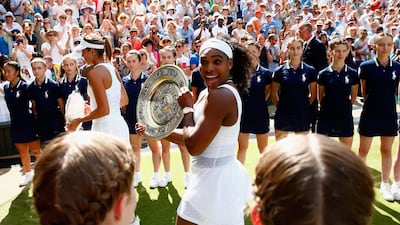
Serena Williams leaves court with the Venus Rosewater Dish after her victory in the final of the Ladies' Singles in 2015. She has won the title seven times. -
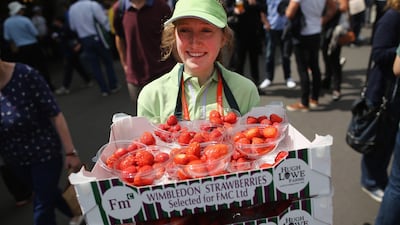
Strawberries - the traditional food of Wimbledon spectators - are carried around the grounds in 2013. -
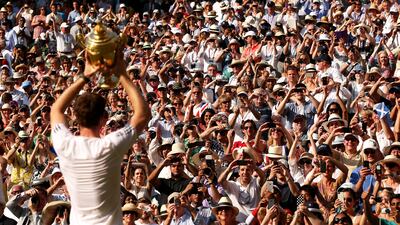
Fans cheer as Scotland's Andy Murray poses with the men's singles trophy in 2013, ending the UK's 77-year wait for a home-grown winner. -
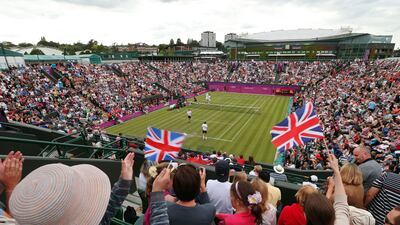
Andy Murray and his brother Jamie compete in the London 2012 Olympic Games at Wimbledon. -

Roger Federer poses for a portrait at Wimbledon in 2007. -
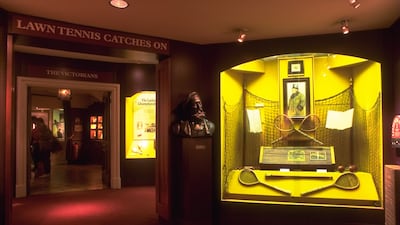
Tennis racquets and equipment from a bygone age displayed at the All England Lawn Tennis Club Museum at Wimbledon. -

Devoted fans often create large queues for a limited amount of tickets sold on the day. These fans are queuing for tickets in their sleeping bags in 1986. -
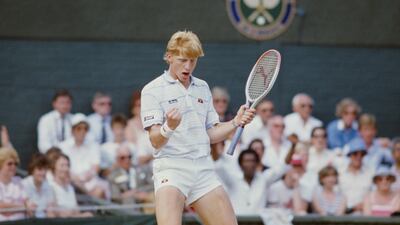
Germany's Boris Becker celebrates after his defeat of Kevin Curren in the Men's Singles Final in 1985. -

Chair umpire Jenny Higgs and the tournament umpires show off a new official uniform before the start of The Championships in 1981. -
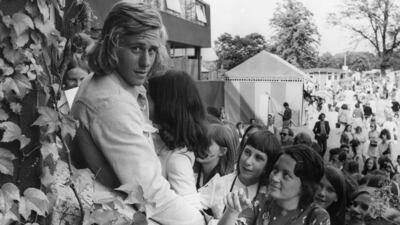
Sweden's five-time singles champion Bjorn Borg is surrounded by young fans in 1973. -
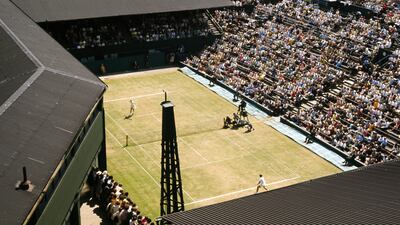
A view of No.1 court in 1970. It was replaced with a new No.1 court in the 1990s, with a retractable roof added in time for the 2019 tournament. -

A view of the courts at the All England Lawn Tennis and Croquet Club during The Championships in 1966. -
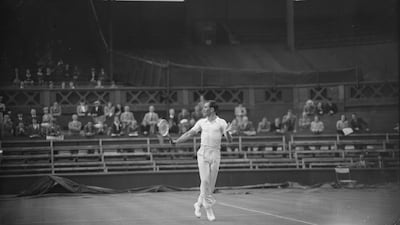
British tennis player D W Butler in action on Centre Court in 1946, during the first Championships at Wimbledon since the Second World War. -
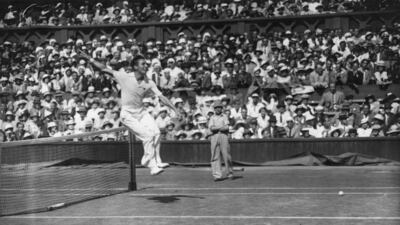
Fred Perry, the Englishman who won the men's singles title three times during the sport's amateur era, leaps over the net after defeating Australia's Jack Crawford in the 1934 final. -
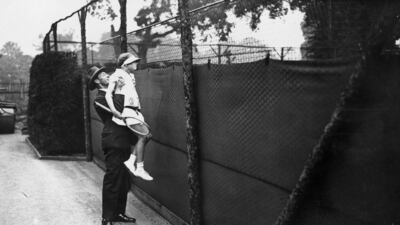
Diana Waring, 11, is lifted up for a view of the Junior Tennis Championships of Great Britain at the All England Lawn Tennis Club in 1930. -
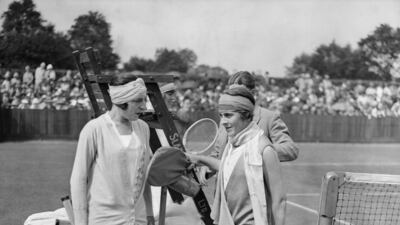
Suzanne Lenglen of France and Lili de Alvarez of Spain at The Championships in 1926. -
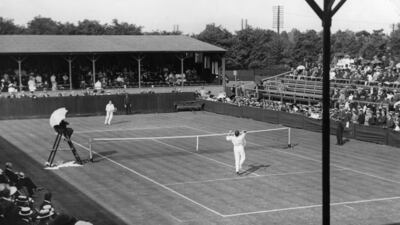
Anthony Wilding of New Zealand and Henry Roper Barrett of Britain competing in the men's singles at Wimbledon in 1910. -
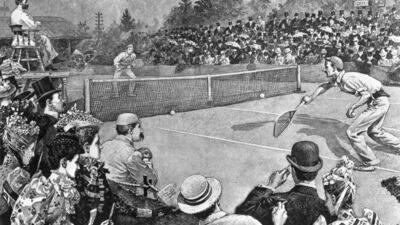
Wilfred Baddeley and Joshua Pim in action during the men's final at Wimbledon in 1891. -
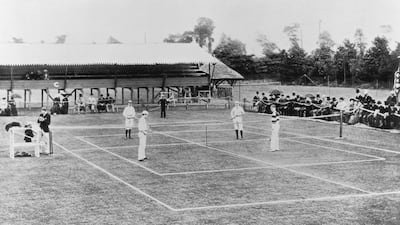
The first international tennis match takes place at Wimbledon, in 1883. The match, between the twins William and Ernest Renshaw of England, and Clarence M Clark and JS Clark of the USA, was won by the Renshaws.


He bemoaned the bleak landscape that would appear when the grass is torn up and reseeded, although the designers say it will grow back quickly.
“Capability Brown did not design boardwalks in lakes. What we want to see is nature,” said Mr Baker.
The Wimbledon Park Residents’ Association separately filed a 20-page objection, which described the proposals as vague and reliant on the club keeping its word.
This lack of certainty is a particular concern because the club is accused of breaching a covenant it agreed to in the 1990s, when it bought part of the land on the understanding that there would be no building work affecting the park.
The proposals to start building regardless have “undermined the integrity of the applicant and the trust of the local community”, the residents said.

A verdict from planning officials is expected in the coming months, with designers in the dark over the exact timeline.
Both sides say they are open to compromise on the building plans, but Stephen Hammond, the Conservative MP for Wimbledon, said in a letter to constituents that legal wrangling over the covenant could prove just as decisive.
Mr Hammond and local councillors said the club’s application “could have been more sensitive”.
Club officials were cautious about discussing the covenant, but said the plans accorded with the spirit of the promises made back then.
The covenant is “all about benefiting the existing park,” said Mr Smith.
He described the proposals as the third great development in Wimbledon’s history after the move to the current site in 1922 and the opening of No 1 Court in 1997.
“Our focus is on having the best Grand Slam and on using the benefit of that Grand Slam to help British tennis and the local community,” said Mr Smith.
“It’s so much better, what we want to give them, than what we can give them on this site now.”

