



A $100 test to show you are fit to fly, a $25 one taken weekly to attend work, and screening children every two weeks to attend school — two years into the pandemic and PCR testing shows no sign of letting up.
Even as some countries in Europe, including the UK and Sweden, drop testing to a minimum, others continue with a strict regime to identify and isolate cases.
In the Gulf, millions are tested every week to go to work, school and public events.
In China last week, the city of Tianjin ordered every single one of its 14 million people to be tested — for a second time — after just 97 cases were found.
As nations such as Malaysia prepare to declare the outbreak endemic, the end of the pandemic may finally be in sight, yet PCR testing could be here to stay.
Dr Mahmoud El-Hussein, an emergency doctor in Paris who sits on the board of the Mediterranean Journal of Emergency Medicine, said testing has been effective in protecting the vulnerable.
“Hospitals don’t have the luxury to change their guidelines while there are patients and personnel at risk,” he said.
“They will continue doing the same procedure whether the rates of Covid are high or low, as we did during summer when Covid rates decreased drastically.
“Two years after the pandemic, and ending up with almost the same results, governments had to change policy regarding lockdowns, quarantine, and vaccination in order to lift the economic burden.
“Mass testing and increasing the testing numbers per day will cost more money and deplete healthcare personnel.
“Instead, broadening the vaccination map and encouraging people to vaccinate themselves and their loved ones is the way to go.”
Hospitals and healthcare settings are likely to require PCR testing for some time, to protect staff and vulnerable patients.
Criteria for screening of emergency patients at the Urgences Hôpital Lariboisière, where Dr El-Hussein works, could provide a signpost to show where regular PCR tests are likely to continue.
All patients with breathing difficulties or oxygen saturation below 95 per cent will be tested for Covid, the doctor said, as will any patients showing traditional symptoms of the virus such as a fever, or upper respiratory tract symptoms.
Growth of private PCR testing market in the UK
Prof Stephen Bustin, professor of molecular medicine at Anglia Ruskin University in the UK, who developed a PCR test for Sars-CoV-2 early on in the pandemic, said private companies will look to maximise profits.
“I think profiteering is certainly part of this. The private sector has clearly filled a niche or a gap that’s been left by public health provision not being adequate,” he said.
“The problem, I guess, because of this happening, is that not everyone was qualified to set up testing appropriately and that’s why we’ve had some cowboys.
“Also, because it is private companies, ultimately their goal is to make money and so a lot of companies have vastly overcharged, particularly at the beginning, when there was not sufficient capacity. You’re talking about tests costing £500 to £600 in Harley Street [in London], which is outrageous.
“So I think there is a role for the private sector, but I think it needs to be regulated much more tightly, and quality standards need to be imposed much more rigorously.
“In the public sector, tests — lateral flow and PCR tests — are free. That’s a good thing.”
-
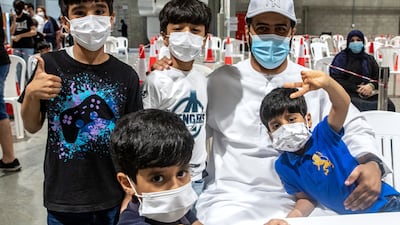
Back-to-school PCR testing gets under way at Biogenix Labs by G42 Healthcare, Masdar City, Abu Dhabi. All Photos: Victor Besa / The National -
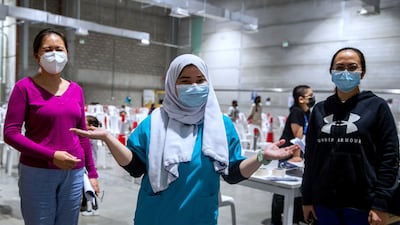
Biogenix Labs staff are ready and waiting for the mass testing as schools reopen in the capital. -
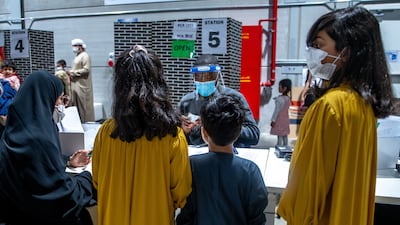
Children queue to be tested. -
Sultan Al Marzooqi, five, gets his back to school PCR test. -
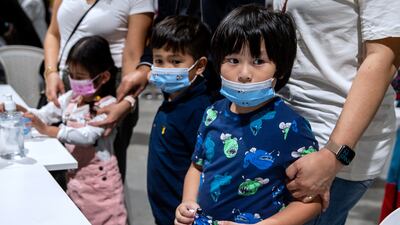
The Solitario family get their PCR tests. -
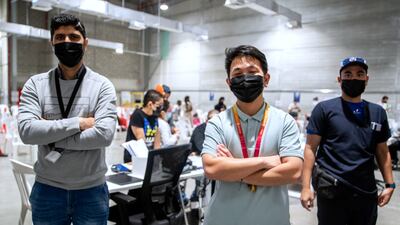
Biogenix Labs staff are ready to help in the fight against Covid-19. -
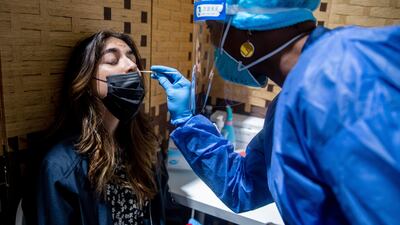
Sarah Ahmad, 17, is tested before heading back to school. -
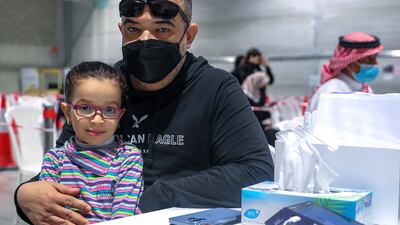
A father takes his daughter for testing. -
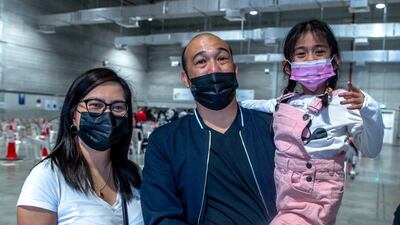
The Aragon family get their PCR tests. -
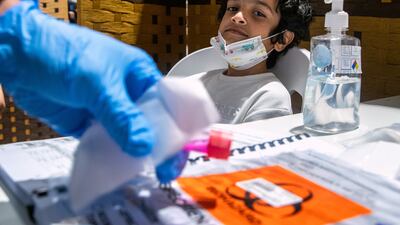
Khamis Al Balooshi, 10, waits for his turn. -
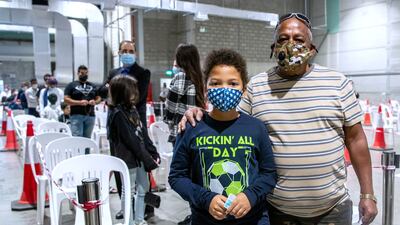
The Williams family get their PCR tests. -
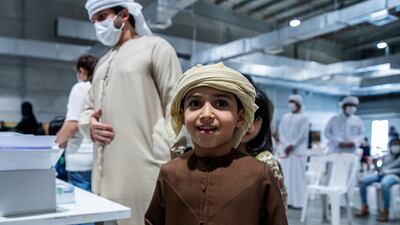
The youngest Al Marzooqi family member is all smiles after his test. -
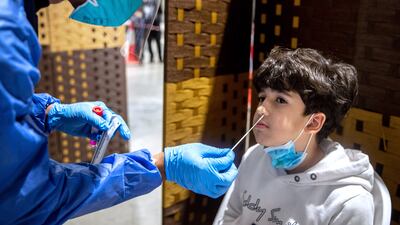
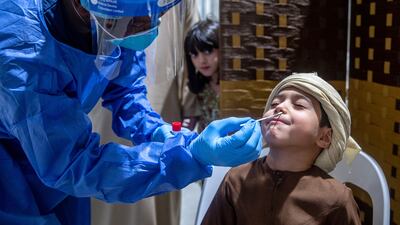
Mohamed Al Zahri, eight, is swabbed.


How much does it cost to carry out a PCR test?
Prof Bustin said the cost of doing a saliva test is just a fraction of what is charged by private companies.
“We use saliva. If you take saliva, add viral extraction buffer and do your PCR. The cost of that, per test, is 50p. If you use an extraction protocol, which you have to use with the swabs that people still use, then you’re talking about perhaps £5 per PCR test, but that would be with not having any large-scale discounts, which these large labs would have.
“But I think £5 would not be an unreasonable amount of money to say it costs for the reagents. Now if you add in all the infrastructure and salaries, I would have thought you could make a profit on £20 per person per test, but I’m not a commercial person.”
The UK scraps tests for vaccinated travellers
In the UK, health authorities have already scrapped PCR requirements to confirm a positive lateral flow test in England, largely a result of huge demand as Omicron swept through the country in December.
In a boost to half-term travel, further changes are in the pipeline as UK restrictions continue to ease.
From 4am on February 11, all testing requirements will be removed for eligible fully vaccinated arrivals, with only a Passenger Locator Form required for entry.
Arrivals not recognised as fully vaccinated will only need to take a pre-departure test and a PCR test on or before day two after landing in the UK.
Sweden has also abolished the requirement of a negative RT-PCR test for all arrivals.
The move came in mid-January, just as the nation soared past its record for daily infections of more than 20,000.
Just weeks earlier, as Omicron spread, the Swedish government asked all tourists entering the country to carry a negative Covid-19 test report, regardless of their vaccination status.
Other nations are slowly beginning to follow suit as the threat of serious illness from Covid in healthy people subsides.
“Developed countries such as the UK easing Covid-19 restrictions and decreasing the testing rates will definitely push other governments to act in the same direction,” said Dr El-Hussein.
“It will be one the main arguments in every political dispute in the near future.
“Testing will no longer be required preflight, to show other countries that they are open for travellers and investors.
“Wearing masks won’t be mandatory in public places, with Covid-19 testing limited to symptomatic patients, the elderly, and healthcare personnel.”
Billion-dollar testing industry
The industry of PCR testing has been one of the few big winners during the global pandemic.
An investigation into testing practices by the UK government’s Competition and Markets Authority revealed features of the PCR testing market which meant competition alone would not deliver the right outcomes for consumers.
“There is a risk of a ‘race to the bottom’, in which providers compete on grounds other than high clinical quality and travellers end up losing out,” the government report said in September.
Consumers’ complaints included people paying over the odds and receiving poor service, with test kits and results arriving late or not at all.
The public also said when things went wrong, they were unable to contact providers, let alone get refunds when test results were due.
The CMA warned firms faced being cut from government-approved lists if found to be breaking consumer laws.
“In any market, you will get people trying to charge very high amounts,” said Prof David Taylor, professor emeritus of pharmaceutical and public health policy at University College London.
“They may, on occasions, do a better service. It depends on the quality of regulation. If there's an unregulated market, you will find some suppliers charging more than others.
“You're highly unlikely, in a free market, to find suppliers charging the marginal cost.”
Prof Taylor said overregulation of pharmaceutical testing, could limit access to testing.
“In the past, in some areas of diagnostics there's a danger when very tight regulation, combined with public ownership, has restricted access,” he said.
“You need good regulation to ensure quality and some people are very much in favour of price regulation, rather than allowing consumer judgment to be the test.
“Over-regulation can itself impose harm.”
“If there's another wave, it [testing] will pick up again, especially if it's more pathogenic.
“There may be some cases where we [continue to] need PCR tests, but it's likely we'll be able to rely more on lateral flow more as an indicator of infectiousness, but we need the capability in place in case things change.”
How widely will PCR tests be used?
According to Prof Bustin PCR tests will continue to be used as newer variants and offshoots of the current strain are being detected.
“In order to monitor this [emergence of new variants], it’s essential that we continue testing … because at some stage, a more virulent virus might evolve,” he said.
“We have climate change, we have antibiotic resistance, which are the two major issues facing us in the future, and both of these will result in infectious diseases or antibiotic-resistant bugs spreading and, again, you need to have a testing infrastructure in place that can deal with this.
“Someone needs to sit down and establish a framework that allows us to tackle anything that appears, like bird flu, like antibiotic resistance, like horse meat in burgers, that kind of thing, and PCR is just the ideal way of doing this.”
Will we get quicker PCR test results in the future?
Yes. In the future, it will be easy to get a simple yes or no answer in just a few minutes to confirm if a person is infected or not, even at home.
Results could be sent to a central database through a device like an iPhone. For more detailed analysis and clinical information, samples could be sent to the laboratory for analysis.
“As a principle, PCR testing is probably the fastest [and] if done properly, the most sensitive and the most reliable way of early detection of Sars-CoV-2,” he said.
“We’re working on extreme PCRs — PCR [tests] in less than a minute. In five years’ time, PCR tests will be the point of care and it will be three or four minutes from the time you spit in the tube or take a sample and get a result. That’s the future for PCR testing and no other method can compete with that.
“We’re nowhere near the limit of the PCR. We’re doing it routinely in 75 seconds now.”
“People don’t realise how easily PCR can be transferred [into the home] if you do it appropriately and design the instruments or a device that could do it in the size of an iPhone.
“There are companies working on this already, so it’s going to happen.
“If you have got the sniffles and want to know whether it’s flu or Covid or just a common cold, you can do multiple assays at one time.
“You just go down to Boots [a pharmacy chain], get the appropriate test — a respiratory virus test — you spit into the tube and it tells you whether you’ve got flu or a common cold or Covid. That’s what’s going to happen.”

