


The UAE's Sultan Al Neyadi said that carrying out the first spacewalk by an Arab astronaut “was a great responsibility” and that he was proud to have completed it successfully.
The Emirati astronaut was answering a question asked by Eddy Boissezon, acting president of Mauritius, on Thursday, as part of a live call from the International Space Station.
It was the first live video call outside of the UAE under Dr Al Neyadi's “A Call From Space” initiative, in which he answers questions from heads of states, pupils and space enthusiasts.
The astronaut completed his first spacewalk on April 28, when he stepped outside of the space station for a seven-hour maintenance assignment.
“It is an honour to speak to you live from Mauritius,” Mr Boissezon said. “I'm curious to know more about your recent spacewalk experience.”
Dr Al Neyadi replied: “The EVA [extravehicular activity, or spacewalk] was a really, really interesting feeling for me.
“It's the first time that was happening in the Arab world. So, I felt like it was a great responsibility.
“We spent seven hours outside of the station to do a lot of maintenance and preparation for installing new solar arrays for power capabilities.”
Dr Al Neyadi arrived on the orbiting laboratory on March 3 to carry out more than 200 experiments for scientists around the world, including in the UAE.
He held his first live video call with the public in March at the Dubai Opera, an event that was attended by 1,900 students, police officers and residents.
Staying safe in space
About 400 pupils attended the live call in Mauritius and many of them had questions for Dr Al Neyadi.
One pupil asked him how the astronauts on the ISS stayed safe from orbital debris.
“The ISS is orbiting Earth at an altitude of 400km and during this motion, it is susceptible to some sort of debris or floating items,” Dr Al Neyadi replied.
“So, luckily, we can monitor the larger objects and we can manoeuvre and avoid these big pieces of debris.
“But, unfortunately, some micrometeorites can hit the station and that is difficult to avoid.
“But, still, we are protected with the very hard body of the station. In case of an emergency, we are ready to react to any emergency regarding a depress of the environment inside the station.”
Manoeuvring the space station to avoid pieces of space junk has become a routine measure as low-Earth orbit becomes overcrowded.
There has been no major damage to the station so far, but debris did puncture a tiny hole into the Canadian robotic arm attached to the structure.
Adapting to life far from home
One pupil asked Dr Al Neyadi how he has adapted to seeing 16 sunrises and 16 sunsets daily.
“It was really hard for me to comprehend this environment,” Dr Al Neyadi replied.
“When we arrived I kept seeing a sunrise and sunset every 45 minutes, so it was really difficult for me.
“We use GMT [Greenwich Mean Time] and that is our reference for daily activities.”
At the weekend, he helped three of his colleagues relocate the Dragon spacecraft they had travelled to the space station in to another docking port.
This helped free up space for other spacecraft that will in later this month and in June.
Two Saudi and two American astronauts are arriving there for a 10-day trip as part of a private mission by Axiom Space.
It will be the first time three Arabs are in space together at the same time.
Dr Al Neyadi is due to return to Earth in late August.
Sultan's historic spacewalk - in pictures
-
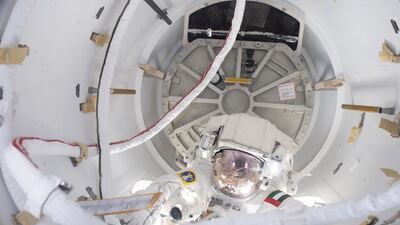
Emirati astronaut Sultan Al Neyadi posted new pictures of his April 28 spacewalk. Photo: @Astro_Alneyadi / Twitter -
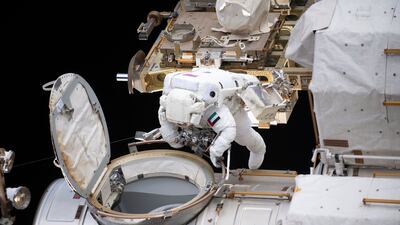
Dr Al Neyadi made history by becoming the first Arab to walk in space. Photo: @Astro_Alneyadi / Twitter -
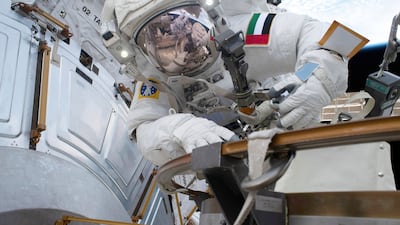
He was assisted by American astronaut Stephen Bowen. Photo: @Astro_Alneyadi / Twitter -

The spacewalk lasted six and a half hours. Photo: @Astro_Alneyadi / Twitter -

Dr Al Neyadi prepares for the spacewalk. All subsequent photos: Nasa -
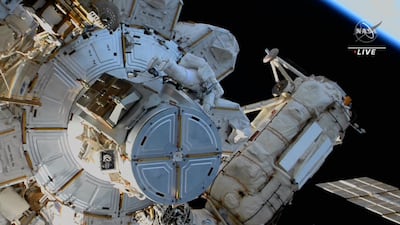
Dr Al Neyadi steps out of the International Space Station -
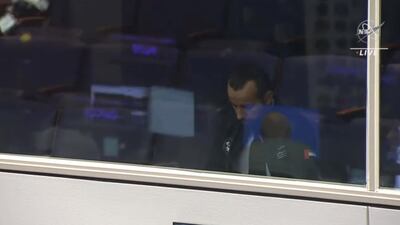
Fellow UAE astronaut Hazza Al Mansouri, increment lead of Expedition 69 on Earth, monitoring the mission from the Johnson Space Centre -
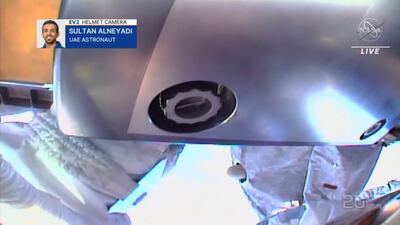
The view from Dr Al Neyadi's camera -
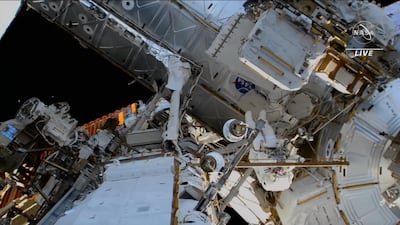
The astronauts outside the space station -
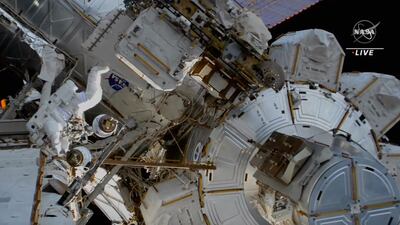
The astronauts carry out maintenance work on the International Space Station -

Dr Al Neyadi, top, carries out repairs outside the ISS -
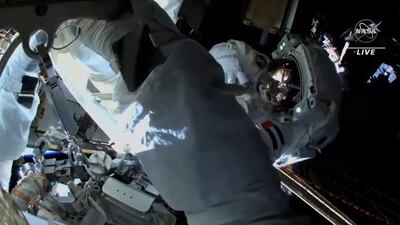
The pair exited the space station at 5.41pm GST -
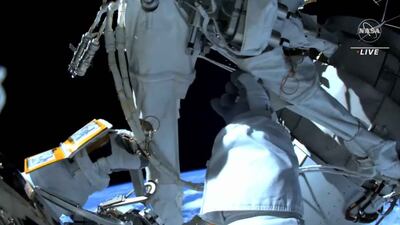
The spacewalk officially began at 5.11pm when their spacesuits switched to battery power -

While the spacesuits weigh 127kg, astronauts cannot feel this weight in space -
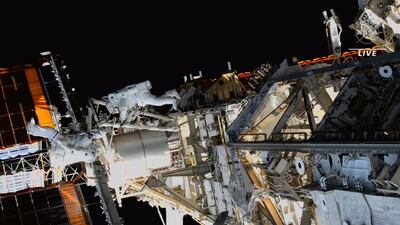
The astronauts are tethered to the station while floating in microgravity more than 400km above the Earth -
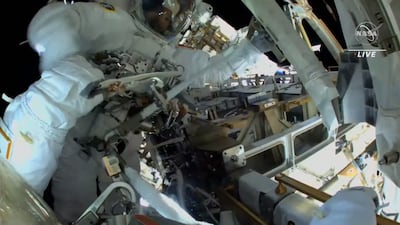
Dr Al Neyadi carries out repairs



