


The James Webb Space Telescope has discovered an Earth-like exoplanet outside the solar system, helping to further unravel the mysteries of space.
Called LHS 475 b, the planet is almost exactly the same size as the Earth, matching 99 per cent of its diameter.
Researchers at the John Hopkins Applied Physics Laboratory used the Webb telescope to capture the planet in wavelengths of light.
“These first observational results from an Earth-size, rocky planet open the door to many future possibilities for studying rocky planet atmospheres with Webb,” said Mark Clampin, astrophysics division director at Nasa headquarters in Washington.
“Webb is bringing us closer and closer to a new understanding of Earth-like worlds outside our solar system, and the mission is only just getting started.”
What do we know about celestial discovery?
The rocky planet orbits another star ― how the Earth orbits the Sun ― and is a few hundred degrees warmer than the Earth.
Researchers used Webb’s near-infrared spectrograph instrument to capture the planet.
However, they were not able to detect much about its atmosphere.
And if clouds are detected in the ongoing research, then it may be concluded that the planet is more similar to Venus than it is to Earth.
“The telescope is so sensitive that it can easily detect a range of molecules, but we can’t yet make any definitive conclusions about the planet’s atmosphere,” said Erin May of the Johns Hopkins University Applied Physics Laboratory.
A day on the planet is two Earth days long and its temperature is half that of the Sun, so researchers believe it could still have an atmosphere.
The Webb telescope was launched into space on Christmas Day of 2021 and began its science operations in 2022.
Since then, it has been beaming back images that are helping scientists better understand the mysteries of the universe.
The first image from the telescope was revealed by US President Joe Biden on July 11 last year. It showed the galaxy cluster SMACS 0723 as it was 4.6 billion years ago.
Strange Earth-like planets that lie beyond our solar system - in pictures
-
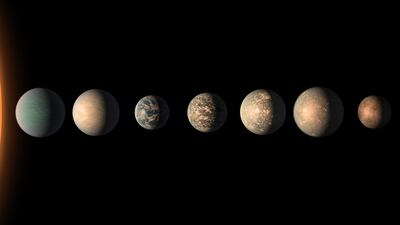
The landmark discovery of Trappist-1 set off a wave of excitement across the space community. It was the first time multiple Earth-sized planets were found in a habitable zone and were orbiting the same star – Trappist-1. Courtesy: Nasa -
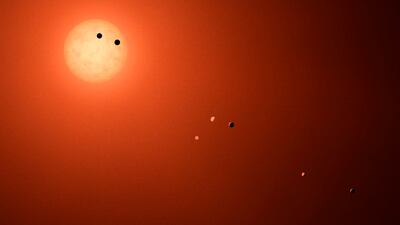
All seven planets orbiting Trappist-1 are believed to be rocky and have potential for water on the surface. Courtesy: Nasa -
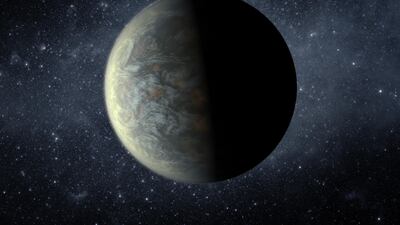
Located in a habitable zone, Kepler-22b was labelled by Nasa as ‘super Earth’. Researchers believe the planet, which is larger than Earth, could be another ocean world. However, because of the planet’s extreme tilt, the north and south poles would experience sunlight and darkness for half a year each. Courtesy: Nasa -
Discovered in 2020, Toi 700 d is only 20 per cent larger than Earth and orbits an M Dwarf star – a cool and stable type of star that do not release killer stellar flares, or radiation. Located 100 million light years away from Earth, one year on the planet is 37.4 days. Courtesy: Nasa -
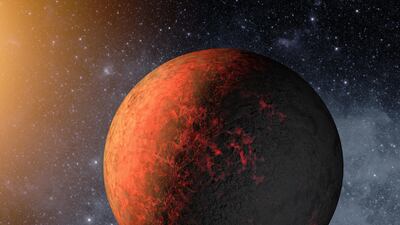
Discovered in 2011, KEPLER-20e is an Earth-size planet that orbits a sun-like star outside of the solar system. It is too close to its star to be in the habitable zone, so it cannot hold liquid water. However, the discovery was still groundbreaking because it was the first time small exoplanets were found to be orbiting around a star that was similar to the Sun. Courtesy: Nasa -

Kepler-20f was discovered along with Kepler-20e. A year on the planet is19.6 days. Courtesy: Nasa



