


The UAE’s space exploration has created an “appetite for risk” to pursue more adventurous missions, including the journey to Venus, Sarah Al Amiri, Minister of State for Advanced Technology and chairwoman of the Space Agency, told the World Economic Forum.
Speaking alongside former US vice president Al Gore and astronaut Matthias Maurer on Thursday, Ms Al Amiri stated there had been a “monumental shift in mindset” in the UAE in taking on more ambitious projects.
She argued that the UAE's research was driven by “the beauty of space”, which “instils in society a deep understanding, because of its aspirational nature, of the benefits of science and technology”.
The UAE would not have been able to consider its more ambitious mission to Venus if the Mars project had not gone ahead.
“For us, it was monumental shift in mindset, especially with regards to the appetite for risk. And this is what societally having a space programme does — it increases your appetite for risk because the bigger the programmes are, the chances of success are lower and therefore your appetite for getting into endeavours that are riskier becomes higher.”
In 2028, the Emirates will launch an exploration mission that will explore Venus then land on a nearby asteroid.
“That's going to look at the history of the asteroid belt and more interestingly, look at the evolution of the asteroid belt as a resource for space exploration,” she said.
As to keeping space safe Ms Al Amiri, who is also the science lead for the Emirates Mars Mission, told the forum that international collaboration was needed to avoid debris from old satellites and rockets damaging missions.
“It's having a better understanding on how you manage space debris so it doesn't impact the critical infrastructure that we have in space,” she told the conference titled “Live from Space: The Next Frontier for Knowledge and Action”.
“We need to ensure that we're not cluttering space and creating another issue as we have today monitoring sustainability here on Earth. That means global dialogue to ensure that we're doing it in a mechanism that is supportive to space development.”

Her views were echoed by Mr Maurer, speaking live from the International Space Station, who said they regularly had to manoeuvre the space station out of the flight path of debris and enter protective capsules in case of an emergency.
He also vividly described the ecological disasters he had witnessed from 400 kilometres above Earth.
“We need to stop everything that I see here from space that makes my heart bleed, like the burning rainforest or the melting of the glaciers,” the European Space Agency astronaut said.
“All these phenomena we can see here from space, the flooding last week in Brazil, we could observe here was clearly evident.”
He added that the more people who flew to space, “the more ambassadors we have that hopefully come back to our beautiful planet Earth and say we need to take care of our planet".
Furthermore, the revolution in space will soon give mankind the chance to precisely detect carbon emissions, helping the global community tackle climate change, Mr Gore told the Davos gathering.
-
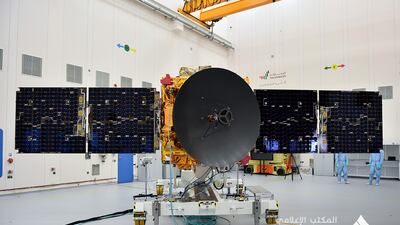
The Hope probe was built by 150 Emirati engineers, researchers and scientists. Photo: Mohammed bin Rashid Space Centre -
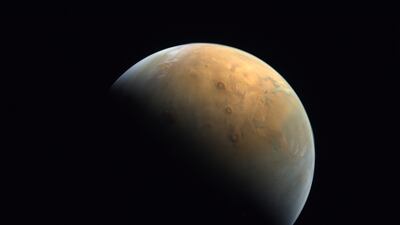
The first image of Mars taken by the UAE's Hope probe, which arrived at the Red Planet on February 9. EPA -
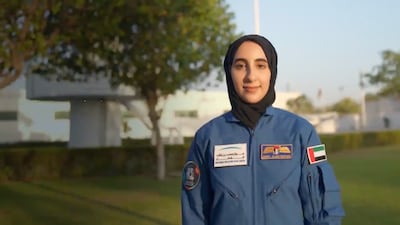
Nora Al Matrooshi the first Arab woman to train as an astronaut. Photo: MBRSC -
Hazza Al Mansouri, left, Nora Al Matrooshi, Mohammed Al Mulla and Sultan Al Neyadi together for the first time at Nasa's Johnson Space Centre in Houston. Photo: MBRSC -
Sarah al Amiri at the launch of a new project to explore the main asteroid belt, with a Venus fly-by, from 2028. Photo: Ministry of Presidential Affairs / Dubai Media Office -
Ministers and VIPs listen as Sarah Al Amiri sets out details of the five-year mission. Photo: Ministry of Presidential Affairs / Dubai Media Office -
The final prototype of the UAE's Rashid lunar rover. Photo: Mohammed bin Rashid Space Centre -
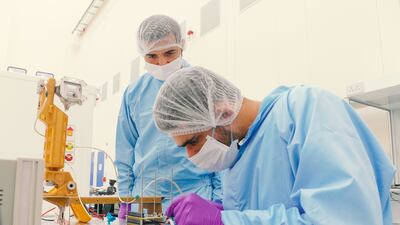
Emirati engineers test parts of the Rashid rover, which will be sent to the Moon in 2022. Photo: MBRSC -
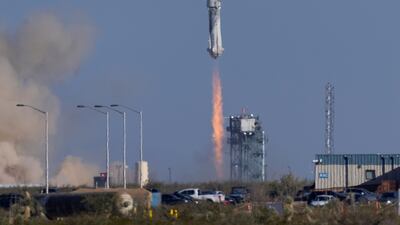
Blue Origin's rocket New Shepard blasts off carrying Star Trek actor William Shatner, 90, on billionaire Jeff Bezos company's second suborbital tourism flight, October 13, 2021. Reuters -

Sheikh Mohammed bin Rashid, Vice President and Ruler of Dubai on a visit to the 72nd International Astronautical Congress at Dubai World Trade Centre on October 25, 2021. Sheikh Mohammed was accompanied, among others, by Emirati astronauts Hazza Al Mansouri, Sultan Al Neyadi and graduates from the second batch of the UAE Astronaut Programme, Nora Al Matrooshi and Mohammed Al Mulla. Wam -
The opening ceremony for the International Astronautical Congress took place on October 25 at Dubai World Trade Centre. Photo: Dubai Media Office


Mr Gore described the new TRACE project — Tracking Real-time Atmospheric Carbon Emissions — that will use 300 satellites coupled with 11,100 ground sensors to create algorithms “that can give us a highly accurate and precise quantification of every significant emitter of greenhouse gas pollution”.
The first report from the programme will be later this year giving the world a real-time measurement of greenhouse gas pollution and “pinpoint” harmful methane emissions that mostly come from rice fields.
He added that TRACE will allow government to “identify precisely the best strategies for quickly reducing greenhouse emissions and we've got to reduce them 50 per cent”.

