


The UAE Space Agency has launched a Dh4 million ($1m) competition for scientists, entrepreneurs, academics and innovators to unearth new ideas that tackle climate change and food security.
The competition, launched in partnership with the Ministry of Climate Change and Environment, aims to find technically feasible, scalable and innovative ideas using data gathered from space to create services that support agricultural or environmental practices.
The ideas could be applications that use data to map and monitor greenhouse gas emissions or analyse soil moisture levels to boost crop yields.
Six finalists will be invited to pitch their ideas in front of a committee of experts in February next year, from which the top two will be selected as the winners.
They will each receive up to Dh2m in funding, as well as technical support, expert assistance and help to secure commercial agreements and reach customers.
Proposals should be submitted before the deadline of January 15, 2022.
-

The first image of Mars as taken by the UAE's Hope probe, which arrived at the planet on February 9. -

This image taken by the Hope probe's ultraviolet spectrometer (one of its three scientific instruments) shows sunlight reflecting off the extended cloud of atomic hydrogen gas that surrounds the planet Mars. The sunlight is visible only as a dark disk hidden inside the fog of gas. The Emirates Mars Mission team said that no other mission have made such kind of recordings before. -
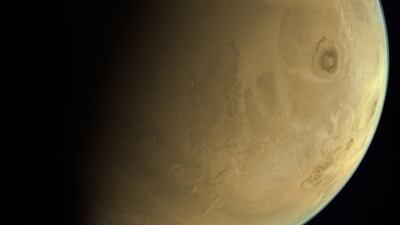
The UAE's Hope probe captured a high-resolution photo of Mars. -
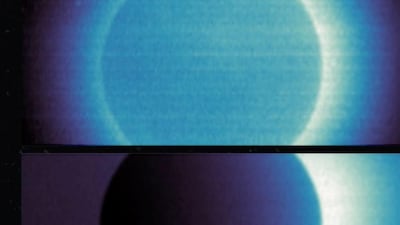
The Hope probe has shared new images from its journey in the orbit of Mars. -
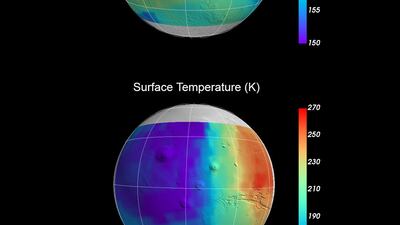
This image was taken by the infrared spectrometer, another instrument on the Hope probe, from an altitude of about 15,000 kilometres. The image shows the surface temperature (left), centred on the Tharsis region of Mars. Dawn can be seen towards the right side. The low surface temperatures observed are due to the dusty nature of the Martian surface. An elevated nighttime atmospheric temperature at 25 km altitude (right) is also observed over the Tharsis region. -
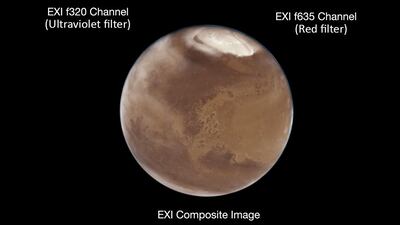
These images were captured by the eXploration imager, a high-resolution camera on the Hope probe. The red channel clearly shows the dark and light features of the Martian surface, while the water ice clouds stand out in the ultraviolet channel. -
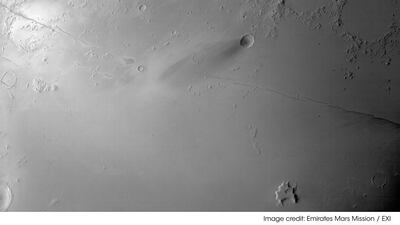
Hope probe sent back an image of the Cerberus Fossae, an area on the planet known for 'Marsquakes'. -
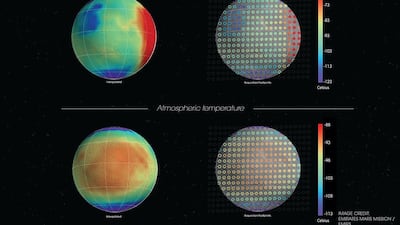
Surface and atmospheric temperature readings collected by the UAE's Hope probe. -

Discrete aurora on Mars captured by UAE's Hope probe -

Discrete aurora on Mars captured by UAE's Hope probe


The competition was announced under the umbrella of the Space Analytics and Solutions programme at the end of a busy Space Week at Expo 2020 Dubai.
In addition to developing the applications, the programme aims to enhance the competitiveness of the UAE space industry, encourage public-private partnerships, boost talent and strengthen the national space ecosystem.
"Our competition aims to find the best and brightest academics, entrepreneurs and scientists to create applications that tackle climate change or food security," said Sarah Al Amiri, Minister of State for Advanced Technology and chairwoman of the UAE Space Agency.
"We are seeking competitive proposals that are original, feasible, scalable and backed by meticulous research and analysis."
The competition comes weeks after the space agency announced a new mission to explore Venus and seven asteroids.
The mission is scheduled to launch in 2028, with the primary goal of exploring the asteroid belt between Mars and Jupiter.

