

Spacecraft are like buses. You wait ages for one, and then three come along at once.
As the space tourism race gathers pace, billionaire British businessman Richard Branson is preparing to take off on Sunday in his company Virgin Galactic’s first fully crewed flight aboard VSS Unity.
One Dubai resident will be watching its departure particularly closely from Spaceport America, New Mexico, in the US.
Namira Salim paid $200,000 to be one of the first passengers aboard Virgin Galactic’s space tourist flights – and now her 17-year wait could finally be over.
Tomorrow's sub-orbital test flight marks a milestone in space travel. Depending on the success of the 90-minute trip, Mr Branson could be inviting passengers on board later this year.
And for Ms Salim, who lives in Emirates Hills, that cannot come soon enough.
“It is very exciting,” she told The National from New Mexico.
“It has been my childhood dream to go to space and I have always been fascinated by the stars.
“I am not going to space just yet but I will be there to see him off. It is a moment we have been waiting for, for a very long time.”
In the space race, Mr Branson is edging ahead of rival and Amazon founder Jeff Bezos, who is launching his Blue Origin spacecraft on July 20.
-

The release of VSS Unity from VMS Eve and ignition of rocket motor over Spaceport America, New Mexico. AP Photo -
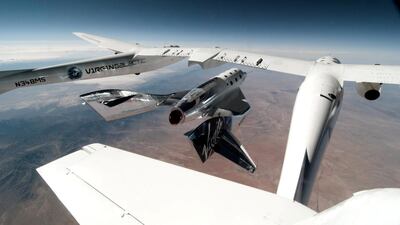
Virgin Galactic's VSS Unity, piloted by CJ Sturckow and Dave Mackay, is released from its mothership, VMS Eve. Reuters -
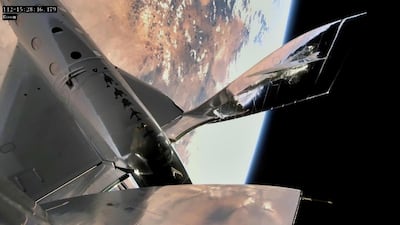
VSS Unity is seen in a still image from video during its first manned spaceflight after being released from its mothership. Reuters -
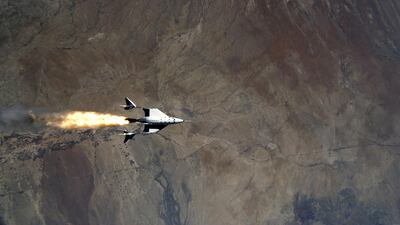
VSS Unity achieved a speed of Mach 3 after being released from the mothership. Reuters -
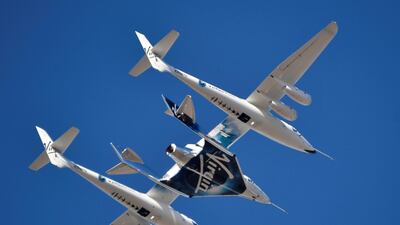
Virgin Galactic rocket plane, the WhiteKnightTwo carrier aircraft, with SpaceShipTwo passenger craft takes off from Mojave Air and Space Port in the US. Reuters


The Virgin boss has attracted funding from the likes of pop star Justin Bieber, who has booked a place on board a future flight, as well as Abu Dhabi’s government investment arm Mubadala, which holds a stake of just over seven per cent stake in Virgin Galactic.
Meanwhile, tech entrepreneur Elon Musk is developing Starship, which he hopes will be capable of transporting up to 100 space tourists to Mars.
Mr Branson will be one of four “guinea pigs” on board the VSS Unity space plane.
His fellow travellers will be astronaut instructor Beth Moses, engineer Colin Bennett and vice president of government affairs and research operations Sirisha Bandla, all Virgin Galactic employees. The spacecraft will be piloted by Dave Mackay and Michael Masucci. The flight will be livestreamed.
VSS Unity will travel to the edge of space, more than 88 kilometres above Earth, after separating from the mothership carrier aircraft WhiteKnightTwo.
It will push through the sound barrier and allow those on board to experience a few minutes of weightlessness, as they unbuckle their seatbelts and float in the craft, looking back at Earth through 17 windows.
For Pakistan-born artist Ms Salim, 50, watching from the ground, it will be a taster of what’s to come.
“It is the realisation of a childhood dream,” she said.
When she first read about the launch of Virgin Galactic in 2004, she rang immediately to express her interest.
“They had not even set up offices,” she recalled. “I signed up in January 2006 and Richard Branson came to Dubai a couple of months later.”
Growing up in Karachi and Dubai, her lifelong fascination with space blossomed during her school years and was fed by amateur astronomy groups.
“Ever since I was a child, I remember telling my parents I didn’t want to play with toys, I just wanted to go to space,” she said.
“As a teenager, I was only interested in stargazing and learning about the night sky.”
Her father Salim Nasir, a former Pakistani army colonel who founded a construction equipment firm in Dubai in the 1980s, encouraged her to focus on business instead.
But even during her business administration degree at Hofstra University in Long Island, New York, Ms Salim would sneak off to Southold at the eastern tip of the island to stargaze.

After graduating in 1992, she completed a masters in business and international affairs at Columbia University, New York.
Her passion never left her, however, and when the chance arose to become one of the world’s first commercial space travellers, Ms Salim seized it.
Initially, her conservative parents were resistant to the idea but came round after meeting the Virgin boss.
Ms Salim said: “They were taken aback and very upset that I had signed up. My mother only wanted me to get married and was more concerned about me settling down.”
Adrenalin junkie Ms Salim gave her parents further cause for concern when she embarked on a series of adventures to prepare mentally and physically for her trip to the edge of space.
These included scuba diving in the Bahamas, training as a pilot, travelling to the North and South poles and doing a tandem skydive from almost nine kilometres, in the world’s highest drop zone near Mount Everest.
That skydive, Ms Salim said, was the closest she had come to experiencing zero gravity: “I was hurtling to the ground at 153 miles an hour (246kph) but felt like I was floating in thin air. It was the most beautiful experience.”
Much has changed in the 17 years since Ms Salim first dreamt of boarding a commercial space flight.
Her mother, Nahid, died in 2017, followed by her father, Salim, in 2019. Ms Salim grieves the fact they will never get to see her take off.
She might not be leaping out of planes anymore, but Ms Salim expects to undergo some of the strenuous physical challenges that astronauts face, including training in a giant centrifugal simulator.
Conscious of this, she is making every effort to stay fit and active, swimming every day and sticking to a healthy diet of raw foods and vegetables.

She said: “As you get older, you get more health conscious. Life is short and there are many things I haven’t done yet.”
But, she said, although waiting to travel to the edge of space has taken years, it was “not the ultimate waiting room. That’s the wait for a soulmate, which still hasn’t happened.”
In the meantime, she has launched Space Trust, a non-governmental organisation that aims to “promote the idea of space as a tool to make peace on Earth”.
Ms Salim hopes commercial travel will democratise space, become more affordable and enable world leaders to come together.
“There are so many people advocating for the demilitarisation of space. I would rather inspire people from a positive angle,” she said.
The more people who got to experience the “overview effect” – the shift in cognitive awareness and perspective that astronauts often experience after returning to Earth – the better for global harmony, Ms Salim added.
Timings of the flight’s key milestones have not yet been released but the livestream will begin at 5pm, Gulf Standard Time, on July 11.

