

Motorists could receive fines of Dh400 from Monday for travelling below 120kph on sections of a major Abu Dhabi motorway.
The new traffic measures were introduced at the start of April on the first and second left-hand lanes of Sheikh Mohammed bin Rashid Road.
The maximum speed limit for the route, which links Abu Dhabi and Dubai, will remain at 140kph.
The third lane and the last lane, for use by heavy vehicles, will not include minimum speed requirements, police confirmed.
Drivers who have failed to maintain the set speed limit since its implementation have received warnings from Abu Dhabi Police.
But financial penalties will be imposed for failing to stick to the speed limit from May 1.
“The goal of the low-speed activation is to ensure the safety of drivers, to require slow vehicles to move on the right lanes and to always make way for vehicles with preference coming from behind or from the left,” said Gen Ahmed Saif Al Muhairi, director of the Central Operations Sector at Abu Dhabi Police, following the announcement of the new rules.
Drivers travelling slowly — particularly in the far-left lane — can often be subject to aggressive tailgating from faster-moving vehicles approaching from behind.
Their behaviour can also force motorists travelling at far higher speeds to take evasive action, such as slowing down suddenly and swiftly changing lanes, which can also be hazardous.
Public support for plan
Abu Dhabi Police posted a poll on social media after revealing the new speed limit, asking the public if it would “enhance the safety of road users”.
More than 3,400 people responded to the poll, with 78.5 per cent in favour of the new speed limit.
Relatively few countries impose minimum speed limits. A 2020 report by the Malaysian Institute of Road Safety Research states that only Australia, Indonesia, Japan, Portugal, the UK and the US have areas with minimum speed limits.
“The objective of imposing minimum speeds in those countries is to reduce the unsafe interactions between fast and slow-moving vehicles by improving the uniformity of traffic flow and safety of operation,” the report states.
It cites studies showing that slow-moving vehicles can pose a hazard to faster-moving traffic on motorways. In addition, it says that travelling below the average speed has been shown to be a greater hazard than travelling above the average speed.

Thomas Edelmann, managing director of Road Safety UAE, said that on UAE motorways, drivers often gravitate to the second-left lane and “hug the lane”.
“Often the drivers of these vehicles are ignorant to the fact that they are not maintaining a similar speed to other vehicles around them and those approaching from behind,” he told The National after the speed limit announcement.
“These drivers often get undertaken — passing on their right side — without moving to the right themselves.”
He suggests that the 120kph minimum speed limit could serve as a pilot to see if motorists change their habits with respect to lanes.
Sheikh Mohammed bin Rashid Road, named in honour of the Vice President and Ruler of Dubai, opened in November 2016.
The 62-kilometre motorway, built at a cost of Dh2.1 billion, shares traffic with Sheikh Zayed Road to ease congestion between the two cities.
Road safety in the Middle East — in pictures
-
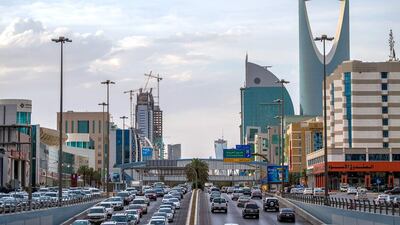
Traffic on the King Fahd highway, in Riyadh, Saudi Arabia. The National -
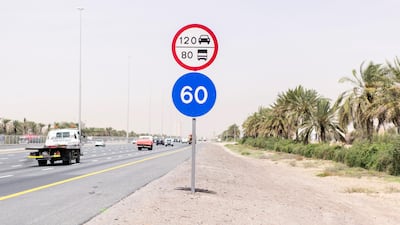
Speed limits have been cut on some roads in the UAE to bolster safety. -

Heavy traffic in Lebanon's capital city of Beirut. EPA -
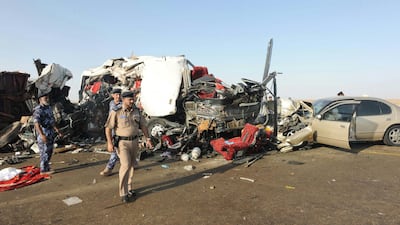
Omani police inspect the site of a collision between a lorry and a bus in western Oman in 2016 in which 18 people were killed. AFP



