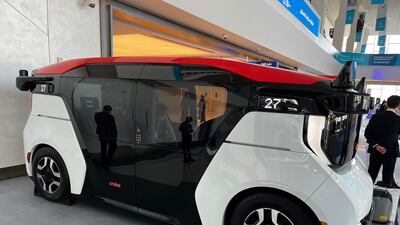
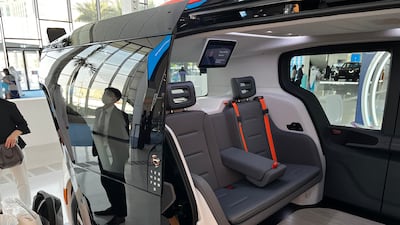
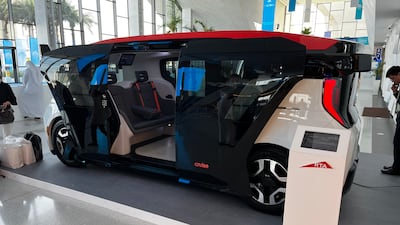
Sheikh Mohammed bin Rashid, Vice President and Ruler of Dubai, has issued a new law that will govern the use of self-driving cars in Dubai.
The law outlines how Dubai's Roads and Transport Authority will regulate the use of driverless vehicles in the emirate, including the issuing of licences and transfer of ownership.
It also says that operators are responsible for covering all damages caused by accidents.
Under the law, the RTA will develop plans and policies to improve the operation of self-driving cars in Dubai, identify the various categories of autonomous vehicles, and set their technical, operational and safety benchmarks.
The authority is also responsible for demarcating the roads, areas and routes that autonomous vehicles will operate in ― and setting their speed limits.
The RTA is also tasked with developing the infrastructure for self-driving cars and introducing the traffic solutions necessary to ensure road safety and avoid traffic disruptions.
It will issue licences for driverless vehicles in the emirate, which are mandatory for their use in Dubai.
A licence will be issued once a vehicle can pass the RTA’s technical test, which includes having the technological capability to read road signs.
The law also outlines the responsibilities of operators, agents and passengers and defines the obligations of operators of autonomous vehicles in case of accidents.
Any sale of autonomous vehicles in Dubai can only be done through authorised agents and the transfer of vehicles from one operator to another is subject to RTA’s pre-approval.
Those who breach provisions of the law face fines between Dh500 and Dh20,000, which could be doubled in case of repeat breaches in the same year. The maximum fine is Dh50,000.
Any other legislation that may conflict with the new law will be annulled. The new law will be effective 90 days after its publication in the Official Gazette.
The RTA announced last year that ten automated taxis supplied by US firm Cruise are expected to begin carrying passengers later this year.
The authority said the vehicles will complete rigorous testing before that launch to ensure the taxis are prepared for the UAE roads.
The launch of driverless taxis is part of a long-term vision to make 25 per cent of total trips autonomous across various modes of transport by 2030.
The RTA announced last week that a fleet of five electric cars had mapped out the roads in parts of Dubai.
The Chevrolet Bolt vehicles were deployed in the Jumeirah 1 district to test technology and gather data on traffic signals, signage and driver behaviour.
The authority has entered into a public-private partnership with US company Cruise to oversee the introduction of self-driving taxis.
Cruise’s technology uses a high-resolution map of the physical environment, which is created using vehicles equipped with sensors including Lidar (Light detection and ranging) and cameras.
The vehicles were driven by specialist drivers to collect data, which will be used to create and maintain a navigable map for autonomous vehicles.

SHAITTAN
%3Cp%3E%3Cstrong%3EDirector%3A%20%3C%2Fstrong%3EVikas%20Bahl%3Cbr%3E%3Cstrong%3EStarring%3A%20%3C%2Fstrong%3EAjay%20Devgn%2C%20R.%20Madhavan%2C%20Jyothika%2C%20Janaki%20Bodiwala%3Cbr%3E%3Cstrong%3ERating%3A%20%3C%2Fstrong%3E3%2F5%3C%2Fp%3E%0A
Islamophobia definition
A widely accepted definition was made by the All Party Parliamentary Group on British Muslims in 2019: “Islamophobia is rooted in racism and is a type of racism that targets expressions of Muslimness or perceived Muslimness.” It further defines it as “inciting hatred or violence against Muslims”.
Mercer, the investment consulting arm of US services company Marsh & McLennan, expects its wealth division to at least double its assets under management (AUM) in the Middle East as wealth in the region continues to grow despite economic headwinds, a company official said.
Mercer Wealth, which globally has $160 billion in AUM, plans to boost its AUM in the region to $2-$3bn in the next 2-3 years from the present $1bn, said Yasir AbuShaban, a Dubai-based principal with Mercer Wealth.
“Within the next two to three years, we are looking at reaching $2 to $3 billion as a conservative estimate and we do see an opportunity to do so,” said Mr AbuShaban.
Mercer does not directly make investments, but allocates clients’ money they have discretion to, to professional asset managers. They also provide advice to clients.
“We have buying power. We can negotiate on their (client’s) behalf with asset managers to provide them lower fees than they otherwise would have to get on their own,” he added.
Mercer Wealth’s clients include sovereign wealth funds, family offices, and insurance companies among others.
From its office in Dubai, Mercer also looks after Africa, India and Turkey, where they also see opportunity for growth.
Wealth creation in Middle East and Africa (MEA) grew 8.5 per cent to $8.1 trillion last year from $7.5tn in 2015, higher than last year’s global average of 6 per cent and the second-highest growth in a region after Asia-Pacific which grew 9.9 per cent, according to consultancy Boston Consulting Group (BCG). In the region, where wealth grew just 1.9 per cent in 2015 compared with 2014, a pickup in oil prices has helped in wealth generation.
BCG is forecasting MEA wealth will rise to $12tn by 2021, growing at an annual average of 8 per cent.
Drivers of wealth generation in the region will be split evenly between new wealth creation and growth of performance of existing assets, according to BCG.
Another general trend in the region is clients’ looking for a comprehensive approach to investing, according to Mr AbuShaban.
“Institutional investors or some of the families are seeing a slowdown in the available capital they have to invest and in that sense they are looking at optimizing the way they manage their portfolios and making sure they are not investing haphazardly and different parts of their investment are working together,” said Mr AbuShaban.
Some clients also have a higher appetite for risk, given the low interest-rate environment that does not provide enough yield for some institutional investors. These clients are keen to invest in illiquid assets, such as private equity and infrastructure.
“What we have seen is a desire for higher returns in what has been a low-return environment specifically in various fixed income or bonds,” he said.
“In this environment, we have seen a de facto increase in the risk that clients are taking in things like illiquid investments, private equity investments, infrastructure and private debt, those kind of investments were higher illiquidity results in incrementally higher returns.”
The Abu Dhabi Investment Authority, one of the largest sovereign wealth funds, said in its 2016 report that has gradually increased its exposure in direct private equity and private credit transactions, mainly in Asian markets and especially in China and India. The authority’s private equity department focused on structured equities owing to “their defensive characteristics.”
Bahrain%20GP
%3Cp%3EFriday%20qualifying%3A%207pm%20(8pm%20UAE)%3C%2Fp%3E%0A%3Cp%3ESaturday%20race%3A%207pm%20(UAE)%3C%2Fp%3E%0A%3Cp%3ETV%3A%20BeIN%20Sports%3C%2Fp%3E%0A