



There are so many lanes on the Katy Freeway in Houston, Texas that it can be tempting to think that photographs of the road have been doctored.
Widened to its present state in 2008, it can have as many as 26 lanes when access roads and managed sections are included.
The UAE too is no stranger to super-sized roads, with Sheikh Zayed Road, part of the E11 that runs from the border with Saudi Arabia to the border with Oman, in places having more than a dozen lanes.
Across the world, adding extra lanes is often the response to congestion, but some question whether this eliminates congestion or merely offers short-term respite.
Among those to have looked closely at this is Prof Matthew Turner, of the Department of Economics at Brown University in the US.
His work with Prof Gilles Duranton, of the Wharton School of the University of Pennsylvania, has resulted in what Prof Turner described as "about as established a fact as you can get", namely that as road capacity increases, the number of kilometres driven goes up too.
____________________________
World's best driving roads - in pictures
-
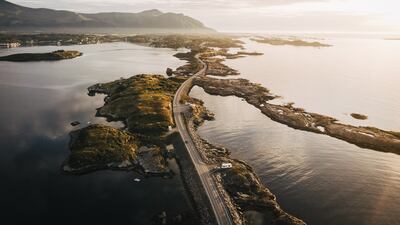
Striking sea views on the Atlantic Ocean Road in Norway. Unsplash -
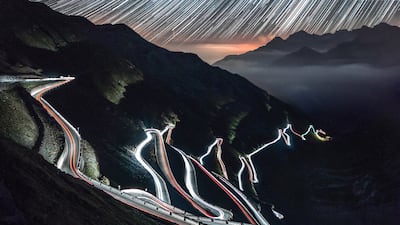
Dark contours of the Stelvio Pass in the Italian Alps in this lime-lapse night photo. Unsplash -
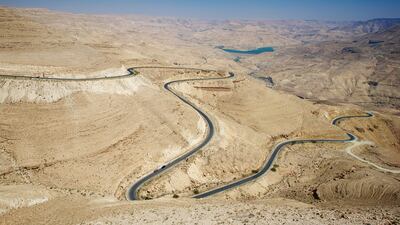
Winding through the desert, the King's Highway in Jordan. Getty Images -

California dreaming on Route 1 of the Pacific Coast Highway in Big Sur. Unsplash -
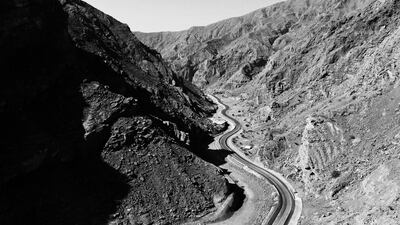
Black and white beauty. The Stark terrain of Jebel Jais road in Ras Al Khaimah. Pawan Singh / The National. -

A misty mountain drive on Milford Road in New Zealand. Unsplash -

A bridge over turquoise waters, the Seven Mile crossing takes drivers from the US mainland to the Florida Keys. Unsplash -
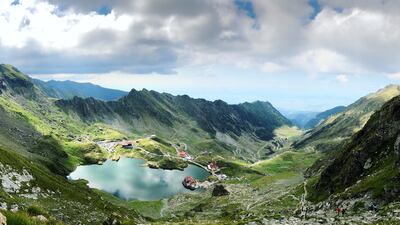
A lake reflects the sky beside the Transfagarasan Highway in Romania. Unsplash -
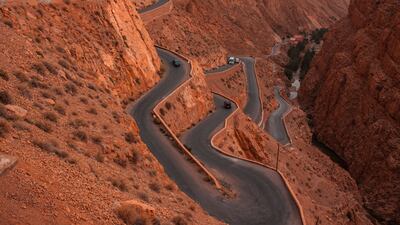
Hairpin bends of the Dades Gorges mountain pass in Morocco. Unsplash -

Drive away from it all at Route 1 in Iceland. Unsplash -
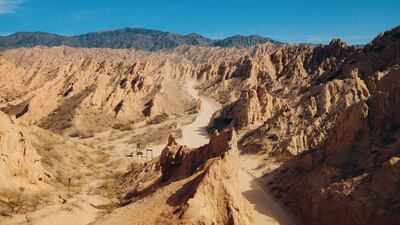
A rugged landscape surrounds the Ruta Nacional 40 in Argentina. Unsplash -

Drive carefully on the 'Death Road' in Bolivia. Unsplash -
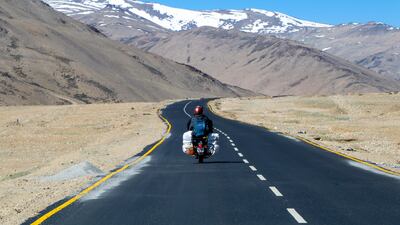
The freedom of the open road, on the Leh-Manali Highway in India. Unsplash -
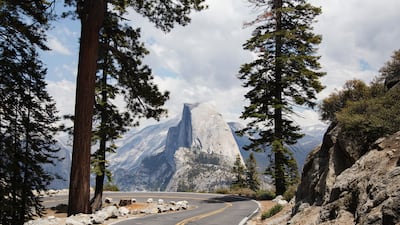
American beauty at Glacier Point Road in Yosemite National Park. Unsplash -
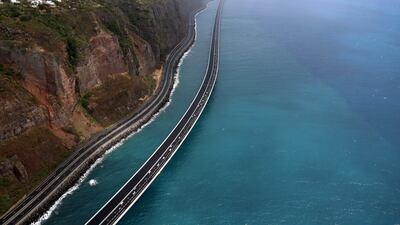
The New Coastal Road on the French Indian Ocean Island of Reunion, reportedly France's most expensive road project. AFP -
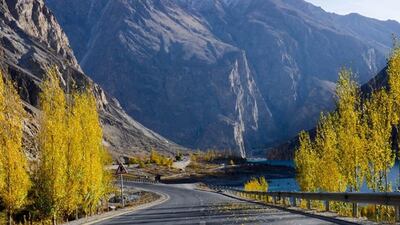
Shadows lengthen on the Karakoram Highway in Pakistan. Unsplash -

Clouds descend over Chapman's Peak Drive in South Africa. Unsplash


____________________________
"If you take a city and you add 1 per cent to its stock of lane miles, of highway or major roads, in less than 10 years, you will see that the annual driving increases by 1 per cent, if you add up all the miles driven by people in the city," Prof Turner said.
"That result has been replicated with different datasets in different countries."
There are, he said, several reasons to explain this phenomenon of induced demand or induced traffic.
About 10 per cent of the increase in road use is, he said, because people move to a city with better roads. A similar amount is because of diversion from other roads, while about one fifth, based on US data, is due to more heavy goods vehicles using the road.
"The lion’s share, half, maybe a little more more, is [because] people change their behaviour and they drive more," Prof Turner said. "They go out and they drive twice as far to get sushi."
Newcastle University
When new roads are built or existing ones widened, it is not just those roads that record an increase in traffic volumes, because there are knock-on effects on neighbouring roads.
"If you increase the traffic on the main roads, when that extra traffic leaves the main roads, it goes on to the side roads to reach its destination, and those side roads are already congested, so they become more congested. It exacerbates pollution and it increases carbon [emissions]," said Prof Margaret Bell, professor of transport and the environment at Newcastle University in the UK.
"Every time you expand a road you are, downstream, putting more pressure on the access roads to that main road."
Given these findings, it raises the question of why so much road building, justified on the basis that it will reduce congestion, takes place.
According to Prof Turner, while his findings "narrow the set of arguments that you can use in favour of building roads", there may be reasons behind road schemes other than alleviating congestion.

Pros and cons of transport expansion
"People often make the argument that we shouldn’t build roads to get rid of traffic jams, which I think is correct, but that doesn’t mean we shouldn’t build roads to facilitate people getting around," he said.
So some people might argue, he said, that it is good if road capacity allows people to, say, live farther from their place of work or to easily drive farther for food.
Building or widening roads has wider consequences, among them the paving over of wildlife habitats, and increased carbon emissions and pollution.
Prof Bell is "very much of the opinion that we should not be building more roads". In the UK, many people working in local authorities, which are responsible for road-building programmes, "listen and they understand" arguments around induced traffic, she said. Wider acknowledgment can be harder to find.
"Some at the coalface listen, but the politicians don’t support it because they’re worried, fundamentally, about losing votes," she said.
"The fear factor comes from the fact you’re hitting the car user. One of the biggest changes we need to make is attitudes to using your car."
Prof Susan Handy, a professor of environmental science and policy at the University of California Davis, indicated that the concept of induced travel, while supported by rigorous research, still faced resistance.
"It is not widely accepted by the public, although that is starting to change, too, and thus it is not widely accepted by the politicians," she said.
Many nations are engaged full-steam-ahead in road-building projects, among them India, which recently inaugurated the first part of its eight-lane,1,385km, $13 billion Delhi-to-Mumbai expressway.
However, there are signs that in some locations, attitudes are changing. In Wales, for example, it was recently announced that all road-building projects would be scrapped because of environmental concerns, although the decision has not come without criticism.
Driving down emissions
The government in Wales said that all future roads must not harm the environment or increase speeds, car numbers or carbon emissions.
"We will not get to net zero unless we stop doing the same thing over and over," Lee Waters, the deputy climate change minister for Wales, recently told the Senedd, the Welsh parliament.
With the expansion of existing roads often not seen as solving congestion, it raises the question of what should be done to relieve gridlock. Numerous other strategies have been adopted.
Land-use changes, by zoning for high-density, pedestrian friendly areas, is one approach, said Prof Turner, as is providing more extensive public transport.
However, the overall effect of better public transport on congestion tends to be limited, he said, because any capacity freed up from people switching from their cars is exploited by other road users.
Most effective, he said, was congestion pricing, because this may shift enough people out of their vehicles at peak periods to allow free traffic flow. A lane with 2,400 vehicles an hour may be gridlocked, but reduce the number to 2,200 and congestion may disappear.
Such a reduction may be achieved by, for example, charging people more to use a particular stretch of road between 7.30am and 8am than between 7am and 7.30am, while 6.30am to 7am may be cheaper still.

"It turns out that some people are willing to do that, typically … people will shift their trips in response to small amounts of money," Prof Turner said.
He described Singapore as a leader in this, saying that the city state’s scheme had "gone a long way to getting rid of all traffic congestion".
"In the other places where they they do it, if you set the prices in a way that you shift demand, you’re using all this slack capacity and not putting yourself to the large expense of building more lanes to serve peak hours, and all the environmental consequences of that," he said.
Alice Ridley, a spokeswoman for the Campaign for Better Transport, a charity that works in England and Wales "to make transport better, greener and fairer", indicated too that pricing may prove effective. She said approaches north of the border were worth looking at.
"The Scottish government has a target to reduce car kilometres by 20 per cent by 2030 and recognises this will need to include measures to ‘discourage car use’ such as road-user charging," she said.
Another way to ensure that existing roads are used more effectively could be to enable people to be moved in multi-occupancy vehicles.
"That’s small minibuses and larger buses like rapid transit, ideally run on electric and hydrogen," Prof Bell said.
Another potential way to reduce road use could be to encourage working from home. However, Prof Bell found that, perhaps counter to expectations, this may be detrimental from an environmental standpoint, because the increase in carbon emissions at home more than cancels out the absence of commuting.
"The only way forward we see in the future is to develop local co-working so that people will share offices, so each residential area or small village would have a place or office so they could work together," she said.

