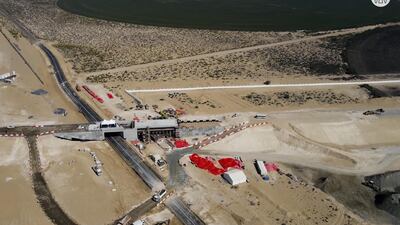
• Once complete, the Etihad Rail network will connect all of the Emirates – from Ghweifat in the Al Dhafra region of Abu Dhabi to Fujairah on the east coast. It will also link with Saudi Arabia. AFP
    Once complete, the Etihad Rail network will connect all of the Emirates – from Ghweifat in the Al Dhafra region of Abu Dhabi to Fujairah on the east coast. It will also link with Saudi Arabia. AFP
  • The link will take an estimated 375,000 vehicles off the roads. AFP
    The link will take an estimated 375,000 vehicles off the roads. AFP
  • Inside an Etihad Rail train at Al Mirfa in Abu Dhabi. The complete network will feature 1,200 kilometres of track. AFP
    Inside an Etihad Rail train at Al Mirfa in Abu Dhabi. The complete network will feature 1,200 kilometres of track. AFP
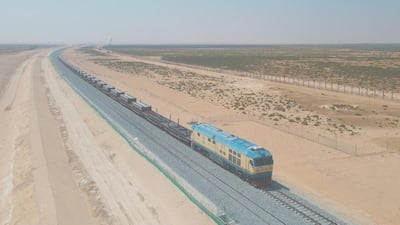
  • An Etihad Rail train at Al Mirfa. A fully loaded freight train can carry the equivalent cargo of 300 lorries – reducing carbon dioxide emission by up to 80 per cent. AFP
    An Etihad Rail train at Al Mirfa. A fully loaded freight train can carry the equivalent cargo of 300 lorries – reducing carbon dioxide emission by up to 80 per cent. AFP
  • An Etihad Rail technician at work on a train at Al Mirfa. Greenhouse gases will be slashed by more than 2.2 million tonnes a year once the network is fully operational. AFP
    An Etihad Rail technician at work on a train at Al Mirfa. Greenhouse gases will be slashed by more than 2.2 million tonnes a year once the network is fully operational. AFP
  • An Etihad Rail train at Al Mirfa. A contract to manufacture and supply 842 carriages will take the total fleet to more than 1,000, an eightfold increase in Etihad Rail’s transport capacity. AFP
    An Etihad Rail train at Al Mirfa. A contract to manufacture and supply 842 carriages will take the total fleet to more than 1,000, an eightfold increase in Etihad Rail’s transport capacity. AFP
  • Trains will carry petrochemicals, aggregates, construction materials, industrial waste, aluminium, perishable goods and general domestic and international cargo. AFP
    Trains will carry petrochemicals, aggregates, construction materials, industrial waste, aluminium, perishable goods and general domestic and international cargo. AFP
  • Engineers work on an Etihad Rail train at Al Mirfa. While freight is the immediate priority, passenger transport will become a key focus in years to come. AFP
    Engineers work on an Etihad Rail train at Al Mirfa. While freight is the immediate priority, passenger transport will become a key focus in years to come. AFP
  • Although much of the route is through flat desert, engineers must excavate at least 15 tunnels through the Hajar Mountains and build 35 bridges for heavy cargo loads. AFP
    Although much of the route is through flat desert, engineers must excavate at least 15 tunnels through the Hajar Mountains and build 35 bridges for heavy cargo loads. AFP
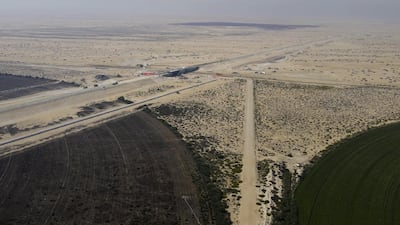
  • Laying of track on stage two commenced at the beginning of 2021, from the railhead in Ruwais, in Abu Dhabi, running westwards towards Saudi Arabia. When completed, the UAE’s national rail network will have a total annual capacity of more than 50 million tonnes of goods. AFP
    Laying of track on stage two commenced at the beginning of 2021, from the railhead in Ruwais, in Abu Dhabi, running westwards towards Saudi Arabia. When completed, the UAE’s national rail network will have a total annual capacity of more than 50 million tonnes of goods. AFP

What is Etihad Rail? Full guide to the region's biggest train project


Kelly Clarke
  • English
  • Arabic

Etihad Rail, the UAE’s megaproject to link the country’s centres of trade, industry and population, will grow from running heavy goods services to carrying millions of passengers between the major cities by 2030.

In a coastal village west of Abu Dhabi city, engineers, technicians and mechanics work day and night to keep the project on schedule.

The depot in Mirfa serves as the centre of operations that maintains and services all movement between the trains and track.

When complete, the network will stretch about 1,200 kilometres across the country and reduce carbon emissions by up to 80 per cent.

The railway line between Abu Dhabi and Dubai was joined up in March and connected to Ras Al Khaimah and Sharjah in October.

It has also been announced that the line will be extended into Oman. The agreement to build the Omani portion of rail network was signed on September 29 during the state visit of President Sheikh Mohamed to Oman.

The line will ultimately carry freight and passengers to connect Abu Dhabi with Sohar in the north of Muscat and more details are expected soon.

The Dh50 billion ($13.6bn) spent on the project is expected to contribute about Dh200bn to the economy.

Here's a glimpse of how the project will meet the global supply-demand needs of today:

What is Etihad Rail - and where does it go?

Etihad Rail was first established in 2009 and stage one of the project became operational in 2016.

Phase one is complete. Since 2016, two tracks spanning 264 kilometres have been in operation – with trains transporting granulated sulphur from gasfields in Shah and Habshan to an export point in Ruwais.

Every day, two trains run across the country, capable of carrying up to 22,000 tonnes of sulphur. Each train can pull up to 110 wagons.

When complete, the railway network will link the main centres of population and industry in the UAE and will form a vital part of the planned railway network across the Gulf region, connecting the seven emirates of the country to the five neighbouring GCC states.

On November 21, Etihad Rail said it had completed excavation work on nine tunnels over nearly seven kilometres, which involved blasting through sections of the Hajar mountain range on the east coast.

Phase two links the UAE and Saudi Arabia from Fujairah Port to Ghuwaifat, through Mussaffah, Khalifa Port and Jebel Ali Port with more than 600 kilometres of additional track. The two phases together will support more than 9,000 jobs, many of them for Emiratis.

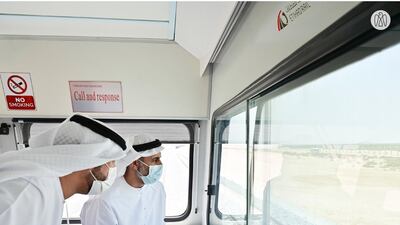
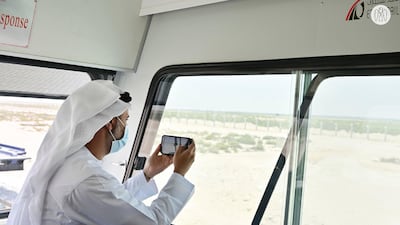
  • Sheikh Theyab enjoyed a 10km train journey across the fast-developing rail network
    Sheikh Theyab enjoyed a 10km train journey across the fast-developing rail network
  • Sheikh Theyab checked the latest progress during a 10km trip aboard an inspection and supervision train.
    Sheikh Theyab checked the latest progress during a 10km trip aboard an inspection and supervision train.
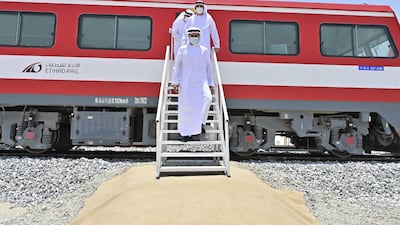
  • The Etihad Rail project aims to transform the UAE's transport sector and encourage economic growth. All pictures courtesy Abu Dhabi Media Office
    The Etihad Rail project aims to transform the UAE's transport sector and encourage economic growth. All pictures courtesy Abu Dhabi Media Office
  • The vast rail network will help to connect the emirates
    The vast rail network will help to connect the emirates
  • The national rail project will bolster links between ports and key manufacturing, production and residential centres.
    The national rail project will bolster links between ports and key manufacturing, production and residential centres.
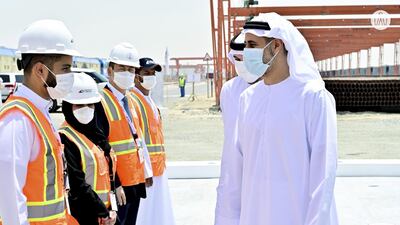
  • At Al Maha Forest area, Sheikh Theyab bin Mohamed bin Zayed was told how wildlife and natural habitats will be protected during construction work
    At Al Maha Forest area, Sheikh Theyab bin Mohamed bin Zayed was told how wildlife and natural habitats will be protected during construction work
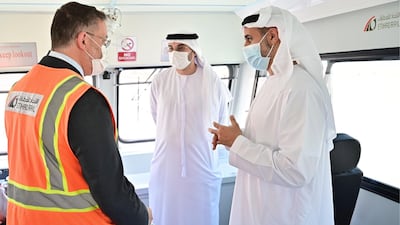
  • Sheikh Theyab joined officials at the Etihad Rail site in Seih Shuaib
    Sheikh Theyab joined officials at the Etihad Rail site in Seih Shuaib
  • Sheikh Theyab was briefed on the rapid progress being made in the ambitious scheme
    Sheikh Theyab was briefed on the rapid progress being made in the ambitious scheme
  • Sheikh Theyab, chairman of Etihad Rail, sampled the growing rail network
    Sheikh Theyab, chairman of Etihad Rail, sampled the growing rail network
  • Stage two of the national rail project is now well under way
    Stage two of the national rail project is now well under way
  • Sheikh Theyab praised UAE leaders for backing the rail project
    Sheikh Theyab praised UAE leaders for backing the rail project

Trains and wagons

Seven locomotives are in operation along the tracks, which run through rural areas in Abu Dhabi, delivering sulphur to clients.

The state-of-the-art trains were supplied by US-based Electro-Motive Diesel and are equipped with in-cab European signalling systems.

Weighing 30 tonnes each unladen, and 130 tonnes loaded, the wagons are fully equipped with extended safety features, including electronically controlled pneumatic brakes and derailment protection.

For stage two of the project, the train fleet will increase to 45 locomotives and connect the emirates via Abu Dhabi, Khalifa Industrial Zone Abu Dhabi, Khalifa Port, Jebel Ali Port, Dubai, Sharjah, Ras Al Khaimah and Fujairah.

Last year, the first batch of Emirati students graduated with diplomas in railways specialities, through a programme introduced by Etihad Rail. Maithaa Al Remeithi also became the first female Emirati train controller in the country, at the age of 29.

One freight train replaces hundreds of lorries

Rail travel scores highly as far as its sustainability goes and that has to be celebrated.

Once fully operational, the fleet of trains and wagons running on the Etihad Rail network will replace 5,600 lorry trips per day. A fully loaded train also emits up to 80 per cent less carbon dioxide than lorries transporting the same tonnage.

Based on traffic volume forecasts, the Etihad Rail network will reduce greenhouse gases by more than 2.2 million tonnes annually once fully operational, the equivalent of taking up to 375,000 vehicles off the roads.

What can be transported on the trains?

By connecting a country’s trade centres, rail acts as a catalyst for economic growth. In the coming years, wagons running along the Etihad Rail tracks will move anything from consumer goods to perishable food and beverages.

Some of the typical products expected to move across the Emirates include hay, ceramics, polymers, sugar, metals, waste and shipping containers.

The type of wagons used will vary, depending on the cargo being transported. They include intermodal steel containers; flat-bed wagons; rail gondolas with low-side walls for loose bulk materials and temperature-controlled carriages.

Will passengers be able to ride on Etihad Rail?

In the future, yes. While increasing freight opportunities is the focus for now, passenger transport will become a key part of the project in the years to come.

Officials did not give a start date for the first service but said "by 2030, the number of passengers is expected to reach more than 36.5 million annually" in a statement in December last year.

New passenger services will run fast at about 200 kilometres per hour. Stations will stretch from Sila near the border with Saudi Arabia to Fujairah on the east coast.

The train will allow "passengers to travel from Abu Dhabi to Dubai in 50 minutes, and from Abu Dhabi to Fujairah in 100 minutes", the statement read.

Etihad Rail is working closely with the Federal Transport Authority and transport authorities across the Emirates to develop existing networks and hubs to improve passenger connections.


RACECARD
%3Cp%3E5pm%3A%20Al%20Shamkha%20%E2%80%93%20Maiden%20(PA)%20Dh80%2C000%20(Turf)%201%2C400m%0D%3Cbr%3E5.30pm%3A%20Khalifa%20City%20%E2%80%93%20Handicap%20(PA)%20Dh80%2C000%20(T)%201%2C400m%0D%3Cbr%3E6pm%3A%20Masdar%20City%20%E2%80%93%20Handicap%20(PA)%20Dh80%2C000%20(T)%201%2C600m%0D%3Cbr%3E6.30pm%3A%20Wathba%20Stallions%20Cup%20%E2%80%93%20Handicap%20(PA)%20Dh70%2C000%20(T)%202%2C200m%0D%3Cbr%3E7pm%3A%20Emirates%20Championship%20%E2%80%93%20Group%201%20(PA)%20Dh1%2C000%2C000%20(T)%202%2C200m%0D%3Cbr%3E7.30pm%3A%20Shakbout%20City%20%E2%80%93%20Handicap%20(TB)%20Dh80%2C000%20(T)%202%2C400m%3C%2Fp%3E%0A

Mercer, the investment consulting arm of US services company Marsh & McLennan, expects its wealth division to at least double its assets under management (AUM) in the Middle East as wealth in the region continues to grow despite economic headwinds, a company official said.

Mercer Wealth, which globally has $160 billion in AUM, plans to boost its AUM in the region to $2-$3bn in the next 2-3 years from the present $1bn, said Yasir AbuShaban, a Dubai-based principal with Mercer Wealth.

Within the next two to three years, we are looking at reaching $2 to $3 billion as a conservative estimate and we do see an opportunity to do so,” said Mr AbuShaban.

Mercer does not directly make investments, but allocates clients’ money they have discretion to, to professional asset managers. They also provide advice to clients.

“We have buying power. We can negotiate on their (client’s) behalf with asset managers to provide them lower fees than they otherwise would have to get on their own,” he added.

Mercer Wealth’s clients include sovereign wealth funds, family offices, and insurance companies among others.

From its office in Dubai, Mercer also looks after Africa, India and Turkey, where they also see opportunity for growth.

Wealth creation in Middle East and Africa (MEA) grew 8.5 per cent to $8.1 trillion last year from $7.5tn in 2015, higher than last year’s global average of 6 per cent and the second-highest growth in a region after Asia-Pacific which grew 9.9 per cent, according to consultancy Boston Consulting Group (BCG). In the region, where wealth grew just 1.9 per cent in 2015 compared with 2014, a pickup in oil prices has helped in wealth generation.

BCG is forecasting MEA wealth will rise to $12tn by 2021, growing at an annual average of 8 per cent.

Drivers of wealth generation in the region will be split evenly between new wealth creation and growth of performance of existing assets, according to BCG.

Another general trend in the region is clients’ looking for a comprehensive approach to investing, according to Mr AbuShaban.

“Institutional investors or some of the families are seeing a slowdown in the available capital they have to invest and in that sense they are looking at optimizing the way they manage their portfolios and making sure they are not investing haphazardly and different parts of their investment are working together,” said Mr AbuShaban.

Some clients also have a higher appetite for risk, given the low interest-rate environment that does not provide enough yield for some institutional investors. These clients are keen to invest in illiquid assets, such as private equity and infrastructure.

“What we have seen is a desire for higher returns in what has been a low-return environment specifically in various fixed income or bonds,” he said.

“In this environment, we have seen a de facto increase in the risk that clients are taking in things like illiquid investments, private equity investments, infrastructure and private debt, those kind of investments were higher illiquidity results in incrementally higher returns.”

The Abu Dhabi Investment Authority, one of the largest sovereign wealth funds, said in its 2016 report that has gradually increased its exposure in direct private equity and private credit transactions, mainly in Asian markets and especially in China and India. The authority’s private equity department focused on structured equities owing to “their defensive characteristics.”

WE%20NO%20LONGER%20PREFER%20MOUNTAINS
%3Cp%3E%3Cstrong%3EDirector%3A%3C%2Fstrong%3E%20Inas%20Halabi%3C%2Fp%3E%0A%3Cp%3E%3Cstrong%3EStarring%3A%20%3C%2Fstrong%3ENijmeh%20Hamdan%2C%20Kamal%20Kayouf%2C%20Sheikh%20Najib%20Alou%3C%2Fp%3E%0A%3Cp%3E%3Cstrong%3ERating%3A%3C%2Fstrong%3E%204%2F5%3C%2Fp%3E%0A
The Vile

Starring: Bdoor Mohammad, Jasem Alkharraz, Iman Tarik, Sarah Taibah

Director: Majid Al Ansari

Rating: 4/5

The White Lotus: Season three

Creator: Mike White

Starring: Walton Goggins, Jason Isaacs, Natasha Rothwell

Rating: 4.5/5

Key figures in the life of the fort

Sheikh Dhiyab bin Isa (ruled 1761-1793) Built Qasr Al Hosn as a watchtower to guard over the only freshwater well on Abu Dhabi island.

Sheikh Shakhbut bin Dhiyab (ruled 1793-1816) Expanded the tower into a small fort and transferred his ruling place of residence from Liwa Oasis to the fort on the island.

Sheikh Tahnoon bin Shakhbut (ruled 1818-1833) Expanded Qasr Al Hosn further as Abu Dhabi grew from a small village of palm huts to a town of more than 5,000 inhabitants.

Sheikh Khalifa bin Shakhbut (ruled 1833-1845) Repaired and fortified the fort.

Sheikh Saeed bin Tahnoon (ruled 1845-1855) Turned Qasr Al Hosn into a strong two-storied structure.

Sheikh Zayed bin Khalifa (ruled 1855-1909) Expanded Qasr Al Hosn further to reflect the emirate's increasing prominence.

Sheikh Shakhbut bin Sultan (ruled 1928-1966) Renovated and enlarged Qasr Al Hosn, adding a decorative arch and two new villas.

Sheikh Zayed bin Sultan (ruled 1966-2004) Moved the royal residence to Al Manhal palace and kept his diwan at Qasr Al Hosn.

Sources: Jayanti Maitra, www.adach.ae

Who was Alfred Nobel?

The Nobel Prize was created by wealthy Swedish chemist and entrepreneur Alfred Nobel.

  • In his will he dictated that the bulk of his estate should be used to fund "prizes to those who, during the preceding year, have conferred the greatest benefit to humankind".
  • Nobel is best known as the inventor of dynamite, but also wrote poetry and drama and could speak Russian, French, English and German by the age of 17. The five original prize categories reflect the interests closest to his heart.
  • Nobel died in 1896 but it took until 1901, following a legal battle over his will, before the first prizes were awarded.
COMPANY%20PROFILE%20
%3Cp%3E%3Cstrong%3EName%3A%3C%2Fstrong%3E%20Haltia.ai%0D%3Cbr%3E%3Cstrong%3EStarted%3A%3C%2Fstrong%3E%202023%0D%3Cbr%3E%3Cstrong%3ECo-founders%3A%3C%2Fstrong%3E%20Arto%20Bendiken%20and%20Talal%20Thabet%0D%3Cbr%3E%3Cstrong%3EBased%3A%3C%2Fstrong%3E%20Dubai%2C%20UAE%0D%3Cbr%3E%3Cstrong%3EIndustry%3A%3C%2Fstrong%3E%20AI%0D%3Cbr%3E%3Cstrong%3ENumber%20of%20employees%3A%3C%2Fstrong%3E%2041%0D%3Cbr%3E%3Cstrong%3EFunding%3A%3C%2Fstrong%3E%20About%20%241.7%20million%0D%3Cbr%3E%3Cstrong%3EInvestors%3A%3C%2Fstrong%3E%20Self%2C%20family%20and%20friends%26nbsp%3B%3C%2Fp%3E%0A
Groom and Two Brides

Director: Elie Semaan

Starring: Abdullah Boushehri, Laila Abdallah, Lulwa Almulla

Rating: 3/5

Greatest of All Time
Starring: Vijay, Sneha, Prashanth, Prabhu Deva, Mohan
Director: Venkat Prabhu
Rating: 2/5

Globalization and its Discontents Revisited
Joseph E. Stiglitz
W. W. Norton & Company

The%20specs
%3Cp%3E%3Cstrong%3EEngine%3A%3C%2Fstrong%3E%206.5-litre%20V12%20and%20three%20electric%20motors%0D%3Cbr%3E%3Cstrong%3EPower%3A%20%3C%2Fstrong%3E1%2C015hp%0D%3Cbr%3E%3Cstrong%3ETorque%3A%20%3C%2Fstrong%3E1%2C500Nm%20(estimate)%0D%3Cbr%3E%3Cstrong%3ETransmission%3A%3C%2Fstrong%3E%20Eight-speed%20dual-clutch%20auto%0D%3Cbr%3E%3Cstrong%3EOn%20sale%3A%3C%2Fstrong%3E%20Early%202024%0D%3Cbr%3E%3Cstrong%3EPrice%3A%20%3C%2Fstrong%3EFrom%20Dh2%20million%20(estimate)%3C%2Fp%3E%0A
The%20specs
%3Cp%3E%0D%3Cstrong%3EEngine%3A%20%3C%2Fstrong%3E4.0-litre%20twin-turbo%20V8%0D%3Cbr%3E%3Cstrong%3EPower%3A%20%3C%2Fstrong%3E666hp%20at%206%2C000rpm%0D%3Cbr%3E%3Cstrong%3ETorque%3A%20%3C%2Fstrong%3E850Nm%20at%202%2C300-4%2C500rpm%0D%3Cbr%3E%3Cstrong%3ETransmission%3A%20%3C%2Fstrong%3E8-speed%20auto%0D%3Cbr%3E%3Cstrong%3EOn%20sale%3A%20%3C%2Fstrong%3EQ1%202023%0D%3Cbr%3E%3Cstrong%3EPrice%3A%20%3C%2Fstrong%3Efrom%20Dh1.15%20million%20(estimate)%3C%2Fp%3E%0A
Who's who in Yemen conflict

Houthis: Iran-backed rebels who occupy Sanaa and run unrecognised government

Yemeni government: Exiled government in Aden led by eight-member Presidential Leadership Council

Southern Transitional Council: Faction in Yemeni government that seeks autonomy for the south

Habrish 'rebels': Tribal-backed forces feuding with STC over control of oil in government territory

Players Selected for La Liga Trials

U18 Age Group
Name: Ahmed Salam (Malaga)
Position: Right Wing
Nationality: Jordanian

Name: Yahia Iraqi (Malaga)
Position: Left Wing
Nationality: Morocco

Name: Mohammed Bouherrafa (Almeria)
Position: Centre-Midfield
Nationality: French

Name: Mohammed Rajeh (Cadiz)
Position: Striker
Nationality: Jordanian

U16 Age Group
Name: Mehdi Elkhamlichi (Malaga)
Position: Lead Striker
Nationality: Morocco

The burning issue

The internal combustion engine is facing a watershed moment – major manufacturer Volvo is to stop producing petroleum-powered vehicles by 2021 and countries in Europe, including the UK, have vowed to ban their sale before 2040. The National takes a look at the story of one of the most successful technologies of the last 100 years and how it has impacted life in the UAE. 

Read part four: an affection for classic cars lives on

Read part three: the age of the electric vehicle begins

Read part one: how cars came to the UAE